It was a December night in 2022. The final whistle in Qatar had not yet blown, but Marrakesh’s famous Jemaa el-Fnaa square was already alive with drums, songs and chants.
After defeating Portugal to become the first African nation to reach a World Cup semi-final, Morocco erupted in celebration. Casablanca, Rabat, and Fes also remained wide awake until dawn.
Now, four years later, Morocco may have to brace for another sleepless night, because the chance to topple Brazil on the world stage does not come that often!
The upcoming Brazil-Morocco match is drawing global attention for several reasons. Morocco’s run to the semi-finals in the last World Cup was no fluke, and the team has spent the past four years proving it. Before beating Portugal in the quarter-finals, Morocco had defeated Belgium in the group stage and Spain in the Round of 16.
Coincidentally, Morocco will co-host the 2030 World Cup alongside Spain and Portugal.
But this year, the team made headlines following a controversial Africa Cup of Nations (AFCON) final at Rabat's Prince Moulay Abdellah Stadium.
Despite their rise, Morocco has faced its share of drama this year.
The team made headlines following a controversial Africa Cup of Nations (AFCON) final at Rabat's Prince Moulay Abdellah Stadium. Senegal, their opponents in the final, walked off the pitch in protest after a goal was disallowed following a review.
Senegal eventually returned to the field and went on to defeat Morocco, lifting the title. But two months later, Confederation of African Football (CAF) stripped Senegal of their trophy for walking off the field, declaring Morocco the champions instead. In a twist after 50 years, Morocco claimed an AFCON crown in a way they perhaps never would have wanted.
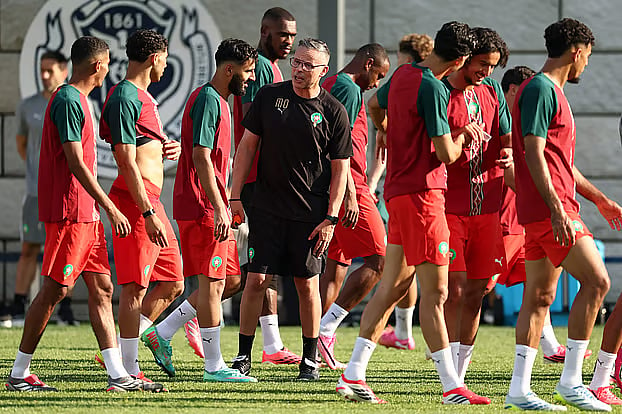
But in a World Cup, Morocco will certainly want no such drama. Like last time, they arrive with a strong squad. Their star attraction, Achraf Hakimi, has just won his second consecutive Champions League title with PSG. The attack has also been strengthened with Brahim Díaz of Real Madrid.
Yassine Bounou remains a dependable presence under the posts. The only concern for head coach Mohammed Ouahbi is injuries. Defensive pillar Nayef Aguerd and forward Abdessamad Ezzalzouli have both been ruled out of the World Cup.
Yet Moroccan football has kept moving forward despite such blows, now operating at an express pace. Behind this rise lies long-term investment and institutional planning. Take player recruitment, for example, Hakimi, Díaz, Amrabat and several others were not even born in Morocco.
Bringing Europe-born footballers under the same national badge is a project Morocco began long ago. They are reaping the rewards now.
Beyond the senior team, the ultimate proof of this success came last year when Morocco was crowned champions of the FIFA U-20 World Cup for the first time. The coach of that team, Mohamed Ouahbi, has now taken over the senior team following the departure of Walid Regragui, who guided Morocco in the last World Cup.
The recruitment of foreign-born players is now a common practice in world football. But Morocco’s rise is also reflected in another development—the relocation of FIFA’s African headquarters to the country. With the 2030 World Cup already in sight, Morocco has become a central hub of African football. For King Mohammed’s Morocco, football has also become a kind of geopolitical tool.
And preparations are in full swing. Near Casablanca, a 115,000-seat stadium is being built in Benslimane, which could host the 2030 World Cup final. Stadiums in Rabat, Fez, Tangier, Marrakech and Agadir are being renovated, while rail and road networks are being expanded under a $5–6 billion investment drive that began with this year’s AFCON.
Still, when all is said and done, Morocco will likely be remembered for the joyful football it played in Qatar. And against Brazil, the nation most closely associated with that kind of expressive, attacking football, they will surely want to recreate that magic once again.