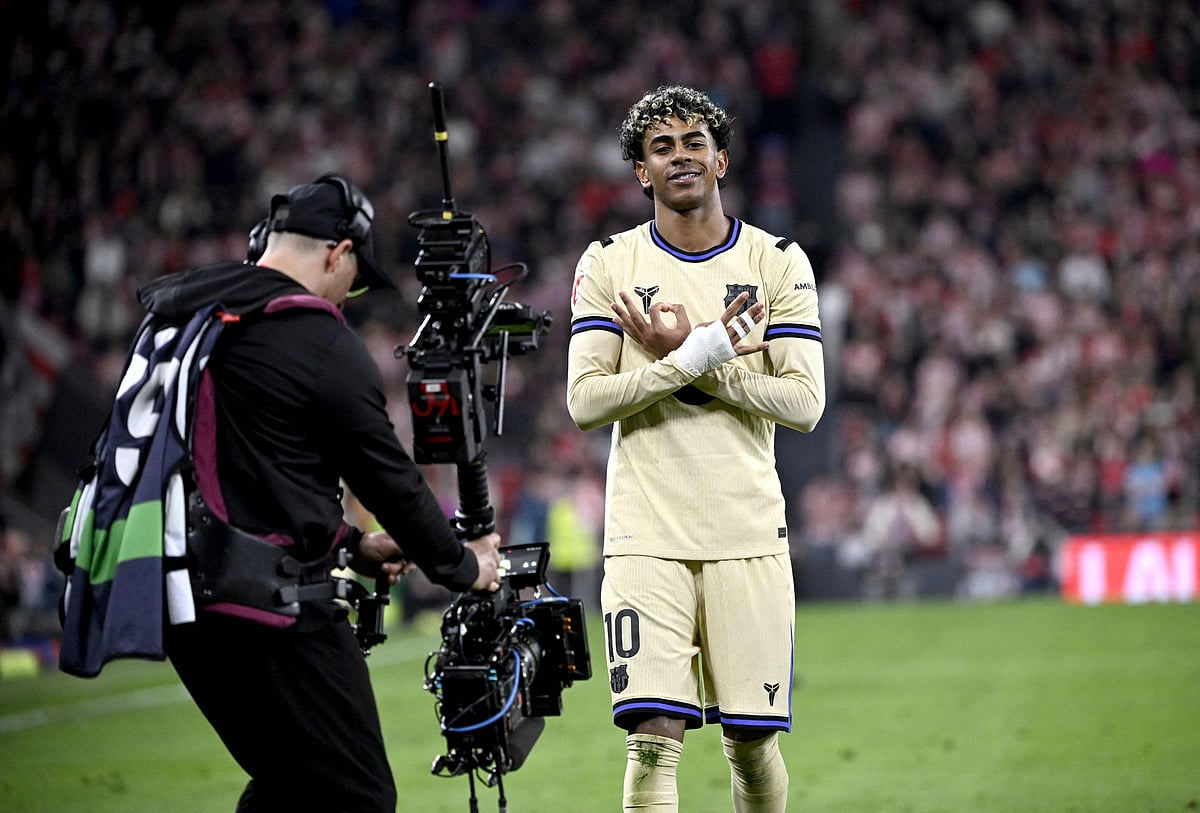
From Rocafonda to the World Cup: Lamine Yamal's meteoric rise
Lionel Messi and Cristiano Ronaldo will play at a record sixth World Cup in 2026, but years from now the tournament may instead be remembered as Lamine Yamal's first.
From the concrete square in Mataro the Spanish 18-year-old used to play in, to the biggest stages in world football, his rise has been dazzling.
His uncle Abdul Nasraoui used to keep a small replica World Cup trophy in his bakery in the humble neighbourhood of Rocafonda, a 20-mile (32-kilometre) crawl up the Catalan coast from Barcelona, telling people it was for when his nephew wins it.
Abdul had the trophy before Yamal even debuted for Spain, because he knew something special was coming. Many claim they did, in Rocafonda, but importantly for Barca it was Jordi Roura who got there first.
Alerted to Yamal by a scout, Barcelona's then youth football chief Roura and close colleague Aureli Altimira pounced. In the chaos of a trial match, Lamine stood out.
"We were there with Aureli and at the beginning we saw him and he looked a bit odd, kind of scrawny, he moved a bit strangely, and we said, 'hmm let's see...'," Roura tells AFP.
"Then once they start playing, it's difficult, right? Because imagine 20 kids of seven, eight years old, all chasing the ball.
"Even so, Lamine would sometimes do something where you'd go, 'Damn!'. Instead of just running after the ball, sometimes he would find space, wait, look for his left foot, execute really quickly."
One attribute, honed on the square where if your feet aren't fast enough to swerve defenders you can end up on the concrete, marked out little Lamine.
"Dribbling might be the most innate technical action, right?" says Roura. "It's hard to train a dribbler. He had that. He would feint, do things which made you say 'wow'.
"We thought this kid had something special, even if he looked a bit slight, and decided to sign him."
Negotiations were quick with Lamine's father Mounir Nasraoui from Morocco, and his mother Sheila Ebana, from Equatorial Guinea.
He was a quiet, even shy child, who loved to play football and spent a lot of time with his paternal grandmother, Fatima.
She was the first of the family to move to Spain, arriving on a ferry from Tangier in 1990 and slowly bringing across her children in the following years.
Fatima settled in Rocafonda and remains there, although Mounir, after being stabbed during an altercation in 2024, has since relocated to the upmarket Barcelona neighbourhood of Sarria.
After Lamine's parents split up when he was three, he also lived with his mother in Roca del Valles, north of Mataro, but Rocafonda was always home.
It is represented in his goal celebration, using his hands to show the numbers 304, the last digits of the neighbourhood's postcode.
Now even in the more well-to-do parts of Mataro the number appears.
Rocafonda is north-east of the elegant centre, a neighbourhood with a negative reputation for crime and poverty, although now it is famous for being where Lamine came from.
Glance down the right street and you can catch a narrow glimpse of sweet Mediterranean blue.
The winger and his father are spotted less frequently there now, but the games go on, with players duking it out in front of a mural of Lamine, painted in 2025.
"With all these great players... they're capable of doing the same, or more than they did when they were children, and that's very difficult, very rare, and that's why they're the chosen ones," said Roura.
"(Lamine) enjoys playing, and I think that even when he was very little, when the challenge was greater, when a game was harder, that's when he liked it the most, you know?"
'No limits'
Not everyone has the accuracy of the neighbourhood's "idol" and an "example" as youngsters sitting and waiting for a chance to play describe him.
The ball is lashed high over the fence that divides the concrete pitch from the road, to howls of frustration.
The kids call to a passer-by, before one player zips past on an electric scooter to retrieve it.
But for the interception, it may have rolled down the road and past the bar run by Lamine's uncle, 'Familia LY 304', since he gave up his bakery.
Over the past three years Abdul has answered plenty of questions about Lamine, but with concerns over the winger's fitness heading into the World Cup, he doesn't feel like speaking for now.
On a shelf behind the bar, sits his replica trophy. Abdul's dream, just three years after Lamine made his professional debut aged just 15, could come true remarkably quickly.
"When you see the resume he already has at 18, it's scary, so what this kid can achieve has no limits," added Roura.
Yamal was still studying for his exams during Spain's run to Euro 2024 glory, where he captured the world's attention with a sensational strike against France.
That moment is memorialised on one wall of the bar, along with others from the winger's short yet glittering career for club and country, along with two framed shirts.
Nearly three decades after arriving from Morocco, Abdul is still happy working. He sits and eats a few mouthfuls of vegetables before a shout comes from the kitchen and he is on his feet again, bringing dishes, olive oil and bread to customers.
"Ojala -- I hope -- ojala," he says on the prospect of Lamine bringing the real thing back to Rocafonda. "If we win the World Cup, then I'll talk."