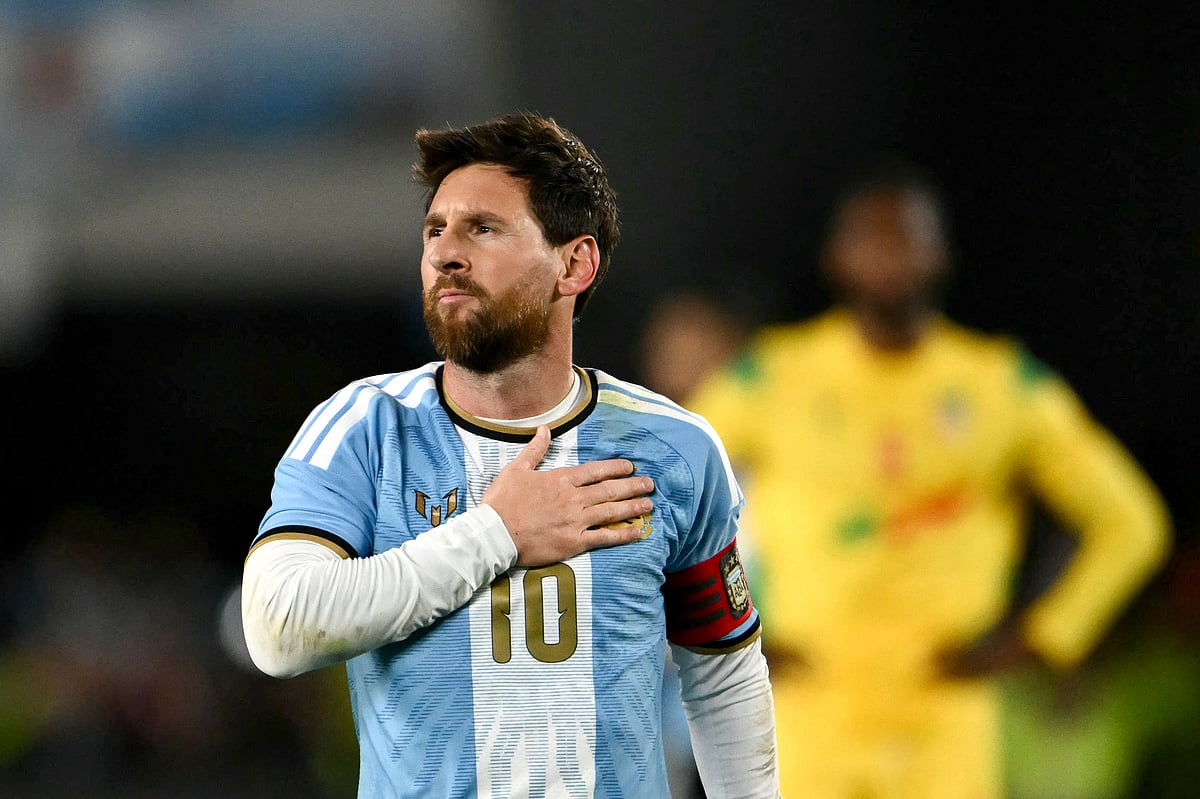
Messi said goodbye, but Messi remains
Thousands of people roared. The Monumental Stadium seemed to shake. Argentina was bidding a final farewell to the man taking the field for the last time in the national team jersey. There was only one chant all around: “Messi... Messi... Messi...”
It was not a slogan, but something closer to a prayer. Some of those chanting were children; others were no longer children. But they were all crying because when they think of the Argentina team, many of them cannot imagine it without Lionel Messi. The “extraterrestrial” had been part of that team for 21 years—before many of them were born, and throughout the formative years of many others.
A country can be divided in many ways. There are many parties and many opinions. But for a few hours today, Argentina forgot all those divisions. Emotion carried everyone away. One of the greatest footballers in the country’s history, perhaps the greatest, had said goodbye to the national team.
2.
Messi was already crying before entering the stadium.
He sat on the bus, looking outside through the window. The more than two decades he had spent in the national team jersey seemed to be flashing before his eyes. It was as if his entire life was playing out like a movie beyond the window. He repeatedly wiped away his tears.
Then came another emotional jolt when he arrived at the Monumental. The dressing room had been decorated. The atmosphere was filled with memories of Messi. He had called ahead to make sure his wife Antonela and their sons were in the VIP box.
Then came one emotional moment after another. When the stands rose to their feet as he came out for the warm-up, he tried to hold back his tears. He could not completely. He simply raised his hands—towards one side, then another, then all around.
3.
Messi looked up at the sky as he entered the pitch. His three sons were with him. The national anthem was playing. But this time Messi did not sing. There was a huge lump of emotion in his throat.
At that moment, he seemed to return to little Leo. Perhaps he remembered his grandmother Celia. She used to take him by the hand to watch matches. One day she told his first coach, Salvador Aparicio, “Play him! Play him. He’ll save the game.” Messi can almost certainly still remember the response: “Madam, he’s too small. They’ll hurt him.” But his grandmother would not give up: “Put him on.”
Messi dedicated his recent album, Last Dance, to his grandmother, as well as to his father, Jorge. His love for football seems to have begun in those days, too. Today, the most cherished chapter of that story has come to an end.
4.
Even in his farewell match, Messi followed every ritual. After the coin toss, he handed the Argentina flag to Benin’s captain. The Benin captain, in turn, presented him with a special gift. Messi embraced each of his teammates. Then began the match that was really much more than a match.
At first, Messi could not find his rhythm, and neither could the team. Benin’s players came up to Messi one after another, embracing him and paying their respects. The game even came to a brief halt around the 10-minute mark because of it. Then Messi seemed to think it would be better to get the formalities over with as quickly as possible. Because he had come to play. For one last time.
That is exactly what he did in the second half. He assisted Nicolas Otamendi for the opening goal. Argentina went 1-0 up. Then, before setting up Nico Paz for the second, Messi produced one of those familiar touches. 2-0. And then he seemed to write the ending himself. A penalty, a goal. 3-0.
His teammates formed a circle around him. Like people gathered around a birthday cake. Messi smiled. His teammates kept him at the centre of the celebration. It was his 126th goal for the national team. Another goal for his grandmother.
5.
Little Leo Messi did not want much as a child. He simply wanted to play football.
His three sons do the same today. Thiago, Ciro and Mateo run whenever they see a ball. They did so on the night Argentina won the World Cup in Qatar, too, even amid the celebrations of the champions. Standing behind them was Pablo Aimar, his childhood idol. Whether at Inter Miami’s stadium or the Monumental, watching his three sons run sometimes makes it seem as though time has turned back. The scene almost perfectly mirrors memories of his mother Celia: Leo, Matias and Rodrigo, three brothers, playing with a ball on the streets or at the Grandoli club ground.
6.
Little Messi dreamed of playing for Newell’s Old Boys and for the national team. But life kept placing one obstacle after another in the path of that boy from Rosario. Coaches would repeatedly say, “There’s a left-footed boy born in ’87. He’s making everyone dance.” But a growth hormone deficiency put that talent at risk. Destiny still did not know who it had picked a fight with...
That boy is now a 39-year-old father. Antonela’s husband. Celia’s son. Jorge’s child. A friend of Rodrigo De Paul, Otamendi, Lo Celso, Di Maria and Paredes. An inspiration to Enzo Fernandez, Cuti Romero, Alexis Mac Allister, Julian Alvarez and Lisandro Martinez.
A lifelong idol to young players such as Nico Paz and Franco Mastantuono. Some of them once watched Messi from afar. Later, they became his teammates. What a strange life!
7.
Just 10 years ago, Messi said he would no longer play for the national team.
There was criticism everywhere after the defeat in the Copa America final. Fierce criticism. Messi came under intense attack, too. Hurt and frustrated, he said, “The national team is not for me.”
But could Messi really leave Argentina? That was another dribble in his life. Another time he evaded the opponent. The lost finals, the humiliation and the criticism ultimately changed him. After moving to Barcelona, he called his mother from a public phone, speaking through tears because he missed her. He took thousands of injections for his growth hormone treatment. He left his childhood city for an unfamiliar country. He repeatedly turned down Spain’s offer. He did all of it because one day he wanted to play for Argentina.
8.
At one point, it seemed the story might remain incomplete. But he wanted more. At 37, he won his second Copa America. At 35, he won the World Cup. At 39, he was still one of Argentina’s best players on the World Cup stage. In the semifinal against England, he produced a moment that could belong only to him. With a tired body, he slipped past two young English players. Then he floated the ball onto Lautaro Martinez’s head. The stands exploded.
9.
Argentina will never be quite the same without him. For generations, people will talk about Messi’s football. They will talk about his goals. They will talk about his trophies. They will talk about his records. But perhaps his greatest legacy is his dedication.
Not everyone gets the privilege of remaining at the highest level for more than 21 years. Messi did it. He did it through his own strength. And to the very end, he left behind a lesson in dedication. He played at the World Cup. He won matches. He dribbled past opponents. He made every spectator feel that their ticket was worth the price.
And yet he knew that his father, Jorge, was approaching the final stage of his life. He cried in private. Even in such circumstances, Messi played like Messi. And in this farewell match against Benin, too, he gave everything of himself until the final whistle.
Messi said goodbye, but Messi will remain.