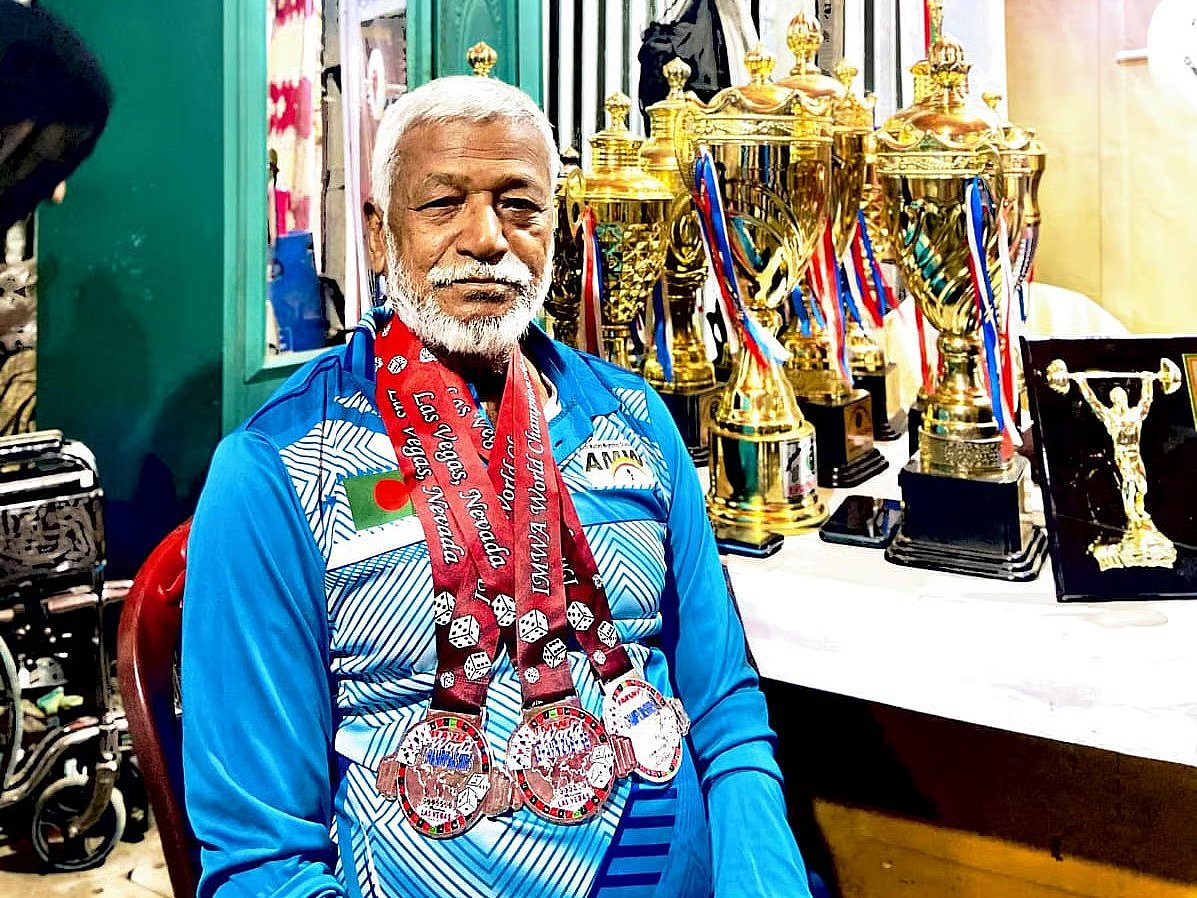
At 84, Mujibur Rahman still devotes his life to weightlifting
Along the paved main road in Block 4 of Ershadnagar in Tongi, Gazipur, stands a modest tin-roofed room. Measuring just 25 by 16 feet, the weathered structure reveals an extraordinary world of dedication the moment one steps inside.
Recently, thieves slipped through gaps in its broken walls and stole four weightlifting locks, a CCTV camera, and a Wi-Fi router. But they could not steal the indomitable dream and lifelong sacrifice of Mujibur Rahman, an 84-year-old freedom fighter.
At an age when most people slow down, he still lifts iron barbells every single day.
In March 2022, Prothom Alo published an online feature titled "Freedom Fighter Mujibur Rahman: Still Devoted to Weightlifting After 80." At the time, his training centre operated from a damp rented room beside a pond in Ershadnagar. Today, it has moved about 200 yards away to a new location.
The address has changed, but Mujibur Rahman has not. For 62 years, he has remained both a passionate weightlifter and an extraordinary humanitarian.
A training center built on determination
Mujibur Rahman established the Bhaibandhu Club in 1988 and later founded the Ershadnagar Weightlifting and Physical Fitness Club in 2005. About four years ago, he launched the Bir Muktijoddha Mujibur Rahman Weightlifting Training Center.
The center operates rent-free on government-owned land. With support from the local council, the then State Minister for Youth and Sports under the Awami League government arranged for the construction of the building.
Initially, training took place beneath a tarpaulin roof, but strong winds repeatedly blew it away. Later, the district administration provided corrugated metal sheets for the roof and walls. Recently, however, thieves took advantage of the deteriorating tin fencing.
A visit to the center last Tuesday showed a cramped space without the photo-filled walls of the previous gym. Rainwater leaks inside during storms, disrupting training. A few trophies sit atop a cabinet.
Today, 21 students train there regularly—five boys and 16 girls. Practice sessions are held morning and evening.
One of the trainees, Shayela Akter, a national gold medalist in the women's 69 kg category, said, "This weightlifting center has become like our home."
Countless success stories
Despite its humble facilities, the club has achieved remarkable success.
It has won the National Club Junior Championship 11 times across the Under-17 and Under-20 categories and finished runner-up four times. It has also been runner-up three times in the National Senior Championship.
More than 25 of Mujibur Rahman's students have secured employment in the Bangladesh Army, Ansar, and the prison service after training under him.
His former student Khorshed Alam said, "Sir has changed the lives of many young people in this area."
Competing internationally at 84
Mujibur Rahman's own sporting achievements stretch back decades.
He won bronze in weightlifting at the 1966 East Pakistan Games and competed in the 1968 Pakistan Games. In 1970, representing the Paltan Cultural Club, he cycled through all 19 districts of East Pakistan in just two months and 16 days.
He received recognition from the Bodybuilding Federation in 1971 and was awarded the Ansar Service Medal by the Prime Minister in 2016.
His competitive career is far from over.
In March last year, at the age of 83, he won gold in the 70 kg category at the Asian Masters Championships in Doha, Qatar. That September, he claimed silver in the same category at the World Masters Championships in Las Vegas.
He is now preparing enthusiastically for this year's World Masters Championships, scheduled for 17 September in Athens, Greece.
A selfless community leader
Mujibur Rahman runs both his household and gym largely with his monthly Freedom Fighter allowance of Tk 20,000 and Tk 13,000 he receives from Ansar.
Since 2001, he has served as coach of the Ansar women's weightlifting team. He expressed gratitude to Ansar for helping finance his participation in competitions in Doha and Los Angeles.
He does not charge his students any training fees. Instead, he often pays for their transportation and meals from his own pocket.
One student sitting nearby said, "Sir personally bears all the expenses."
His community service extends well beyond sports. He enrolls disadvantaged and orphaned children in school, has donated wheelchairs to three children with disabilities, pays the educational expenses of an orphaned sixth-grade girl, and regularly buys and distributes notebooks to underprivileged students.
During the devastating floods of 1988, he helped deliver clean drinking water and food to affected households.
In 2014, Mujibur Rahman lost his eldest son at the age of 35. Today, he lives with his wife Peyara Begum, two daughters, and one son.
"I don't regret the past," he says. "I don't worry about what I'll eat tomorrow. The present is everything to me. These boys and girls in weightlifting are my family."
He enjoys Baul, Lalon, and Bhawaiya folk music. Late pop legend Azam Khan and folk singer Fakir Alamgir were among his friends. A fan of classic actors Uttam Kumar, Dilip Kumar, and Dev Anand, he often visited the film studios at FDC to watch shooting sessions.
Pioneer of women's weightlifting in Bangladesh
Women's weightlifting in Bangladesh owes much of its foundation to Mujibur Rahman.
In 1998, while watching a Bulgarian female weightlifter compete on television in the office of sports organiser Mohiuddin Ahmed, he asked, "Can't we do this too?"
Mohiuddin replied, "If you can make it happen, I'll arrange the funding."
Soon afterward, Mujibur persuaded four young women—Nargis Akter, Parul Akter, Lily Akter, and Mariam Begum—to take up the sport.
On 28 June, 1998, they became the first women in Bangladesh to begin formal weightlifting training.
From those four pioneers, Bangladesh's women's team has grown into an international success story, winning medals including gold at the South Asian Games. National star Mabia Akter counts Mujibur Rahman among her inspirations.
From Pirojpur to Dhaka
Born on 1 January 1942, in South Bhandaria village of Pirojpur's Bhandaria upazila, Mujibur Rahman moved to Dhaka in the early 1960s in search of a better future.
Through family connections, he obtained a job as a dispatch rider with the then T&T department.
Delivering telegrams across the city brought him past the Wanderers Club, where he became fascinated by weightlifting. There he learned the sport under Mokhlesur Rahman Bhuiyan, alongside future weightlifter Mohiuddin Ahmed.
He also maintained close ties with film personalities, including actors Wasim, Khosru, and Zafar Iqbal.
Extraordinary courage in the liberation war
After completing 50 days of military training at Hasnabad Amlani Camp in India's North 24 Parganas in 1971, Mujibur joined the Liberation War under Sector 9 in the Sundarbans region.
During one mission, he and 52 fellow fighters came under attack by Pakistani forces. Their only boat drifted toward the sea with the strong tidal current.
Around 1:00 am on a cold night, the young Mujibur jumped into the dark river.
For nearly 40 minutes, he battled strong currents and crocodile-infested waters before reaching the drifting boat and bringing it back to shore, saving all 52 fellow freedom fighters.
The group later crossed the Shibsa River and returned safely to Hasnabad in India.
His final wish
Mujibur Rahman has no desire for a luxurious home or vast property. At 84, he has just one request to the government, "Build a permanent, modern gymnasium or training center for the thousands of underprivileged children of Ershadnagar in Tongi. That is my only wish now. I want to remain with weightlifting for the rest of my life."
Leaving the worn-out tin building, one cannot help but reflect: thieves may have stolen surveillance cameras and iron plates, but no one can steal Mujibur Rahman's determination to build a better future for underprivileged children. His dream remains untouched.