North South University secures multi-million research funding
It would be incorrect to say that research activity in Bangladesh is low compared with other countries. However, in my view, our research is failing to have sufficient impact. When we say that countries like China or the United States are producing strong research in engineering, what does that really mean?
It means that the practical application of their research is clearly visible. They are not conducting research only on paper. By applying that research, they are developing AI tools, building robots, even sending people into space. They have an environment—or an “ecosystem”—that supports this.
So the question is- where is the gap in Bangladesh? Why is the application of our research not very visible? Yes, research is being conducted in our country. But in most cases, our interest is limited to publication.
The majority of our research is theoretical. Even when applied research is done, it rarely reaches the stage of commercialisation or product development.
Why is that? One of the many reasons is that, historically, we have had a limited entrepreneurial mindset. Consider our parents’ and grandparents’ generations. Most were once engaged in agriculture. Later, there was a strong shift towards salaried employment.
In our time, if a student was academically strong, parents would dream that their child would become a doctor or an engineer. Very few imagined their child becoming a businessperson. Society, too, does not really encourage that idea.
As a result, we lag behind when it comes to start-ups. But a start-up is not merely about starting a business; it is about launching a new initiative. And where do new initiatives come from? From innovation. Research gives birth to innovation. But are we able to turn innovation into enterprise?
Let me give an example. One of my classmates from BUET went abroad to complete a PhD. His research focused on how software bugs could be automatically detected and fixed. Even leading researchers in the United States believed that a 100 per cent solution was not possible. But my friend proved otherwise.
As a result, his work received widespread recognition, and he went on to establish a start-up. Today, many major global companies use his software. This is the practical application of academic research—transforming it into enterprise. This is what is largely missing in our country, because that culture has not developed in the same way.
In our universities, academic promotion requires research, but it is enough simply to publish that research. There is little scope for a teacher to engage with society at different levels, understand real problems by interacting with people, and then work towards solutions through research. It is also very difficult to secure funding here. Yet, adequate funding is a prerequisite for good research.
Government support is limited. Abroad, companies like Tesla, Ford and Google invest heavily in research. They actively approach researchers in search of solutions to their problems.
In Bangladesh, that practice has not yet taken root among local companies, largely because they do not see an immediate, tangible return from research. If there is no visible benefit, why would a company invest money?
At North South University, we are trying to break out of this cycle. We are conducting research by securing funding from private-sector organisations and working on real-world problem-solving.
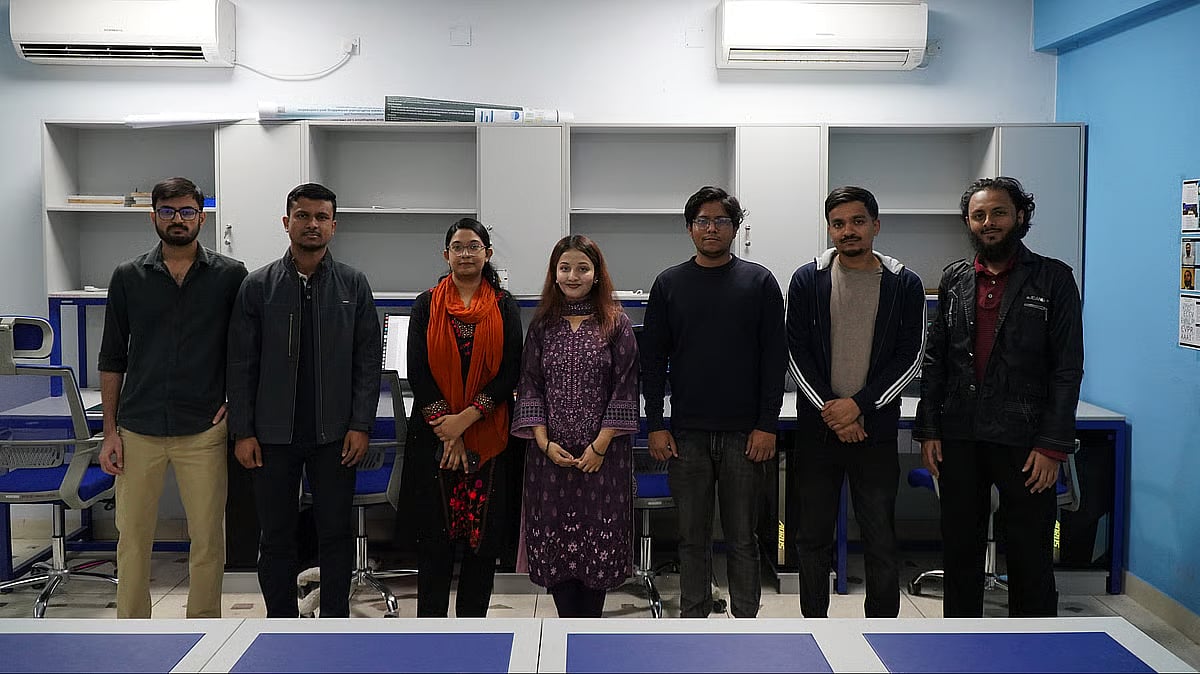
For the past five years, the Machine Intelligence Lab at North South University has been conducting research with funding from the private sector. Companies approach us with their problems, seeking solutions. Frankly speaking, such companies are still relatively few in Bangladesh.
However, several foreign-owned companies are also funding our research. I should mention that last year alone, the Machine Intelligence Lab carried out work worth Tk 18 million.
Now consider this: to train an AI model, the required GPUs or servers are not available locally. As a result, researchers have to rely on cloud services. Our researchers use a cloud service called RunPod. Last year alone, the RunPod bill amounted to nearly USD 60,000 or more than Tk 7.3 million.
This funding came entirely from private-sector organisations. No university could realistically allocate such a large sum for a single research project. So why are private companies willing to pay this amount?
Because, we are solving their problems. Our researchers travel to international conferences to present their work, and there are also costs associated with publishing research papers, all of which are covered by private funding.
We believe that if the practical application of research becomes more visible in a real sense, it will be possible to change the research culture in the country. More such research can be undertaken—research that will have a tangible impact on society.