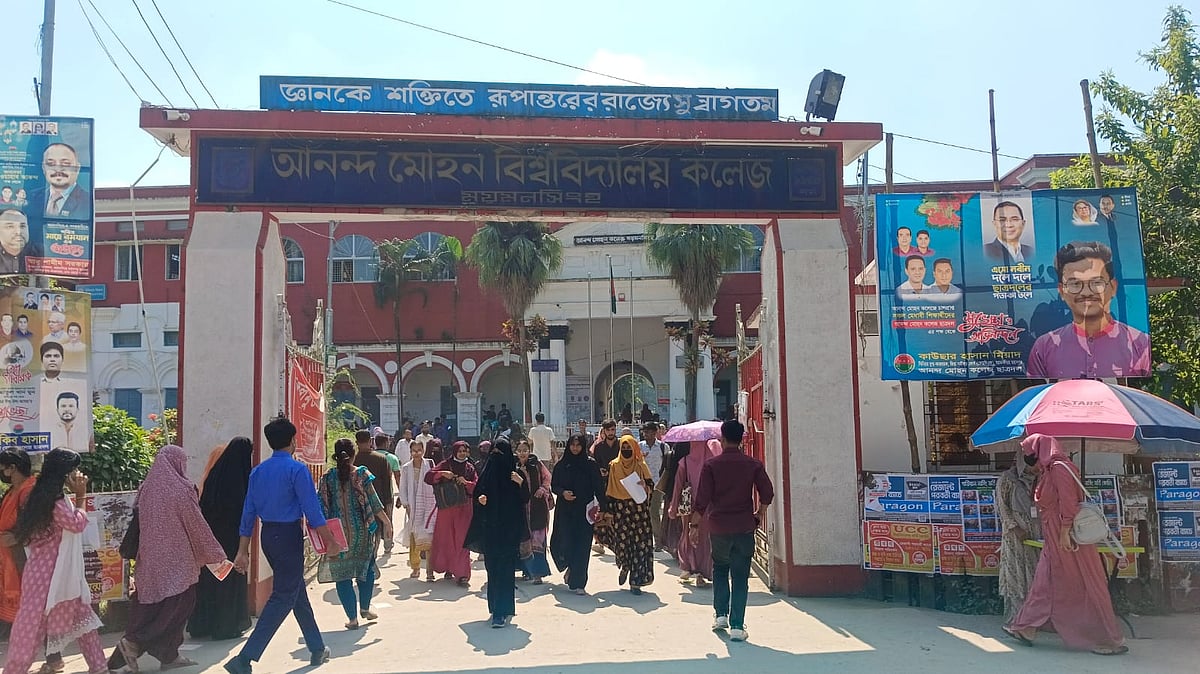
Major college
Ananda Mohan College: A century-old institution in ‘stalemate’
Ananda Mohan College is one of the country’s most prestigious and historic educational institutions. Established 117 years ago, it has long been regarded as the “cradle of knowledge” for the greater Mymensingh region. But today, this once-revered institution is struggling through multiple crises.
Currently, the college offers honours courses in 21 departments and master’s programmes in 20 departments, in addition to its higher secondary section. Altogether, it has 41,883 students. For this vast number of students, there are only 180 teachers, though 208 positions are officially approved.
In addition, the college is plagued by shortages of classrooms, accommodation, and transportation. For nearly two months, students have kept the acting principal and vice-principal’s offices locked. They have held a press conference with a seven-point list of demands. Altogether, the situation has reached a state of “deadlock.”
Classroom shortage
The English Department has only two classrooms. Mahmudul Hasan, a third-year undergraduate student, said, “Today (21 October), we had to vacate our room right after class because the master’s examination is going on. We need at least five classrooms, but there are only two.”
The college has 76 classrooms for 41,883 students — meaning one classroom for every 551 students. The administration says at least 50 more classrooms are needed.
Associate Professor of Political Science, Mohammad Nazrul Islam, said, “We have three classrooms. During exams, we have to use other departments’ rooms. Two more classrooms would make a big difference.”
There is also an acute shortage of toilets in many departments. The only toilet in the English Department has a broken tap and no running water. Student Mominul Islam said, “Boys and girls use the same toilet, and the flush doesn’t work.”
Nesar Ahmed, a student of the Bangla Department, said, “We don’t have a toilet in our department; we have to go to another department.”
Associate Professor of Bangla, Mohammad Shamim Siddiqui, said, “We use the toilet beside the staircase, but a permanent solution is needed.”
Transport inadequacy
For 42,000 students, the college owns only three buses, which operate on the Muktagachha, Phulpur, and Haluaghat routes. There is also one rented bus serving the Bhaluka–Mymensingh route.
Hafiza Akter, a student of the Management Department, said, “Each bus has 40 seats, but about 80 of us travel packed together. If we miss the bus, we have to spend around Tk 150 on transport. More buses are urgently needed.”
The college authorities said students come from all 13 upazilas of the district, but due to the lack of sufficient buses, it is not possible to expand routes.
“Extra seats” have become the norm
The college has three dormitories for male students and four for female students, with an official capacity of 350 for men and 450 for women — but in reality, the numbers are much higher.
Ahmed Junaid, a resident of Kazi Nazrul Islam Hall, said, “Rooms meant for four people now have five. That has become the rule.”
Anjuman Nahar, a student living in Khaleda Zia Hall, said, “Twelve of us share a room meant for six. We pay Tk 6,700 a year, plus Tk 60 daily for meals. It’s so overcrowded that it’s hard to study.”
However, Hall Superintendent and Associate Professor of Bangla, Jharna Begum, claimed, “No room houses more than ten students, and the old problems have been resolved.”
According to the college authorities, the construction of a new five-storey dormitory for male students is nearly complete, and another new hall is under construction. Still, the accommodation remains insufficient compared to the number of students.
Morsalin Mia, a first-year student of the English Department, said, “Staying in a private mess costs about Tk 5,000 a month. If I got a place in the hall, it would save money and allow me to focus on my studies.”
No reading rooms, library in disarray
The four female dormitories — Syeda Nafisa Islam, Taramon Bibi, Khaleda Zia, and Shaheed Janani Jahanara Imam Halls — have no reading rooms. Students study in the dining areas instead.
Saliha Jahan, a student of the Economics Department, said, “When no one’s eating, we sit and study in the dining room.”
The library has about 50,000 books, but operations have been temporarily moved to another building for the past two years due to construction. Though the books are available, there is no space for reading. Only 420 registered readers remain.
Library staff member Lucky Akter said, “Students used to come regularly, but now they rarely do — there’s no space to sit and read.”
One dining hall for three dorms
The three male dormitories — Jatiya Kabi Kazi Nazrul Islam Hall, Abu Saleh (Tarun) Hall, and Jasim Uddin Hall — share a single dining facility. Every day, meals are prepared for about 185 students. Three meals a day cost Tk 70.
Student Ahmed Junaid said, “Each day, a different room takes charge of managing the meals. We collect the money ourselves.”
Dining worker Alal Uddin said, “We provide three meals a day for Tk 70. Considering the price, the food isn’t bad. But if the budget were higher, the quality could be better.”
Demands for resolution
The college’s principal, Aman Ullah, was made OSD (Officer on Special Duty) on 31 July. On 3 August, Vice-Principal Sakhir Hossain became acting principal. However, since 12 August, a section of students began protesting, locking the offices of both the principal and vice-principal and placing their chairs outside.
The acting principal has still been unable to enter his office. On 21 October, the students held a press conference announcing their seven-point demand, which includes the immediate appointment of a principal, the prompt opening of the Hindu Students’ Hall, and ensuring complete transparency and accountability in administrative activities. They also demanded a police box on the college campus.
Acting Principal Sakhir Hossain said, “In such a large institution, problems are inevitable, but they will be resolved gradually. However, the ongoing student movement is disrupting administrative work.”
Named after Bengali educationist, social reformer, and politician Ananda Mohan Bose, the college was established in 1908, with academic activities beginning in 1909. Once the intellectual heart of the Mymensingh region, Ananda Mohan College is now mired in crises — from classrooms and accommodation to library and transportation. Teachers and students alike hope that this historic institution can soon reclaim its lost glory.