The latest National Education Policy recommended extending the duration of primary education from Class-V to Class-VIII. However, this pivotal recommendation of the policy has yet to be implemented.
Primary education is compulsory and free of cost. The rationale behind extending primary education up to Class-VIII was that students fail to fully master basic education by Class-V. Extending it to Class-VIII would have completed a crucial stage of learning while smoothing the path for their subsequent academic journeys.
A vast number of primary-level students attend private institutions. Although free education is available in government primary schools, many students must rely on coaching centres and private tutors to bridge learning gaps. As a result, the concept of free education faces stumbling blocks in reality.
After independence, the country’s first Education Commission was formed in 1972, headed by the renowned educationist and scientist Qudrat-i-Khuda. Since then, eight education commissions or committees have been constituted under various governments.
It remains unclear whether the incumbent BNP (Bangladesh Nationalist Party) government will formulate a new education policy or take another approach, although it has already announced extensive curriculum revisions set for 2028. Ahead of this, several amendments will be made to the 2027 textbooks, along with the introduction of four new books for Class-IV and Class-VI.
Meanwhile, from primary to university levels, distinct realities have emerged based on income, social standing, and opportunity. Some places lack adequate teachers, some face limited research opportunities, and in others, students are heavily dependent on coaching. Consequently, a student's future is largely determined by where they are born, their family's financial capacity, or the type of educational institution they have the opportunity to attend.
Against this backdrop, Education Day is being observed in Bangladesh today, 17 September. The movement for education that originated on this day in 1962 in protest against the then Sharif Education Commission centred on people-oriented, discrimination-free education for all. Sixty-four years later, that objective remains unfulfilled; rather, diverse forms of inequality have entrenched themselves in the education system.
A vast number of primary-level students attend private institutions. Although free education is available in government primary schools, many students must rely on coaching centres and private tutors to bridge learning gaps. As a result, the concept of free education faces stumbling blocks in reality.
Several students lost their lives during the protests against the then Pakistan government's education policy. Ever since, teachers' and students' organisations have been observing this day as Education Day.
Inequality begins at the primary level
Government primary schools are the main reliance for the education of most children from poor and low-income families. These schools charge no tuition fees. However, due to teacher shortages, poor education quality, and other constraints, quality education cannot be guaranteed in most government primary schools.
A recent government inspection report highlighted this issue. In June, the Compulsory Primary Education Implementation Unit inspected over 2,000 schools across Dhaka, Narayanganj, and Munshiganj. It revealed that many children cannot pronounce Bengali letters correctly, alongside evident weaknesses in English and Mathematics.
Conversely, children from affluent families enjoy access to kindergartens, English-medium, or expensive private schools. Consequently, two distinct realities are created right at the start of academic life.
While education up to Class-V is free on paper, this facility is practically restricted to government schools. Tuition fees in kindergartens run into thousands of taka. The vast majority of English-medium students come from high-income families. Apart from this, a massive number of children study in Qawmi madrasahs.
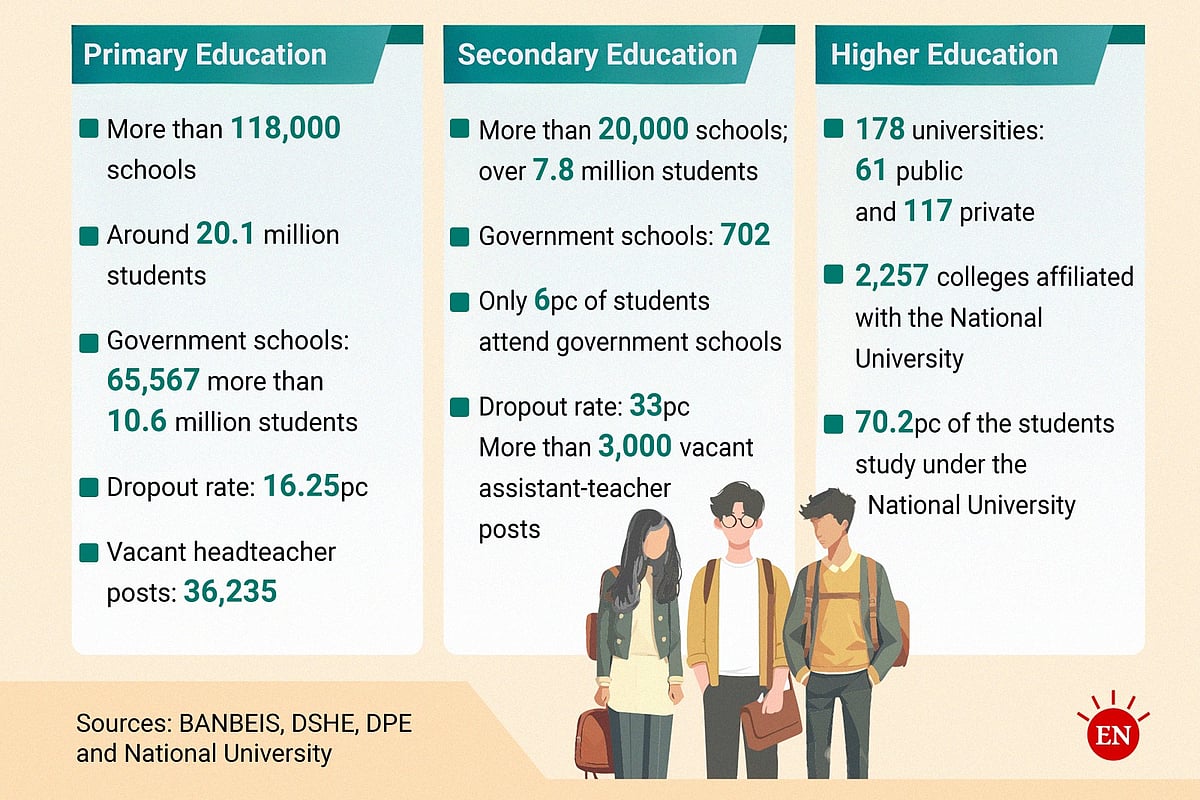
Adding to the concern is the rising drop-out rate. Currently, the primary school drop-out rate stands at over 16 per cent, representing an increase of nearly 3 percentage points within a single year.
Speaking on condition of anonymity, a Joint Secretary of the Ministry of Primary and Mass Education told Prothom Alo that the government is taking various initiatives to curb drop-out rates. The process for teacher recruitment and promotion is also underway.
Quality education stalled by teacher shortages
The average teacher-student ratio in primary schools is 1:28. However, a major inequality lies hidden behind this figure. Teacher shortages are far more acute in schools located in char lands, haor regions, hills, and remote areas compared to urban areas.
According to data from the Ministry of Primary and Mass Education, 36,235 sanctioned posts for headteachers remain vacant. It is understood, however, that initiatives have been taken for promotions to these positions.
State Minister for Primary and Mass Education Bobi Hajjaj stated that work must be done alongside the Public Service Commission (PSC) regarding this matter. Discussions have commenced, and progress will be shared within the next month to month and a half.
A student’s family in Old Dhaka incurs a monthly expenditure of approximately Tk 6,500 for two private tutors. While solvent families can bear this expense, it is impossible for low-income families.
According to recruitment rules, 80 per cent of headteacher posts are filled through the promotion of assistant teachers, with the remaining 20 per cent filled via direct recruitment. Consequently, promoting a large number of assistant teachers at once risks creating a new vacancy crisis.
A headteacher of a government primary school in Dhaka's Hazaribagh area told Prothom Alo that to improve the quality of education, paramount importance must be placed on recruiting qualified teachers, providing training, and ensuring their professional dignity.
Meanwhile, primary scholarship examinations have been reintroduced. According to a large section of educationists, this may exacerbate competition and inequality rather than establishing equity in education.
They argue that concentrated attention is given to a specific subset of students for the scholarship, leaving relatively weaker students further behind. Similar concerns surround the Class-VIII scholarship examination.
Former advisor to the caretaker government Rasheda K. Choudhury told Prothom Alo that inequality in primary education is stark.
Vast disparities have developed in facilities, teacher shortages, infrastructure, and education quality between urban and rural schools, she pointed out.
According to her, inequality in primary education undermines the very foundation of the nation, and addressing it is imperative.
Disparities more pronounced in secondary education
Inequalities become even more explicit upon transitioning from primary to secondary education. Out of over 7.8 million students at this level, only 6 per cent attend government schools. In other words, the vast majority depend on private institutions, where significant disparities exist in teaching staff, infrastructure, and educational quality.
Inequality in primary education is stark. Vast disparities have developed in facilities, teacher shortages, infrastructure, and education quality between urban and rural schools. Inequality in primary education undermines the very foundation of the nation, and addressing it is imperative.Former advisor to the caretaker government Rasheda K Choudhury
According to sources at the Directorate of Secondary and Higher Education (DSHE), more than 3,000 out of 15,293 sanctioned posts for assistant teachers in government secondary schools are vacant, along with 383 vacant headteacher posts. The shortage is most acute in Science, Mathematics, and Information and Communication Technology (ICT).
Educationists believe that the dual crises of overall teacher shortages and a lack of subject-specialist teachers are compromising the quality of secondary education. Students in rural and marginalised areas suffer the most from this.
Out-of-classroom spending-dependent education
Classroom instruction in secondary schools is no longer sufficient. Most students must depend on coaching centres or private tutors to achieve good examination results. Consequently, a parallel, cost-dependent education system has emerged alongside formal education.
A student’s family in Old Dhaka incurs a monthly expenditure of approximately Tk 6,500 for two private tutors. While solvent families can bear this expense, it is impossible for low-income families.
Added to this is the preparation for admission tests. From the 2027 academic year, admission tests will be introduced for all grades above Class-I, discarding the lottery system. Educationists fear this will increase pressure on children and trigger a resurgence in admission-coaching trends.
Disparity in higher education allocations
There are 178 public and private universities in the country, alongside two international universities. According to UGC data, annual expenditure per student at Dhaka University stands at Tl 252,241, whereas expenditure per student in colleges affiliated with National University is merely Tk 789. A staggering 70.2 per cent of higher education students in the country attend colleges under this university. Most of these colleges suffer from limited access to adequate faculty, modern laboratories, and research environments.
On the other hand, private universities receive no government financial assistance. They rely almost entirely on tuition fees to cover operational costs, placing the cost of higher education beyond the reach of average families.
Effective initiatives needed to reduce inequality
According to educationists and stakeholders, today's situation is the outcome of long-standing asymmetrical priorities in policymaking, funding, teacher recruitment, and infrastructure development.
According to them, it is essential to increase needs-based investment, expedite teacher recruitment, eliminate subject-specific teacher shortages, ensure basic learning skills at the primary level, and boost investment in research and infrastructure.
The new government has proposed an allocation of Tk 136,606 crore (more than 1.36 trillion) for the education sector in this fiscal year (2026-27), representing 2 per cent of GDP. In the 2025–26 fiscal year, the allocation was Tk 87,206 crore (872.06 billion).
According to educationists, merely increasing allocations will not suffice; funds must be utilised effectively based on actual needs and aimed at reducing disparities.
The aspirations of the education movement from 64 years ago—people-oriented and equal education for all—cannot be fulfilled simply by expanding access.
Unless equal-quality education is guaranteed regardless of where a student is born, their family income, or the institution they attend, that aspiration will remain unfulfilled.