Private universities: 54 of 117 move to own campuses, yet questions over quality
The number of private universities in the country has increased, as has the number of students. Half of these universities, which once operated on a limited scale in rented buildings, have moved to their own campuses; but academicians and administrative leadership has failed to keep pace with this infrastructural progress.
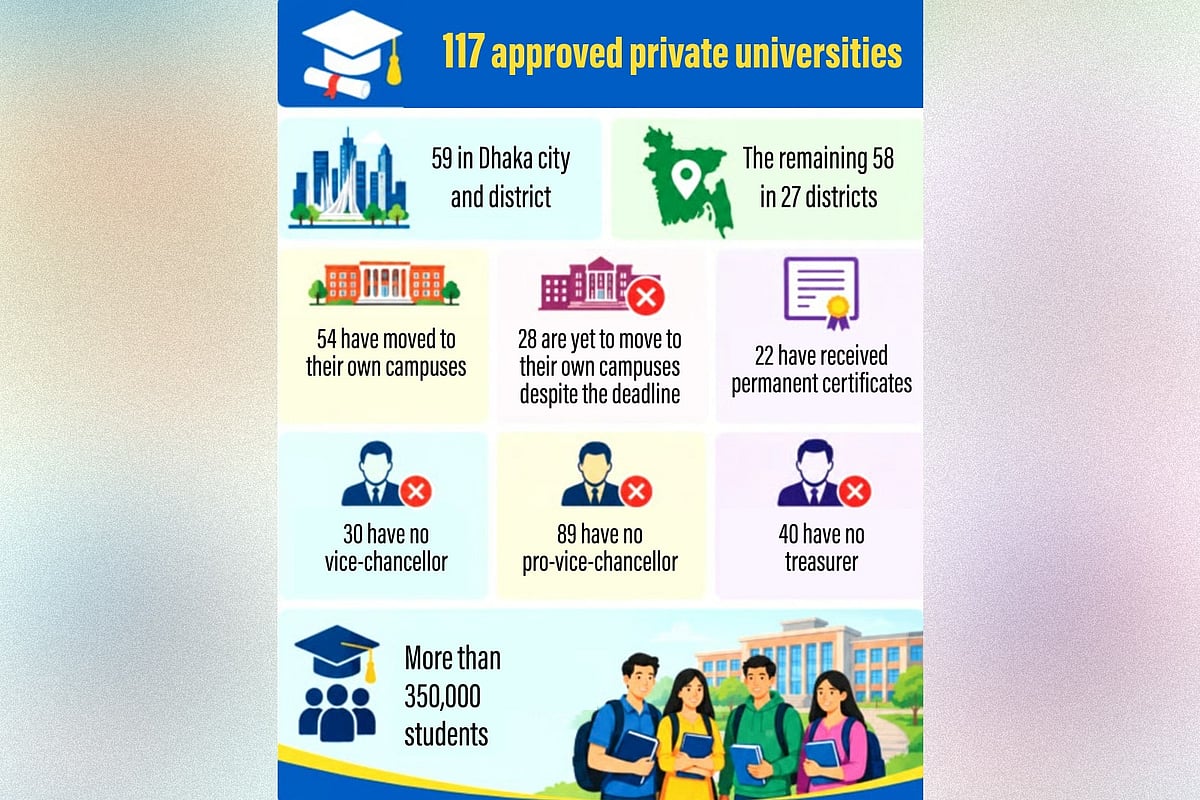
There are now 117 private universities in the country. Of these, 54 universities are conducting academic activities on their own campuses. However, as of 13 September, 30 of them do not have vice-chancellors (VCs). The vacancy is even greater in the post of pro-vice-chancellor; 89 universities have no one in this position. Forty universities do not have treasurers. Among them, 14 universities have all three top positions—the vice-chancellor, pro-vice-chancellor and treasurer—vacant.
People concerned including academicians said that the quality of a university cannot be judged solely by its buildings, land or own campus. Quality teachers, research, the teaching environment, academic leadership, libraries and laboratories, financial management, good governance and accountability—all together determine the quality of a university. Therefore, alongside progress in moving to own campuses, it is essential to address leadership vacancies and shortcomings in quality.
Currently, private universities have more than 350,000 students and over 17,500 teachers. This means private universities now account for a significant share of higher education in the country and play an important role in expanding access to higher education for students.
Vacancies in three top positions
University Grants Commission (UGC) sources say that 14 universities do not have any of the vice-chancellors, pro-vice-chancellors or treasurers appointed by the chancellor. One of them is Victoria University of Bangladesh. The university has had no vice-chancellor since 2022 and no treasurer since 2019. According to UGC data, the university’s address is Barek Mansion on Panthapath in the capital.
On 14 September, a visit to the building found furniture shops on the floors up to the sixth floor. The Victoria University office is on the seventh floor. However, it was closed. An untidy condition could be seen inside through the opaque glass on the door. The signboard had also been removed and kept inside. The university is also on the list of universities that have not moved to their own campuses. An employee of a furniture shop on the sixth floor told Prothom Alo that he occasionally saw people from the university coming there.
Among the universities with vacancies in all three top positions are Southern University Bangladesh in Chattogram, Asian University of Bangladesh, Isha Khan International University, Cox’s Bazar International University, German University Bangladesh, Canadian University Bangladesh and The People’s University of Bangladesh.
The registrar of The People’s University, located in Mohammadpur, Dhaka, Md Monirul Islam, told Prothom Alo that they have prepared panels for the appointment of a vice-chancellor and a treasurer. These will be submitted to the government very soon.
People concerned said that 351 professors would be needed to appoint vice-chancellors, pro-vice-chancellors and treasurers at 117 universities. It is not easy to find so many qualified and experienced professors at the same time. This has been compounded by lengthy appointment procedures and, in some cases, a tendency among university authorities to appoint their preferred candidates.
UGC Chairman Professor Mamun Ahmed told Prothom Alo that the posts of vice-chancellor, pro-vice-chancellor and treasurer are very important for running a university’s academic and administrative activities. However, there are some complexities in making appointments to these posts for various reasons. Once panels are submitted to the UGC, efforts are being made to provide opinions quickly and send them to the ministry.
54 on permanent campuses, 28 still outside
One of the key conditions for establishing a private university was to move its academic activities to its own permanent campus within a specified period. At one time, most private universities operated from rented buildings in Dhaka and Chattogram. This raised questions about the availability of classrooms, research facilities, libraries, laboratories and opportunities for students to take part in extracurricular activities.
According to UGC data, after being under pressure for a long time, 54 private universities have now moved to their own campuses. Most of the older private universities, including North South University, BRAC University, University of Science and Technology Chittagong, Independent University Bangladesh, International University of Business Agriculture and Technology, International Islamic University-Chittagong, Ahsanullah University of Science and Technology, American International University-Bangladesh, East West University, University of Asia Pacific, Gono University, Asian University of Bangladesh, Dhaka International University, Manarat International University, BRAC University, Bangladesh University, Leading University, BGC Trust University, Sylhet International University, Premier University, Southeast University, Daffodil International University, State University of Bangladesh, City University, Northern University, Southern University Bangladesh, Green University of Bangladesh, Pundra University of Science and Technology, World University of Bangladesh, Shanto-Mariam University, Eastern University, Metropolitan University, Uttara University, United International University and Central Women's University, are conducting academic activities on their own campuses.
A UGC official told Prothom Alo that among the 51 older private universities established between 1992 and 2006, all but four or five have moved to their own campuses. However, at least 28 private universities have still been unable to move to their own campuses, even though they have passed the legally prescribed period of 12 years from the time of their establishment.
The first law for approving and operating private universities in Bangladesh was enacted in 1992. It was later repealed and a new law was enacted in 2010. Under the law, a proposed university can begin operations after receiving temporary approval. For this, it must fulfil a total of 10 conditions, including forming a board with at least nine trustees or owners, having its own or rented building of 25,000 square feet, three faculties and six departments, and depositing Tk 1.5 crore to Tk 5 crore in a bank as a reserved fund, depending on the area.
After receiving temporary approval, a university becomes eligible for a permanent certificate if it fulfils some additional conditions within the next seven years. These include moving to its own campus on a specified amount of land depending on the area and allocating a budget for research. For its own permanent campus, a university must have at least one acre of land in the Dhaka and Chattogram metropolitan areas and two acres in other areas.
However, only 22 universities have so far received permanent certificates after fulfilling all the conditions, including having their own campuses. These are University of Science and Technology Chittagong, International University of Business Agriculture and Technology, Ahsanullah University of Science and Technology, American International University-Bangladesh, East West University, University of Asia Pacific, BRAC University, Leading University, Premier University, Daffodil International University, City University, Green University, World University of Bangladesh, Eastern University, Metropolitan University, United International University, Atish Dipankar University of Science and Technology, East Delta University, Varendra University, BGMEA University of Fashion and Technology, Khwaja Yunus Ali University and Bangladesh Army University of Engineering and Technology in Natore.
Universities increasing, questions over quality
The objective of establishing private universities in the country was to expand opportunities for higher education and discourage students from going abroad. In the beginning, education-minded entrepreneurs came forward to establish universities. However, after 2001, the tendency to approve universities on political considerations increased. According to those concerned, some universities established with business motives and political considerations have become more inclined towards ‘selling certificates’ than education and research.
According to UGC data, 11 universities were approved between 1992 and 1995, 12 between 1996 and 2001, 32 between 2002 and 2006, and 60 between 2012 and 2024. In addition, during the tenure of the interim government, Grameen University was approved in Dhaka in 2025, while Eco University of Science and Technology was approved in Thakurgaon last August during the tenure of the current government.
According to UGC data, 117 private universities are located in 28 districts of the country. Of these, 59 are in Dhaka district, including Dhaka city. This is followed by 10 in Chattogram, five each in Sylhet and Narayanganj, four each in Khulna and Rajshahi, three each in Cumilla, Barishal and Kushtia, and two each in Kishoreganj and Natore. In addition, one private university each has been approved in Bogura, Munshiganj, Chuadanga, Shariatpur, Chapainawabganj, Sirajganj, Feni, Faridpur, Jamalpur, Cox’s Bazar, Gazipur, Nilphamari, Manikganj, Bandarban, Brahmanbaria, Rangpur and Thakurgaon districts. This means a large share of private universities are still located in the capital and its surrounding areas. Although the expansion of universities outside Dhaka has taken place, it has not occurred equally across all regions.
People concerned in education sector said that, alongside expediting the appointment of qualified and experienced people to the vacant top positions at private universities, necessary action should be taken against universities that are not fulfilling the conditions set by law.