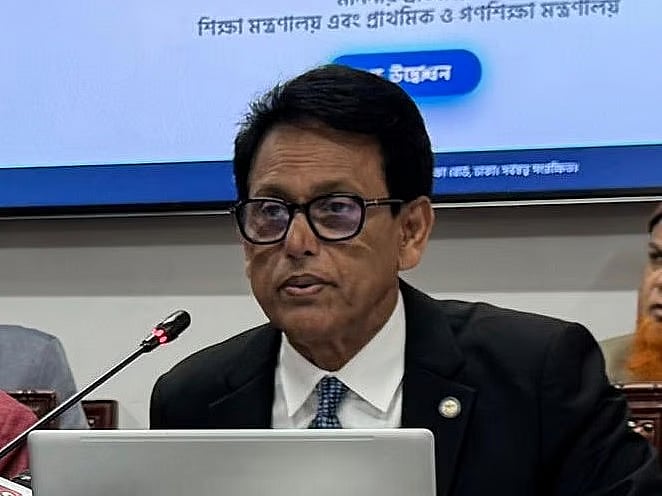
Decision on educational institutions to be taken at next cabinet meeting, says education minister
In the context of the global energy crisis triggered by the war situation in the Middle East, a plan to save electricity in educational institutions will be finalised at the next cabinet meeting to be held this week.
That is, a decision will be taken at the cabinet meeting on whether classes will be conducted through a hybrid system—both in-person and online—or through any other arrangement. Before that, the ministry of education will hold meetings with stakeholders.
Education Minister ANM Ehsanul Hoque Milon said this today, Sunday while responding to questions from journalists at the secretariat. He said the matter would likely be placed at the cabinet meeting after discussions with stakeholders.
Following the cabinet meeting, the Cabinet Division will hold a press conference. There will be nothing further to say before that. Notably the weekly cabinet meeting is usually held on Thursday. Accordingly, the next cabinet meeting is scheduled for 9 April.
Earlier, at the cabinet meeting held last Thursday, it was decided that, among other matters, the Ministry of Education would have a discussion with stakeholders and present a proposal at the next cabinet meeting on implementing a plan to save electricity in educational institutions, as mentioned in meeting minutes issued last Friday.
Cabinet secretary Nasimul Ghani had said at a press briefing after last Thursday’s cabinet meeting that the Ministry of Education would issue separate guidelines regarding educational institutions, as some aspects require discussion. However, it would be ensured that educational activities are not disrupted.
The Ministry of Education had planned, for the time being, to hold classes six days a week. Of these, a proposal under consideration includes three days of online classes and three days of in-person classes on an alternating basis—that is, if classes are held online one day, they would be conducted in person the next day.
Even during online classes, teachers would remain physically present to deliver lessons and practical classes would be conducted in person.
However, primary school teachers believe that it will be quite difficult to effectively conduct online classes in government primary schools. A head teacher of a government primary school in Dhaka told Prothom Alo on Saturday that students in such schools largely come from working-class and low-income families, and it is impossible to bring all of them under online classes.
Previously, during the COVID-19 pandemic, online classes were introduced, but in reality, most students in their school could not participate, he added.
A senior official from the Ministry of Primary and Mass Education also said they believe it is difficult to conduct online classes for all students in government primary schools. They are therefore considering how to address the issue while keeping schools open. However, the final decision will come from the cabinet.
After nearly 40 days of closure due to Ramadan, Eid-ul-Fitr and other occasions, educational institutions reopened on 29 March. Meanwhile, many countries are facing an energy crisis due to the war situation in the Middle East, which has also affected Bangladesh. In this situation, the idea of introducing partial online classes in educational institutions has emerged to reduce pressure on energy use.