Climate adaptation: Students can bring a ray of hope
Bangladesh is one of the countries that are most vulnerable to climate change. The impacts are already evident. On one hand there is coastal erosion, cyclones and tidal surges. On the other, there are disasters such as landslides in the hills and drought, making lives and livelihoods increasingly difficult. In such circumstances, it has become important to involve students in protecting the lives of the marginalised communities.
The UN Capital Development Fund (UNCDF) and the UNDP’s Local Government Initiative on Climate Change (LoGIC) project have supported many like these students. Implemented under the Local Government Division of the Ministry of Local Government, Rural Development and Cooperatives (LGRD), the LoGIC project is a joint effort of the Government of Bangladesh, Sweden, Denmark, UNCDF, and UNDP.
The project has engaged nearly 30,000 students across 291 wards in nine districts of the country. In each ward, a platform has been created where local students are not only working to address climate-related risks, but are also contributing to the effective use of funds, raising awareness, and fostering transformative leadership.
One of the major achievements of the LoGIC Youth Platform is the rise of young entrepreneurs who are not only earning their livelihoods but also confronting formidable challenges such as climate change. In Bangladesh’s climate-vulnerable districts, young people are using their resilience, creativity, and entrepreneurial skills to turn local problems into sustainable green solutions.
Ontu Rani’s Sagar Konya Pure Dry Fish
Char Montaz, an isolated island in Patuakhali district, is battered every year by sea waves and cyclones. With the threat of climate change, there is even a fear that one day the island may sink beneath the sea. It is in this vulnerable area that Ontu Rani, a second-year honours student, has grown up. Alongside her studies, she has been actively working for the past year to combat climate change.
Ontu says, “We who live on the coast face new problems every day. On one hand, there's river erosion; on the other, there's salinity in the water. Our agriculture, health and even our education are at risk. Before I used to feel only fear, but now I feel something must be done. Working with the LoGIC project, I’ve learned that when young people come together, change is possible.”
In 2023, Ontu and some local young people and women, started a business called Sagar Konya Pure Dry Fish. This is basically a women-led enterprise focused on processing and marketing dried fish. Ontu’s would look after the accounting and financial management, product promotion and marketing, also would maintain communication with local government offices.
In 2025, Ontu visited Dhaka for the first time to participate in the Youth Entrepreneurship Expo at the Bangladesh Investment Summit. There she presented the success of Sagar Konya Dry Fish, its investment plans and future vision, to both local and international investors.
Kurigram's Faridul Islam and YouthNet for Climate Justice
The riverine char areas of Rajibpur upazila in Kurigram are among the country’s most climate-vulnerable regions. Floods, river erosion and frequent natural disasters render people’s lives and livelihoods highly uncertain. Md. Faridul Islam became a beneficiary of the LoGIC Youth Platform. In 2020, he received local-level training on climate change and began organising awareness meetings and working on strengthening cooperatives.
Over time, Faridul Islam emerged as a community leader. He not only raised awareness but also brought young people together to form an organisation called “YouthNet for Climate Justice.” Their initiatives include:
Sustainable agricultural ventures: With support from local women entrepreneurs, they are cultivating new types of crops, such as quinoa and chia, which are climate-resilient and in demand in the market.
Women entrepreneur support: Engaging women in poultry farming, handicrafts, and small-scale agricultural businesses to create income-generating opportunities.
Market linkages: Presenting locally produced green products at national-level exhibitions.
In 2025, Faridul and his colleagues showcased quinoa and chia seeds at the Bangladesh Business Summit, earning national and international recognition.
Today’s students are tomorrow’s leaders. Their creative thinking, problem-solving skills, and social responsibility can guide Bangladesh toward sustainable development
So far, YouthNet has organised over 400 young people across three upazilas in Kurigram, each contributing to climate change mitigation in their communities. By financially empowering women, diversifying agriculture, and preparing disaster-prone communities, the organisation has sparked a new sense of hope.
Sabin's solar-powered clean water supply system in the hills
Sabin Chakma lives in Safari union of Rangamati district. In the hilly area, landslides, floods, and drought are a constant part of life. From his school days, he has been deeply interested in nature. Now a college student, Sabin has joined the LoGIC project and is working alongside local students.
Sabin shared his experience: “During the monsoon, landslides occur in our area, and many lives are lost. In the dry season, water scarcity becomes a serious problem. Earlier, I would just see the problems, but now I feel we must step forward to find solutions. Through LoGIC, we have learned how to identify risks and develop local-level solutions. Without active participation from young people, no change is possible.”
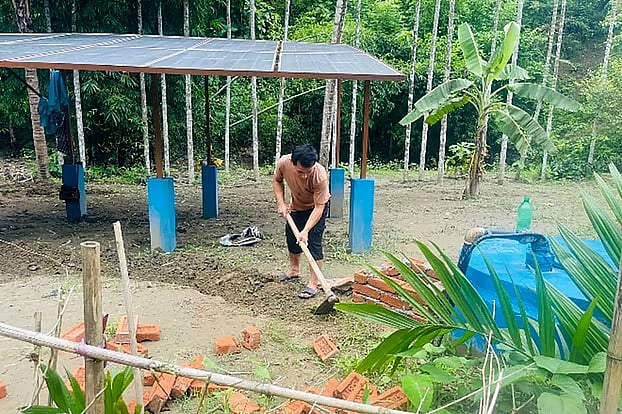
He has set up a solar-powered clean water supply system for the people in his village. Due to the remoteness of the hilly area, access to water had long been limited, and local residents suffered from a lack of safe drinking water. Using a local natural water source and solar energy, Sabin Chakma has created an environmentally friendly and sustainable water supply system, which now provides safe drinking water to hundreds of people every day.
The need for young entrepreneurs
The youth involved in LoGIC are constantly learning. They are confronting the risks posed by climate change. Climate experts believe that in areas vulnerable to climate change, the government—especially the Ministry of Youth Affairs and its departments, the Local Government Division, and the Ministry of Disaster Management and Relief—can utilise their knowledge during disasters.
The expertise of volunteers can also be leveraged. Experienced individuals can help train new volunteers. Special projects with dedicated budgets could be undertaken to support this initiative.
Bangladesh faces two major challenges simultaneously—the climate crisis and youth unemployment. Nearly 30 per cent of the total population is between 15 and 29 years old. To harness this vast potential, investment in their entrepreneurial journeys is crucial—especially in green sectors such as renewable energy, sustainable agriculture, eco-tourism, and waste management.
Youth-led initiatives can generate employment in rural and climate-affected areas; encourage innovation by transforming local knowledge into sustainable practices; increase resilience, as these enterprises play an effective role in addressing climate risks; and accelerate SDG achievement, particularly in climate action, poverty reduction, and gender equality.
Today’s students are tomorrow’s leaders. Their creative thinking, problem-solving skills, and social responsibility can guide Bangladesh toward sustainable development. Most importantly, they do not see climate change solely as a natural disaster but also as a social and economic challenge. Education, health, agriculture, and livelihoods—all are connected to climate change. That is why when students come together to identify risks, seek solutions, and share their knowledge with the wider community, they are safeguarding not only their own future but the future of society as a whole.