BRAC and LEGO Foundation launch SPLASH for children affected by humanitarian crises
Children affected by humanitarian crises must have access to safe, inclusive and play-based learning opportunities.
Ensuring their education, mental wellbeing and long-term development requires sustained support from the earliest years, alongside strengthening the capacities of parents, teachers and local communities.
This will enable children to continue learning and realise their full potential despite displacement and other humanitarian crises, reports a press release.
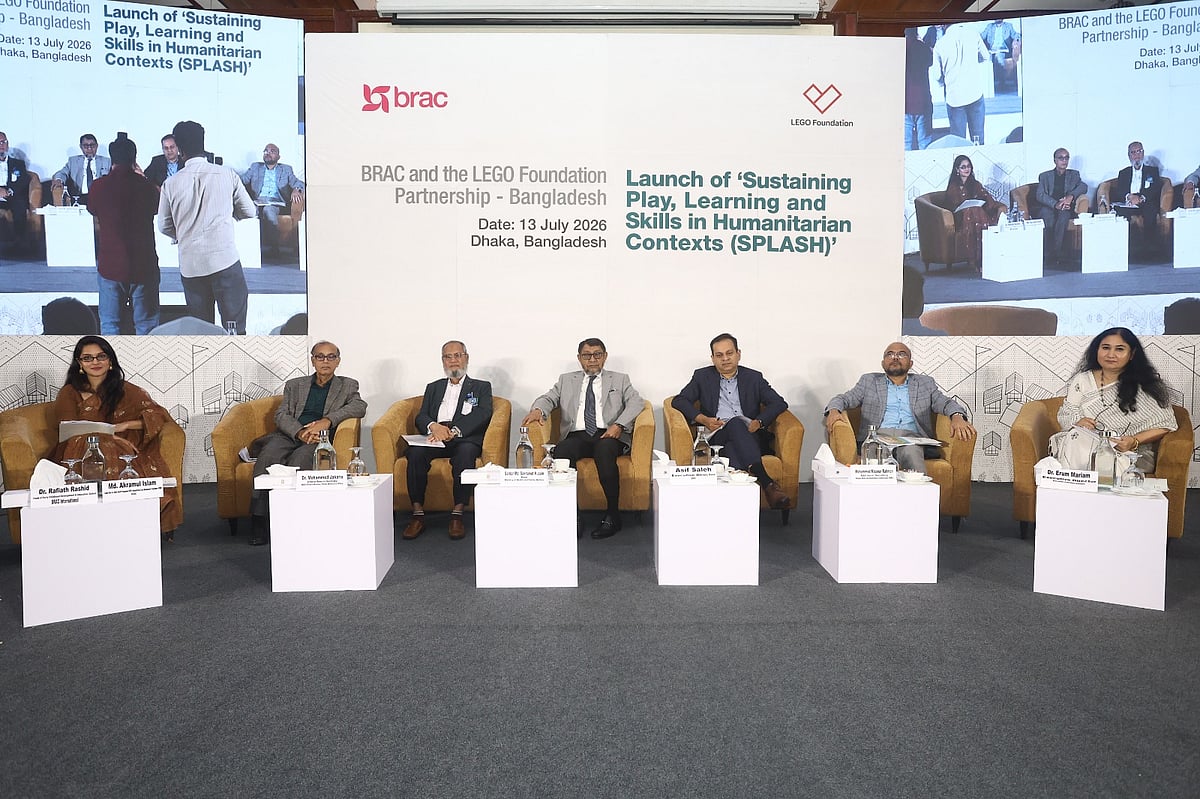
These messages were highlighted at the inauguration ceremony of Sustaining Play, Learning and Skills in Humanitarian Contexts (SPLASH) initiative, organised by BRAC. The event was held on Monday, 13 July 2026, at Hotel Pan Pacific Sonargaon in Dhaka.
The first session was attended by Sardar Md Sakhawat Husain, minister of Health and Family Welfare, as chief guest, while the second session was graced by Bobby Hajjaj, state minister for Primary and Mass Education, as chief guest.
Mohammed Jakaria, director general (Secretary), NGO Affairs Bureau, attended as special guest, while Mohammed Mizanur Rahman, additional secretary and Refugee Relief and Repatriation Commissioner (RRRC), addressed the event as guest of honour.
Asif Saleh, executive director of BRAC, delivered remarks during the opening session. A video message from Tarek Alami, vice president and head of International Programmes at the LEGO Foundation, was also presented.
It was noted that more than 473 million children worldwide are currently living in conflict-affected and humanitarian settings, while more than 52 million children remain out of school.
Access to education, protection and mental health and psychosocial support remains severely limited in these contexts. Through the five-year, USD 50 million partnership between BRAC and the LEGO Foundation, 400,000 children and adolescents affected by humanitarian crises in Bangladesh and Uganda will receive support.
The partnership will also strengthen the capacities of parents and teachers to create nurturing environments that support children's learning and development.
Addressing the opening session, Sardar Md Sakhawat Husain said, "Every child and adolescent deserves to feel safe, valued and have a sense of belonging, and it is our shared responsibility to engage with them in ways that are positive, respectful and nurturing. Our young people are among the nation's greatest assets, and initiatives such as this partnership between BRAC and the LEGO Foundation are an important step towards ensuring children of all ages have the opportunity to thrive. Let us start the habit of giving back: By giving our children the care, support and opportunities they deserve today, we can help nurture the responsible, resilient leaders our country will need tomorrow."
Speaking at the second session, Bobby Hajjaj said, "Play-based learning can play a transformative role in inspiring children's interest in STEM (Science, Technology, Engineering, and Mathematics) subjects from an early age. By identifying models that are proven to work, we can collaborate with partners such as BRAC and the LEGO Foundation to adapt and expand them across government primary schools. Scaling holistic approaches to learning will not only benefit children but also contribute to the country's long-term social and economic development.”
Asif Saleh, executive director of BRAC, said, "Development must be rooted in local needs and driven by local actors, with a long-term vision rather than a project-by-project approach. That is what makes this partnership with the LEGO Foundation unique. Over the past 50 years, BRAC has focused on developing models that are fit for purpose, low-cost and scalable, before working with partners to expand their reach. As the global development landscape evolves, governments play an increasingly important role in scaling proven solutions, while NGOs continue to develop community-led models that reach those at the last mile. At a time when trust, social cohesion and hope are being tested, we must go back to the fundamentals and continue creating opportunities for every child to learn, grow and thrive through early childhood development, education and mental health. The work of pioneers such as Sir Fazle Hasan Abed reminds us that meaningful change begins by standing alongside communities with optimism and purpose. If we could transform lives under far more difficult circumstances back in 1972, there is every reason to believe we can do so again. With this belief, we hope SPLASH will become a model that creates lasting impact in Bangladesh and beyond."
Expressing sympathy for those affected by the recent flash floods and landslides caused by heavy rainfall, Mohammed Jakaria said, “Initiatives such as SPLASH have an important role to play in supporting children and families in humanitarian settings, particularly in the Rohingya camps and host communities in Cox's Bazar. Through strong collaboration among the government, NGOs, and development partners, we can build on our collective strengths to improve children's well-being and contribute to the country's development.”
Mohammed Mizanur Rahman said, "Initiatives such as SPLASH provide valuable opportunities to learn what works in some of the most challenging humanitarian settings and apply those lessons more broadly. Effective approaches developed in the Rohingya camps have the potential to inform and strengthen programmes across the country. We can expand these successful models so that more children can benefit from them.”
In his video message, Tarek Alami said, " Our partnership with BRAC reflects a shared commitment to improving outcomes for children through approaches that are locally led, evidence-based and sustainable. We believe lasting change happens when governments, communities and partners work together to strengthen the systems that children and families rely on every day. Through SPLASH, we hope to generate valuable lessons that can help improve support for children in humanitarian settings, both in Bangladesh and beyond."
During the opening session, Md Akramul Islam, senior director of BRAC Health Programme and Humanitarian Crisis Management Programme, highlighted the importance of play-based learning in promoting children's development.
Erum Mariam, executive director of the BRAC Institute of Educational Development (BIED), spoke on the importance of play-based learning and its contribution to children's holistic development.
The panel discussion in the second session was moderated by KAM Morshed, senior director of Advocacy, Communications and Engagement at BRAC.
Panellists included Farid Ahmed, director general, NAPE (National Academy for Primary Education); Professor Md Iqbal Hyder, Member (Primary Curriculum), National Curriculum and Textbook Board (NCTB); and Mohammad Akkas, Principal, Fasiakhali Islamia Kamil Madrasha, Pekua, Cox's Bazar.
Closing remarks were delivered by Safi Rahman Khan, director of BRAC's Education, Skills Development and Migration Programme.
It was announced that the first phase of the BRAC–LEGO Foundation partnership, SPLASH, will be implemented in Bangladesh from June 2026 to December 2028. The initiative will provide age-appropriate support for children and adolescents from birth to 18 years.
This includes responsive caregiving for young children and their families, play-based early learning for children in refugee camps and host communities, support for children's participation in pre-primary and primary education, and continued learning opportunities, life skills development, technical and vocational training, mentoring and livelihood pathways for adolescents.
This initiative will also strengthen the role of parents, teachers and local communities in supporting children's education and overall development.
Speakers across different sessions included Syeda Sazia Zaman, programme head, BRAC Institute of Educational Development; Md Moazzem Hossain, programme head, Education Programme, BRAC; Mehadi Hasan, lead of Rural Primary Health Care under the BRAC Health Programme; and SM Hasanuzzaman, programme coordinator, Health, Nutrition and Early Childhood Development, Humanitarian Crisis Management Programme. Rafiath Rashid, head of Early Childhood Development and Education (Global), BRAC International, delivered the welcome address.
Representatives from development partners, government institutions and other stakeholders also participated in the event and shared their perspectives on advancing play-based learning and child development in humanitarian settings.