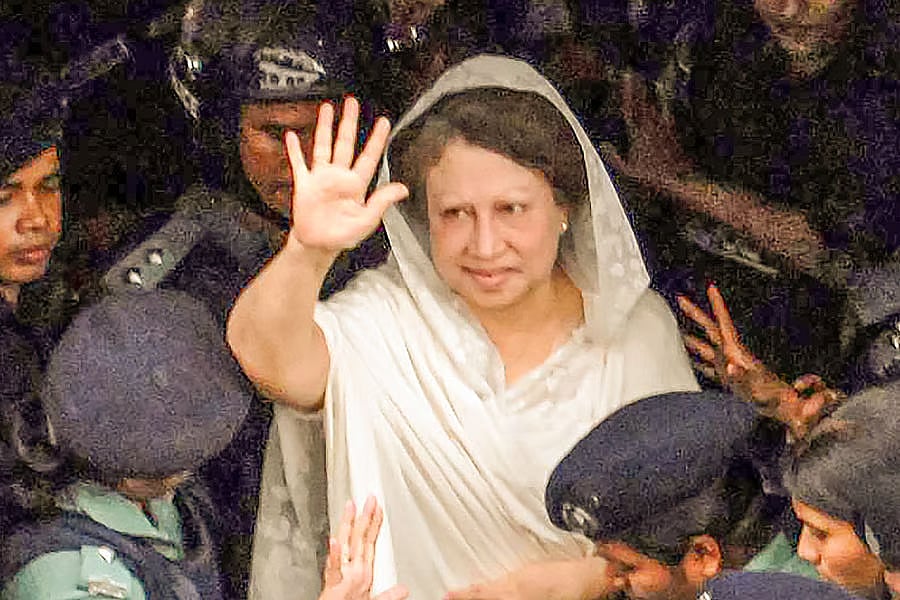
Statement in court
I regard myself as an ordinary person: Khaleda Zia
I was intimidated and warned that engaging in politics would bring immense suffering. Ignoring all such threats, I chose to play an active role in politics.
I entered politics holding aloft the banner of the ideals of martyred Ziaur Rahman. My struggle began with the objective of completing the unfinished tasks he had left behind.
The hopes and aspirations of the people became my own hopes and aspirations. My life has become inextricably intertwined with the dreams and convictions of the people of this country.
My civic rights have been repeatedly stripped away. A continuous campaign of falsehood and vile propaganda has been carried out against me. None of this is an isolated occurrence.
All the allegations are entirely fictitious and wholly fabricated, my lord.
Centred on the Zia Orphanage Trust, a completely false, malicious and harassing case has been filed against me and others. All the allegations in this case are entirely imaginary and utterly baseless. They are riddled with internal contradictions.
I have never had, either personally or in my capacity as prime minister at any time, any involvement whatsoever with the funding, management or any other affairs of this trust, nor do I have any such involvement now. This case has been filed beyond the legal authority and jurisdiction of the Anti-Corruption Commission (ACC). On the basis of such unfounded allegations, I have for a long time been subjected to harassment, distress and humiliation in the name of justice.
The fear of abuse of power therefore naturally weighs on the minds of judges. In the lower courts, the negative impact of this situation and environment is even more pronounced. I wish to cite just one small example.
The senior vice-chairman of the Bangladesh Nationalist Party (BNP), and the son of Shaheed Ziaur Rahman and myself, Tarique Rahman, was acquitted in absentia by a judge of a fabricated charge of money laundering. In response, the ruling authorities initiated such acts of harassment and persecution against that judge that he was compelled to leave the country with his family to protect himself. This single example alone is sufficient to obstruct justice and to instil fear in individual judges regarding their personal security.
My lord, I am reminded of the period of the Fakhruddin–Moeenuddin regime. Where are you seated while conducting the proceedings of this trial? Where has this courtroom been established? Is this a place of justice? Is this part of any recognised court complex?
A special court has been set up within the premises of Alia Madrasah to try the case filed against me. Does this madrasah compound have any connection with judicial proceedings or court administration? Each time I come here, I am reminded of the illegal and unconstitutional rule of the Fakhruddin–Moeenuddin regime.
Why did I enter politics? Why did I abandon a secure and safe life to step onto a risky and uncertain path? At that time, there was no lure of office or power before me. The illegal usurpers of state power did not want me to remain in politics. They promised me far greater respect and privileges if I refrained from politics. I was intimidated and warned that engaging in politics would bring immense suffering.
We all know, and you know as well, that you are not responsible for this. It is not you who took the decision. The venue of the trial and the location of the courtroom are administrative decisions. Those decisions are intertwined with the wishes and intentions of the ruling authorities. It is they who have established this courtroom here to conduct the trial against me.
The same venue where courts were set up to try individuals accused of disorder, rebellion, sedition, murder and rape has been chosen to conduct the trial of the case filed against me. I am being compelled to appear there.
The intention of those in power is, through this process, to humiliate, insult and demean me publicly even before the verdict, during the trial itself, and in the name of justice. This too constitutes a form of interference in the judicial process. Such measures have created an atmosphere of fear, giving rise to profound doubt and scepticism in the public mind regarding justice.
Through this process, I am being subjected to extreme harassment and humiliation even before any judgment is delivered and through the very mechanism of the trial itself. From whom shall I seek redress? Where shall I find remedy? How am I to respond to such statements made by the prime minister?
On 11 January, I quote a statement by the prime minister published in the daily Prothom Alo. Addressing BNP chairperson Khaleda Zia, the prime minister said, “You stole and consumed the money of orphans. Money came in the name of orphans. You go to court for hearings. You go one day and then stay away for 10. You keep running away. What is this? This itself proves that a thief fears the police.”
How am I to respond to such defamatory, vile and obscene remarks by the prime minister concerning a sub judice matter? …
My lord, you have surely examined the allegations and the related documents. You have surely already ascertained that part of the foreign donation received in the name of Ziaur Rahman for establishing an orphanage has indeed been used for the welfare of orphans at that institution. The remaining portion of the funds, which was deposited in the bank, remains fully intact. With accrued interest, the amount has increased significantly. Not a single penny has been misappropriated or embezzled. There is no question whatsoever of anyone stealing or consuming this money.
How, then, could the prime minister make such defamatory and offensive remarks about stealing the money of orphans? Does she have the right or authority to comment in this manner on a matter under trial? Is this not a breach of the law and an interference with justice?
My lord, I regard myself as an ordinary person. Yet I have devoted my life, my limited strength and capacity, and my intellect and knowledge to the interests and welfare of the country and the nation.
Nearly three decades ago, responding to the call and affection of the people, I entered the arena of politics. From that very day, I sacrificed the comfort and happiness of my personal and family life.
Why did I enter politics? Why did I abandon a secure and safe life to step onto a risky and uncertain path? At that time, there was no lure of office or power before me. The illegal usurpers of state power did not want me to remain in politics.
They promised me far greater respect and privileges if I refrained from politics. I was intimidated and warned that engaging in politics would bring immense suffering.
Ignoring all of this, I chose to play an active role in politics, because there was no democracy in the country at that time. An elected government had been overthrown and power seized. The people had no rights. From the very outset, I had to take to the streets to establish democracy and the rights of the people.
I entered politics holding aloft the banner of the ideals of Shaheed Ziaur Rahman. My struggle began with the aim of completing his unfinished work. I have always sought a Bangladesh governed along democratic lines, where people enjoy rights, freedom of expression, and where the judiciary and the press are independent.
I wanted our economy to be strong and for Bangladesh to occupy a place of dignity in the global community. That is the purpose of my politics.
By entering politics, I merged my own fate with that of the country and its people. I have no separate personal aspirations. The hopes and aspirations of the people have become my own. My life has become inseparably intertwined with the dreams and convictions of the people of this country—their joys and sorrows, their rises and falls, their struggles and crises, their victories and disasters, and their prospects and prosperity.
My present and my future have become one with the present and future of the nation. Perhaps that is why, whenever my beloved motherland Bangladesh and its people have faced calamity and crisis, I too have faced adversity.
My lord, you surely have seen that armed attacks were carried out against me, and, in recent years, one false case after another has been filed against me. Arrest warrants have been issued. I was forcibly evicted from my home of nearly four decades. My residence and political office were repeatedly blockaded for long periods with truckloads of sand. While I was confined inside my office, electricity, water, telephone and internet connections were cut off.
While in that state of confinement, I received the news of the death of one of my children who was undergoing treatment abroad. On that very day, a completely fabricated case was filed against me and those confined with me, accusing us of burning vehicles on the streets and killing people with explosives—acts that were allegedly committed while we were under siege inside the office. Is this civilised or humane conduct?
My lord, you have seen how, at the direction of the ruling authorities, my freedom of movement has been obstructed in various ways. The world has witnessed repeated attempts on my life. Armed attacks were carried out against me. Bullets were fired aiming at my vehicle. Armed terrorist attacks targeted my convoy, injuring party leaders, activists and security personnel. Not a single attacker has been arrested. To this day, no trial has been held for any of these incidents.
My civic rights have been repeatedly stripped away. A sustained campaign of falsehood and vile propaganda has been waged against me. None of this is isolated. I firmly believe that my persecution is inextricably linked to the overall situation of Bangladesh and the present suffering of its people.
Therefore, my lord, however ordinary a person I may be, the causes, background and context of the treatment meted out to me by the present ruling authorities are anything but ordinary. This cannot be separated from the suffering of the nation.
Accordingly, the filing of the present case and all its proceedings and consequences are not confined merely to criminal procedure, laws and the justice system. I respectfully request that you hear me out. Without explaining the broader context, it is not possible to present a complete, accurate and truthful picture of this case by focusing solely on narrow legal technicalities.
* Tomorrow: I have no address outside Bangladesh.