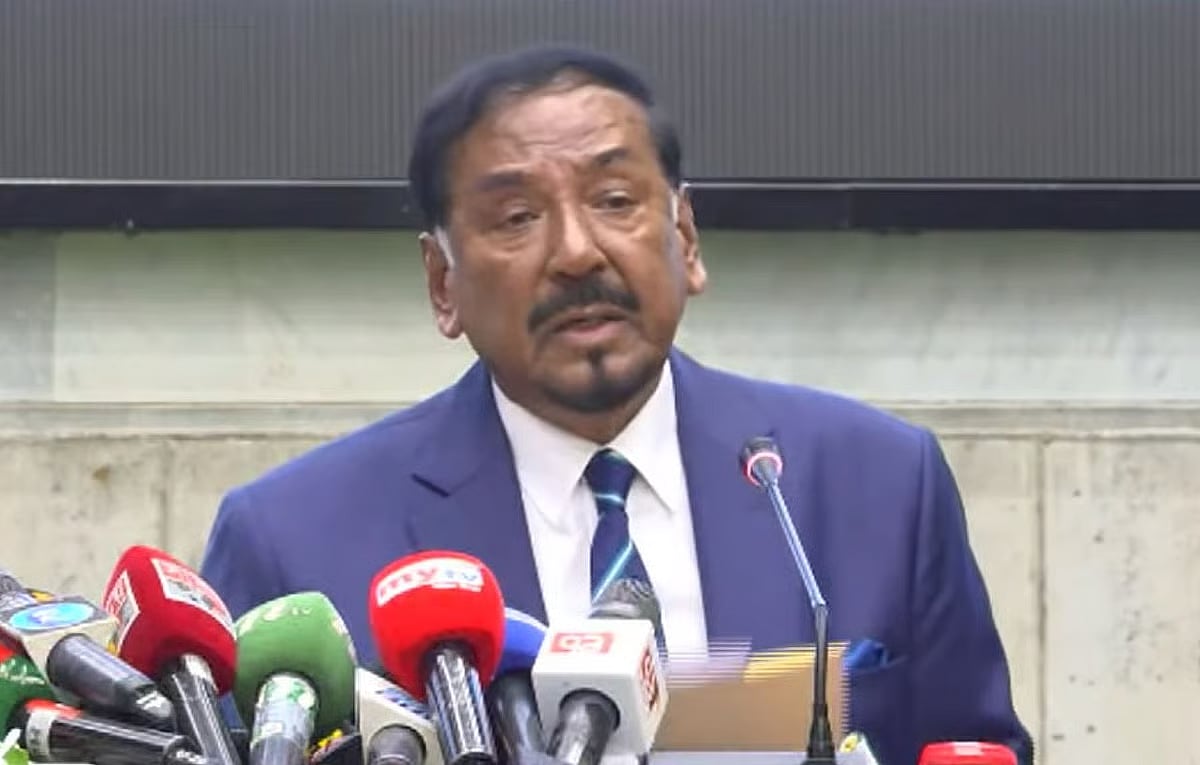
Speaker’s press conference
Reasons cited for President Shahabuddin’s resignation
Ill health has been cited as the reason behind the resignation of President Mohammed Shahabuddin. He submitted his resignation letter to Speaker of the Jatiya Sangsad (national parliament) Hafiz Uddin Ahmad on Friday.
Announcing the resignation at a press conference at Parliament House at 5:00 pm, the Speaker said the President had stepped down because he was suffering from serious health problems.
“He is seriously ill. Owing to multiple medical conditions, he has become physically and mentally unable to discharge the responsibilities of such an important constitutional office as that of the President,” the Speaker said.
The Speaker further said that the President has been suffering from heart disease, hypertension, diabetes and kidney-related complications. He has previously undergone coronary artery bypass surgery. More recently, medical examinations diagnosed him with autonomic neuropathy, a condition that causes him to experience intermittent episodes of brief loss of consciousness.
Although Shahabuddin had been elected President with the nomination of the Awami League, the BNP government did not seek his immediate removal after taking office.
According to the Speaker, the combined impact of these illnesses has left the president physically and mentally incapable of discharging the responsibilities of such a significant constitutional office.
Mohammed Shahabuddin was sworn in as Bangladesh’s 22nd President on 24 April 2023. Nominated by the Awami League, he was elected unopposed for a five-year term that had been due to expire in April 2028.
Following the fall of the Awami League government during the student-led mass uprising of 5 August 2024, Bangladesh’s political landscape underwent a fundamental transformation.
After the then Prime Minister Sheikh Hasina resigned and left the country, President Shahabuddin remained in office through several critical stages of the political transition, including the dissolution of Parliament and the formation of the interim government.
After the uprising, student leaders demanded Shahabuddin’s removal. Several platforms involved with the July Movement staged protests, including demonstrations outside Bangabhaban, calling for his resignation. However, the interim government led by Muhammad Yunus did not initiate any move to remove him from office.
Following the subsequent general election, the Bangladesh Nationalist Party (BNP) returned to power, creating a political contrast between the presidency and the new government.
Although Shahabuddin had been elected president with the nomination of Awami League, the BNP government did not seek his immediate removal after taking office. Nevertheless, speculation over his future persisted, although neither the government nor the BNP publicly called for his resignation.
In recent days, media reports claimed that, while in London for medical treatment in May, President Shahabuddin had spoken by telephone with former Prime Minister Sheikh Hasina, who has been living in India since being ousted during the mass uprising. Those reports fuelled fresh speculation about his future.
When asked on Thursday about the possibility of the president’s resignation following a meeting at the Secretariat, Home Minister Salahuddin Ahmed told journalists to “wait until Friday”.
Responding to questions about reports of the alleged telephone conversation with Sheikh Hasina, the minister said the government had no knowledge of the matter.
Later on Thursday, following a Cabinet meeting, the Parliament Secretariat announced that Speaker Hafiz Uddin Ahmad would cut short his visit to Thailand and return to Bangladesh on Friday.
He had travelled to Bangkok on 19 July for medical treatment and had originally been scheduled to return on Sunday. Instead, he arrived in Dhaka around 12:00 noon on Friday, two days ahead of schedule. A few hours later, he announced the President’s resignation at a press conference.
Speaker to serve as Acting President
With the office of the President now vacant, Speaker Hafiz Uddin Ahmad will discharge the functions of Acting President until a new Head of State assumes office, in accordance with the Constitution.
Under Article 50(3) of the Constitution, the president may resign by submitting a signed letter addressed to the Speaker. Article 54 further provides that, if the office of the President becomes vacant, or if the President is unable to perform the duties of office due to absence, illness or any other reason, the Speaker shall perform those functions until a new President is elected.
Under Article 123(2) of the Constitution, a presidential election must be held within 90 days if the office falls vacant owing to death, resignation or removal. Article 48(1) stipulates that the President is elected by a vote of the members of parliament.
The ruling BNP holds a two-third majority in parliament, making its nominee the clear favourite to become the next President. Senior party leaders have been discussing potential successors to Mohammed Shahabuddin over the past several days.