Analysis
Paul Kapur emphasises implementation of trade deal, other key issues
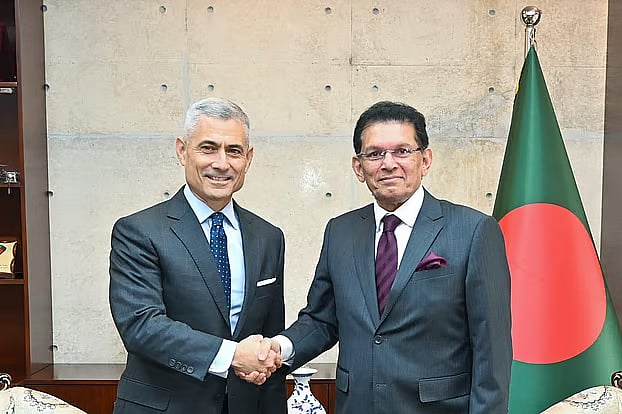
Paul Kapur, the United States Assistant Secretary of State for South and Central Asian Affairs, emphasised regional cooperation as well as advancing bilateral relations between Dhaka and Washington during his first visit to Bangladesh.
He also conveyed messages about implementing the trade agreement reached during the tenure of the interim government and speeding up the repatriation of Bangladeshi citizens who have become undocumented in the United States.
A few months after the long-ruling party, the Awami League, was ousted from power in August 2024 following a mass uprising, Republicans came to power in the United States after winning the election.
After Donald Trump assumed office as president, Paul Kapur replaced Donald Lu as the US Assistant Secretary of State, a position that is widely discussed in the political arena of the subcontinent.
Having taken office in October, Kapur’s first visit to Dhaka therefore drew significant interest.
During his three-day visit beginning on 3 March, Kapur held meetings with ministers and state ministers of the government, including Foreign Minister Khalilur Rahman. He also met leaders of the ruling party, the Bangladesh Nationalist Party (BNP), and the opposition party Bangladesh Jamaat-e-Islami.
Kapur arrived in Dhaka after visiting New Delhi. Naturally, there was curiosity about whether Washington’s views on post-election relations between Dhaka and New Delhi were discussed in Bangladesh.
Contacts with diplomatic circles in both countries indicate that the United States expects relations between Bangladesh and India to remain constructive. Kapur conveyed this message in both countries.
According to Kapur, under US domestic regulations there are several alternative options that allow the president to take unilateral decisions to finalise tariff and trade processes. Therefore, the agreement remains valid, and Bangladesh should now implement it quickly and properly.
‘The trade agreement remains in force’
The main focus of Kapur’s visit was the implementation of the trade agreement signed between Bangladesh and the United States. After Donald Trump became US president for a second term, reciprocal tariffs were imposed on several countries, including Bangladesh.
As part of negotiations to reduce those tariffs, the interim government signed a bilateral trade agreement with the United States.
The agreement was signed just two days before Bangladesh’s national election on 12 February, but doubts arose after the US Supreme Court annulled Trump’s counter-tariff.
Diplomatic sources say that after the Supreme Court ruling, various statements were made at the official level in Bangladesh, which drew the attention of the United States.
In particular, questions were raised about whether the agreement remained effective after the ruling. During his visit to Dhaka, Kapur clarified the matter.
He said that the agreement remains in force despite the Supreme Court ruling.
According to Kapur, under US domestic regulations there are several alternative options that allow the president to take unilateral decisions to finalise tariff and trade processes. Therefore, the agreement remains valid, and Bangladesh should now implement it quickly and properly.
Discussions with diplomatic sources from both countries suggest that although there may be scope to review the agreement, the United States wants its full implementation.
However, the agreement cannot be implemented without parliament. Parliament may review the deal, raise questions and give opinions, but the final decision generally rests with the executive branch. The United States hopes the agreement will pass smoothly without any obstacles.
Under the trade agreement between the two countries, Bangladesh plans to purchase 14 Boeing aircraft for Biman Bangladesh Airlines, buy liquefied natural gas (LNG) from the United States in the long term, import cotton for duty-free garment production, and purchase wheat and soybeans to ensure food security. Discussions on these issues are ongoing.
Irregular migration
Kapur also stressed that the United States will place particular importance on the issue of irregular migration. In line with President Donald Trump’s immigration policy, he emphasised accelerating the process of repatriating Bangladeshi nationals who have become undocumented in the United States due to a lack of valid documents.
Usually, Bangladesh verifies the identities of individuals after receiving a list from the United States and then arranges their return. The United States is now saying that people should be returned immediately after their court cases are resolved there, without delay.
Diplomatic sources say Bangladesh has agreed to expedite the repatriation process. However, it has sought assurances that the process will follow proper procedures and that the returnees’ dignity will be preserved. Some individuals previously deported from the United States were reportedly sent back on military aircraft with shackles on their hands and feet.
The United States wants to return about 5,000 Bangladeshis. So far, 327 people have been sent back.
The India factor
In a post on X, the South and Central Asia Bureau of the US State Department said that Paul Kapur discussed the United States’ key priorities with Foreign Minister Khalilur Rahman.
These included creating opportunities for US businesses to expand in the Bangladeshi market, strengthening cooperation on irregular migration, and deepening collaboration on regional security and counterterrorism.
Diplomatic sources say that discussions in Dhaka during Kapur’s visit also highlighted regional cooperation and Bangladesh’s importance as a US partner in the Indo-Pacific region. In that context, relations between the two neighbouring countries—Bangladesh and India—were also raised.
Kapur conveyed that India wants to engage positively with Bangladesh, a position he learned about during his visit to New Delhi. He also learned that Dhaka seeks to advance relations with New Delhi while prioritising Bangladesh’s interests and maintaining mutual respect.