Only independent journalism tells govt the truth: Mahfuz Anam
If a government truly believes in independent journalism and genuinely upholds a liberal perspective, it will be the biggest beneficiary, said Mahfuz Anam, editor of the English newspaper The Daily Star.
He said, “Government, remember this—no one will tell you the truth. Your party people will not tell you, out of fear. Your government bureaucracy will not tell you. Your intelligence community will not tell you. They will always keep you confined within a world of praise upon praise. Independent journalism is the only institution that tells you the truth.”
Mahfuz Anam said, “If a government genuinely believes in independent journalism and truly holds a liberal perspective, then it will benefit the most.”
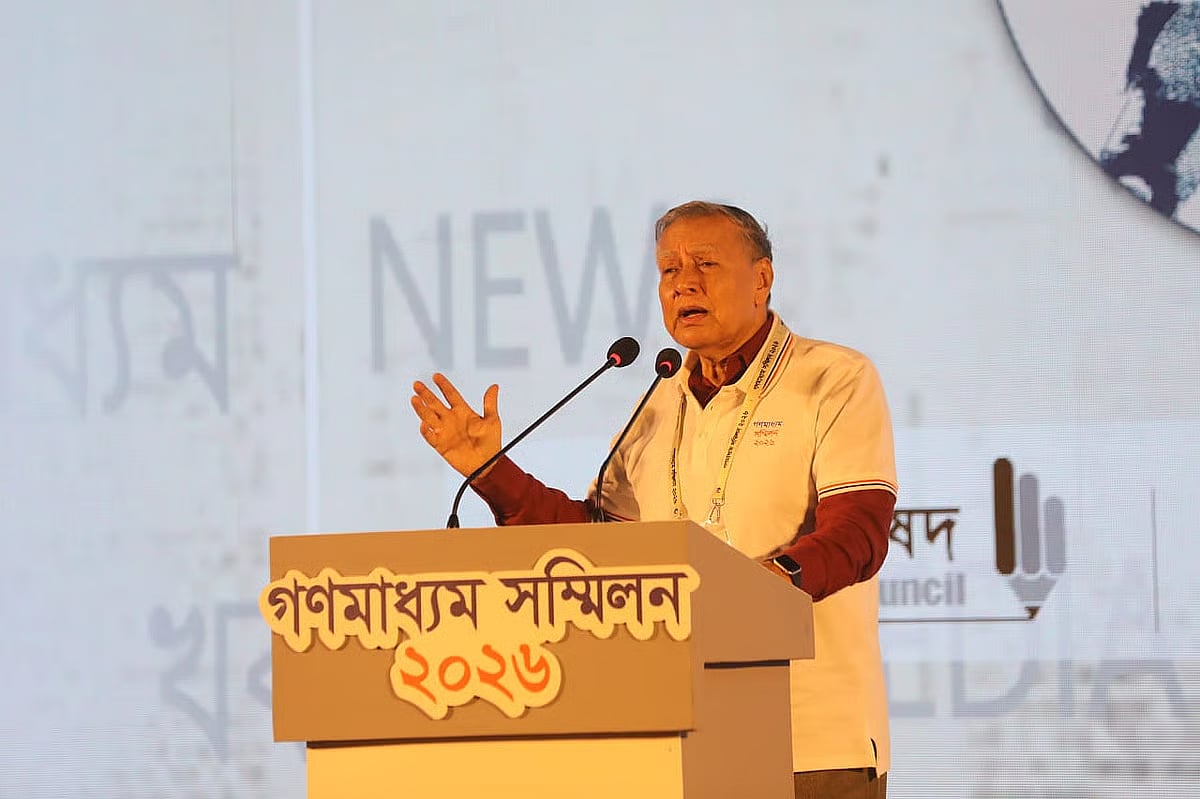
He made these remarks at the Media Convention 2026, arranged to protest organised attacks (mob violence) on freedom of expression and democratic values, and to express a united stance in favour of independent, responsible, and courageous journalism.
The convention was jointly organised by the Newspaper Owners’ Association of Bangladesh (NOAB) and the Editors’ Council today, Saturday, at 10:00 am at the auditorium of the Krishibid Institution Bangladesh (KIB) in the capital.
Referring to how various government projects and budget oversight come to light through independent journalism, Mahfuz Anam said, “The programmes you have taken, the projects you are implementing—are they correct? Are they being accepted by the people? Are they not getting plunged into corruption? Who will tell you these things?”
The Daily Star editor said, “The government controls budgets worth billions of taka. Do not think for a moment that this money belongs to you. This money belongs to the taxpayers; this money belongs to the people. How you use it—we will certainly support you where projects are good, democratic, and pro-people. But if those projects become centres of corruption, independent journalism will tell you that.”
Referring to the opportunity to re-establish democracy anew through the July mass uprising, Mahfuz Anam said, “The time has come to establish an accountable society. At the same time, the time has come for a new kind of democratic, strong, just, and ethical journalism.” He called upon everyone to work together so that journalism as a profession can earn greater public trust.
Mahfuz Anam said journalism is not merely a job; it is essentially a profession of social service. Upholding democracy, human rights, eliminating discrimination, and working for equal rights for people of all religions and communities are the core principles of journalism.
The Daily Star editor said that only two professions are given special protection in the Constitution—an independent judiciary and an independent media. Explaining this, he said that in societies where journalism is strong and independent, democracy becomes robust and citizens’ rights are established.
Addressing journalists regarding professional ethics, Mahfuz Anam said, “Those of us who have come into journalism must have this realisation. In our personal lives and social lives, the fundamental ethical values of honesty, integrity, and the practice of accurate, independent journalism—I request that you always uphold these in your life and consciousness. Because if we, as journalists, do not stand behind these values, society will not accept us as a solution.”
Speaking about the role of editors, Mahfuz Anam said the behaviour of editorial institutions and editors directly affects the credibility of the institution. If an editor deviates from ethics, it harms not only the individual but the entire institution and the profession. In his view, an editor’s ethical responsibility is greater than that of most other professions.
Addressing media owners, the Daily Star editor said that if investment in media is made with the same mindset as investment in other industrial sectors, the media will never earn public trust. Comparing journalism to a “social doctor,” he said journalists highlight society’s limitations, failures, and weaknesses out of love for society. If journalism is controlled for business interests, the public will not accept it.
Calling on the judiciary, Mahfuz Anam said that an independent judiciary and independent journalism are complementary to each other. He also urged that powers such as “contempt of court” should not be used to stifle the voice of independent journalism.
At the beginning of the Media Convention, the national anthem was performed, and everyone stood to show respect. This was followed by the speech session.
Members of NOAB and the Editors’ Council, along with leaders of the Association of Television Channel Owners, Broadcast Journalist Center, National Press Club, Bangladesh Federal Journalists Union, Dhaka Journalists Union, Dhaka Reporters Unity, Diplomatic Correspondents Association, Economic Reporters Forum, Photo Journalists Association, Crime Reporters Association, and various other journalists’ organizations, as well as journalists working outside Dhaka and editors and publishers of media outlets, participated in the convention.
Invited media representatives and columnists also took part in this event, standing together in support of responsible and courageous journalism.