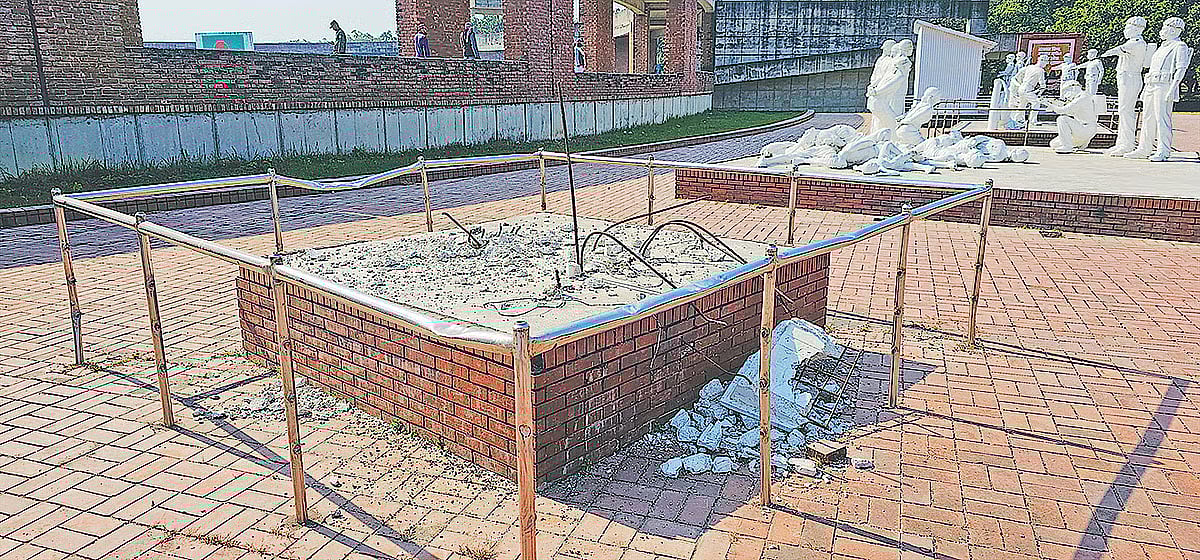
Liberation War monuments: Signs of vandalism, no move for restoration
Even though a year has passed since vandalism at the Mujibnagar Liberation War Memorial Complex in Meherpur, steeped in the memories of the war, restoration work has yet to begin. The damaged structures remain in a broken state.
In Gazipur city, the ‘Shoshostro Protirodh’ (armed resistance) sculpture built at the open stage west of the railway line also lies in ruins. Similarly, damaged Liberation War–related sculptures at various locations in Madaripur municipality and across the district have seen no restoration initiative either.
According to the Ministry of Liberation War Affairs, information on damage to Muktijodda (freedom fighters) complexes has so far been received from around 35 districts.
In addition to these complexes, damage has been reported to 33 other Liberation War–related monuments across the country, including museums, memorials and Boddho Bhumi (mass killing site).
A report titled ‘1,500 sculptures and murals vandalised all over country’, published on Prothom Alo English on 21 August last year, stated that the Sheikh Hasina government fell on 5 August in the face of a mass uprising led by students and the public. Investigations by Prothom Alo correspondents found that between 5 and 14 August, 1,494 sculptures, relief sculptures (figures carved or moulded on walls using ceramic or terracotta), murals and monuments were vandalised, set on fire or uprooted in 59 districts.
The Ministry of Liberation War Affairs has yet to compile data on exactly how many Liberation War-related sculptures, murals, monuments, museums or Boddho Bhumi were vandalised nationwide. It has also not been able to estimate the cost of restoring these, stating that it does not have sufficient funds.
Most of the vandalism and arson occurred on 5, 6 and 7 August. The majority of the damaged sculptures and murals depicted Bangabandhu Sheikh Mujibur Rahman, the struggle of independence and the Liberation War.
However, the Ministry of Liberation War Affairs has yet to compile data on exactly how many Liberation War-related sculptures, murals, monuments, museums or Boddho Bhumi were vandalised nationwide. It has also not been able to estimate the cost of restoring these, stating that it does not have sufficient funds.
The ministry says it will seek funding from the Ministry of Finance once the damage assessment is completed. Information is still being collected from different districts, and finalising the process will take time.
Liberation War Affairs Adviser Faruk-e-Azam believes the Mujibnagar Memorial Complex should be redesigned anew. He told Prothom Alo that the interim government has limited time, but Bangladesh’s Liberation War, the country’s map, rivers and the 11 sectors of the Liberation War need to be re-presented afresh, which won’t distort the history.
There is no known instance of any case being filed against those who attacked Liberation War monuments. Adviser Faruk-e-Azam said the environment at the time was not conducive to filing cases, and now it is too late. However, he added that if anyone wishes to file a case, the government will provide support.
According to the Ministry of Liberation War Affairs, information on damage to Muktijodda (freedom fighters) complexes has so far been received from 35 districts. In addition to these complexes, damage has been reported to 33 other Liberation War–related monuments across the country, including museums, memorials and Boddho Bhumi (mass killing site).
Meherpur
Local residents said the Mujibnagar Memorial Complex was attacked and vandalised in two phases on the afternoon and evening of 5 August last year.
The Mujibnagar Memorial Complex was built at the site where the first government of independent Bangladesh took oath on 17 April 1971. A visit to the site last Sunday revealed that some sculptures are missing their heads, while others lie broken into pieces. Nothing remains of the sculpture inspired by Bangabandhu Sheikh Mujibur Rahman’s historic 7 March speech.
Many artworks depicting the resistance battles of freedom fighters and the suffering of refugees are now unrecognisable. Plastic bottles and discarded polythene bags are scattered everywhere.
The sculpture depicting the Guard of Honour given to the four national leaders on 17 April during the Liberation War was also vandalised. One of the Ansar members who provided the Guard of Honour to the Mujibnagar government, Mohammad Azimuddin Sheikh, told Prothom Alo, “An attack on Mujibnagar is an attack on independence. The government must take firm action to prevent attempts to erase history.”
Abdullah Al Amin, vice-principal of Meherpur Government Mohila College, said that if the place from where independent Bangladesh came into being is left in such a state, what will the new generation learn? He urged swift restoration.
Sub-divisional engineer at Meherpur District Public Works Department, Jamal Uddin said a team from the Ministry of Liberation War Affairs had visited the memorial complex. A survey report has been submitted for the reconstruction of around 400 large and small damaged sculptures, but no funds have yet been allocated.
Deputy commissioner of Meherpur Syed Enamul Kabir said the issue would be treated “with importance”.
The environment at the time was not conducive to filing cases, and now it is too late. However, he added that if anyone wishes to file a case, the government will provide support.Faruk-e-Azam, Liberation War Affairs Adviser
Gazipur
The ‘Shoshostro Protirodh’ (armed resistance) sculpture built at the open stage west of the Joydebpur railway line in Gazipur city was demolished on the afternoon of 5 August last year. Each of the nine 13-foot-high figures has been broken up to the knees, leaving no visible form from the front.
The sculpture was built during the previous government at a cost of Tk 17.7 million (Tk 1.77 crore) by the Local Government Engineering Department under an initiative of the Ministry of Liberation War Affairs. Created by sculptor Kuasha Bindu under district administration supervision, it was demolished even before its inauguration.
A visit last Sunday morning showed that political banners and festoons now obscure the site from the front, making it impossible to tell that a sculpture once stood there. The broken parts are visible from behind, with piles of rubbish accumulating below.
Vegetable vendor Azizul Islam said, “It was demolished during the student movement, and it has remained in this broken condition ever since.”
Convener of Gazipur District Freedom Fighters’ Command Council, Rafiqul Islam mentioned applying to the deputy commissioner to construct a new sculpture. He warned it was this blood-soaked resistance of the people of Gazipur on 26 March that gave courage to the Bengalis the courage. If that memory is not preserved, that future generations will become disconnected from history and that is the greatest fear today.
Sculptor of the ‘Shoshostro Protirodh’ sculpture Kuasha Bindu said, “I created the sculpture with years of labour and dedication, but it was destroyed in moments. I still haven’t recovered from witnessing that scene.”
Deputy commissioner of Gazipur Mohammad Alam Hossain said, “I am new here, so I do not have much information about the sculptures yet. However, I will look into the matter.”
Madaripur
A visit to Shibchar in Madaripur showed the ‘Probohoman 71’ sculpture in front of the Chowdhury Fatema Begum Municipal Auditorium lying damaged. At least five Liberation War sculptures, including ‘Muktobangla’ in front of the upazila parishad, the Martyred Intellectuals’ Memorial at the entrance of the upazila, and the Swadhinata Chattar (independence square) at College More intersection, are also in a broken state.
Apart from them, vandalised under-construction sculptures in front of the Liberation War Museum and by the side of the lake in Madaripur municipality remain abandoned.
Local residents say that despite demands from valiant freedom fighters to restore the damaged sculptures, the administration has yet to take any initiative.
Shibchar upazila nirbahi officer (UNO) HM Ibne Mizan told Prothom Alo, “This is a very sensitive issue. It is not possible to re-erect the eye-catching sculpture that stood in the upazila complex. It may be removed and replaced with something new.”
There is still time. The Mujibnagar Memorial Complex and the Independence Museum at Suhrawardy Udyan in Dhaka should be restored immediately considering them as symbols, followed by rapid restoration of other Liberation War landmarks across the country.Mofidul Haque, trustee of the Liberation War Museum
Restoration needed urgently
One freedom fighters’ complex was built in each of the country’s 64 districts for the welfare of the freedom fighters, with separate complexes constructed additionally in every upazila.
During and after 5 August last year, many of these complexes were vandalised across districts and upazilas, though the exact number remains unknown.
In September last year, the Ministry of Liberation War Affairs sent letters to all deputy commissioners (DCs) and upazila nirbahi officers (UNOs) seeking information on damaged freedom fighters’ complexes. The letter stated that complexes with higher income could use 40 per cent of their funds for building maintenance.
Following this directive, several upazilas, including Sitakunda in Chattogram, restored their complexes. Others unable to fund restoration themselves were asked to report the extent of damage and required funds to the ministry.
The Ministry of Liberation War Affairs says it will seek funds from the Ministry of Finance once data of all the damages have been received.
Mofidul Haque, trustee of the Liberation War Museum, told Prothom Alo that there is no conflict between the Liberation War and the July mass uprising. Yet, a group attacked Liberation War memorials on and after 5 August. Vandalising Liberation War symbols means trampling on history.
He added that the Ministry of Liberation War Affairs should have treated the issue with greater seriousness. There is still time. The Mujibnagar Memorial Complex and the Independence Museum at Suhrawardy Udyan in Dhaka should be restored immediately considering them as symbols, followed by rapid restoration of other Liberation War landmarks across the country.
[This report was prepared with contributions from correspondents in the respective areas.]