People’s Stories
They wait to be ‘sold’ at the labour market
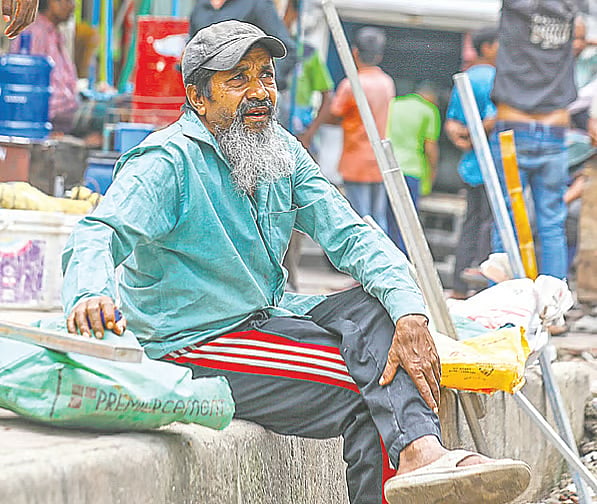
His name is Darun Ali. Mo one calls him by that name. In his youth, he loved playing the flute. Since then, everyone calls him simply by the name ‘Bashiwala’ — the flute player.
This correspondent met Darun Ali, better known as Bashiwala, at dawn yesterday, Monday, in the Fakirapool water tank area of the capital — the place where working-class people gather every day in search of work, at what many describe as a ‘labour market’.
Darun Ali is a construction worker by profession and is now around 60 years old. While speaking with him, someone from behind suddenly called out, “Hey, Bashiwala! Coming? There’s a job.” Turning around, he asked, “What kind of work?” The reply came: “Construction work. On the seventh floor.”
Darun Ali explained that the work involved standing on bamboo scaffolding outside a seven-storey building under construction. In his words, “If one bamboo pole breaks, it’s over. At this age, I can’t do that kind of work anymore.”
After talking a little longer with the man, Darun Ali paused for a moment before declining the offer. He lives in Shahjahanpur with his wife and three sons. Although his sons are now adults, they show little interest in working. As a result, even at this age, he still has to shoulder the entire family’s expenses.
The household spends between Tk 22,000 and Tk 25,000 a month. Darun Ali earns between Tk 1,000 and Tk 1,200 a day — though he doesn’t find work every day.
Then why refuse a job when he had finally found one? Darun Ali explained that the work involved standing on bamboo scaffolding outside a seven-storey building under construction. In his words, “If one bamboo breaks, it’s over. At this age, I can’t do that kind of work anymore.”
What happens if you cannot find work? With a faint smile, Darun Ali replied, “If it’s written in my fate, it’ll happen.”
This correspondent stayed in the Fakirapool water tank area until 10:00 am yesterday. Darun Ali had still not found work. Later that night, he said over the phone that he had eventually gotten a job around 11:00 am, for a wage of Tk 1,000.
What happens if you cannot find work? With a faint smile, Darun Ali replied, “If it’s written in my fate, it’ll happen.”
Waiting to be ‘sold’
The pavement beside the Fakirapool water tank, where this correspondent was speaking to Darun Ali, turns into a daily ‘labour market’ every morning. Countless people come there each day to sell their labour. Among them are carpenters, masons, plumbers, painters and their assistants. There are also earth-cutting workers, day labourers, van drivers and other working-class people.
At 6:30 am yesterday, only a handful of workers were present near the Fakirapool water tank. But before the clock struck 7:00, around 60 to 70 labourers had gathered there. Some carried baskets and spades, others buckets and paintbrushes. All waited with hope and uncertainty — wondering who would be ‘sold’ first.
Prothom Alo spoke to eight labourers gathered near the water tank in search of work. Every one of them said jobs had become scarce. At times, they remain unemployed for three or four days a week.
At around 7:30 am, this correspondent spoke with Md Shahin, who works as a mason’s assistant. His is from Jashore, but he has been living in Dhaka’s Kamalapur with his family for several years.
By 10:00 am yesterday, Shahin still had not found work. Later that night, he said over the phone that luck had not been on his side — he did not get any work that day.
Shahin’s family consists of his wife and two young children. He used to run a small roadside tea stall in the Fakirapool area, but it was recently demolished during a special police drive. Now, carrying a basket and spade, he comes to this labour market every day in search of work.
The man said there is no guarantee of finding work every day, even after coming to the market. Whether he finds work or not, he still has to pay Tk 6,000 in monthly house rent.
When asked how he manages to support his family under such circumstances, his face turned gloomy. “Brother, we are surviving with great difficulty. My children are young. There’s hardly any work. You don’t get work here every day,” he said.
By 10:00 am yesterday, Shahin still had not found work. Later that night, he said over the phone that luck had not been on his side — he did not get any work that day.
At around 8:30 am, an employer was seen leaving with four workers. Tile worker Karim Mia was still waiting behind. “We sit on this roadside in storms and rain hoping for work. When we are hired, the contractors don’t even offer a cup of tea,” he said. “That’s how our lives go on.”
At around 8:30 am, an employer was seen leaving with four workers. Tile worker Karim Mia was still waiting behind. “We sit on this roadside in storms and rain hoping for work. When we are hired, the contractors don’t even offer a cup of tea,” he said. “That’s how our lives go on.”
Try to ‘cheat’
A number of the workers who were sitting around left the Fakirapool Water Tank area by 9:00 am after finding work. By then, many others had already arrived and taken their place.
One of them was Shahidur Rahman, around 70 years old, his body visibly bent with age. He still works as a construction labourer’s assistant to support his household. He lives alone in Dhaka, while his village home is in Chandpur. His sons, he says, hardly keep in touch.
Shahidur Rahman complains that people often try to ‘cheat’ him because of his age. He says some try to get work worth Tk 800 done for Tk 500–600. “People say, ‘Uncle, you’ve grown old, you can’t do the work properly,’” he says.
By around 10:00 am, the workers who still hadn’t find jobs were sitting by the roadside. Some looked gloomy, while others were chatting among themselves. Among them was a man around sixty years old, who works as an assistant to a painter.
When asked his full name, he said, “Just write Babui.” He is not particularly worried about whether he gets work or not. He too simply says, “Whatever is written in my fate will happen.”