In the Kaderabad Residential Area of the capital’s Mohammadpur, a monthly waste collection bill of Tk 150 is collected from each flat, which was Tk 100 as recently as last December. In Lalmatia, Tk 250 is collected in some places and Tk 300 in others. In different sections of Mirpur, Tk 100–150 is being collected per flat. In Shewrapara, each flat has to pay Tk 150 to 200.
On the other hand, the amount of the waste bill is even higher in upscale areas such as Gulshan and Banani. Owners of large hotels and restaurants in these areas have to pay Tk 3,000 to 5,000 per month. The bill varies from area to area within Dhaka North City Corporation (DNCC) area. However, according to city corporation guidelines, the monthly waste bill should not exceed Tk 100. But people are collecting bills in whatever way they can.
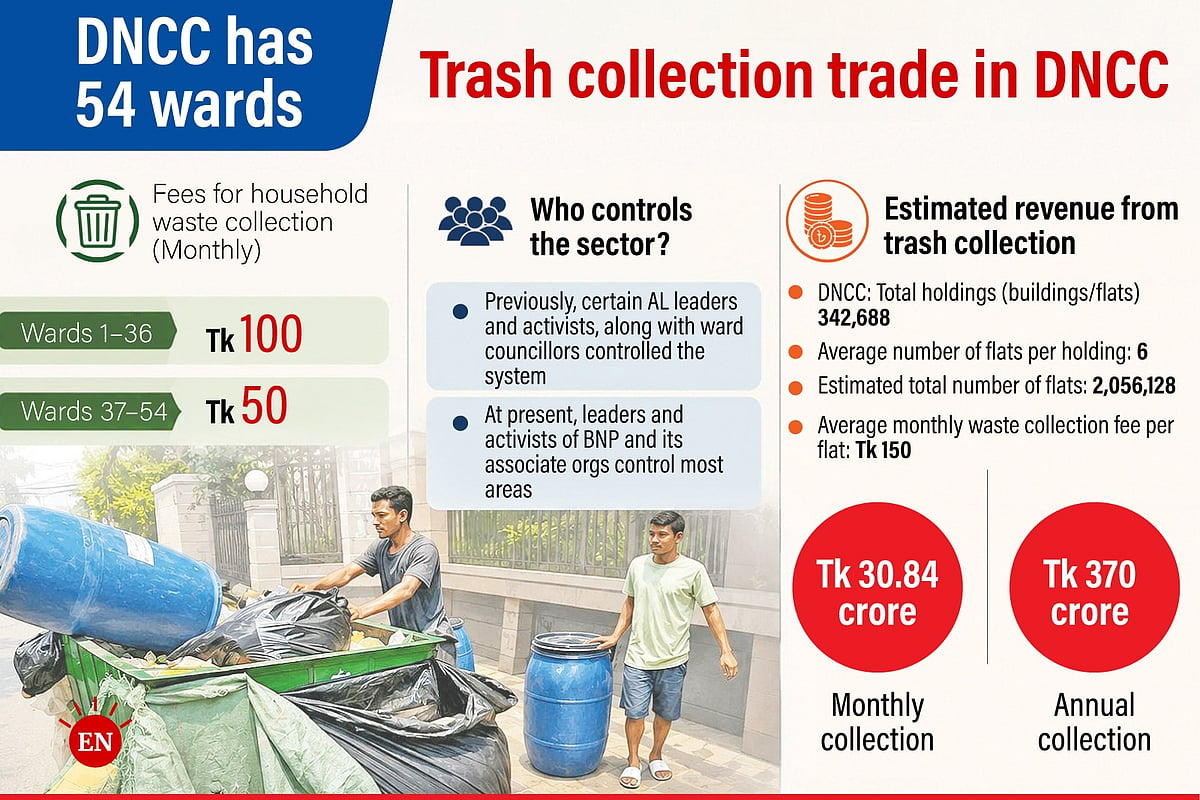
DNCC has 54 wards. Among them, in Wards 1 to 36, the monthly fee fixed by the city corporation for household waste collection is Tk 100. For the remaining 18 wards (37–54), the fee is Tk 50. These wards (including Uttarkhan, Dakkhinkhan, Badda and some other areas) were incorporated into the city corporation in June 2016. Even in the new wards, more than Tk 50 is collected as household waste bills. For example, in Dakkhinkhan (Ward No. 48), Tk 150–200 is collected. Again, in the Barobigha area of Bhatara (Ward No. 40), Tk 100 is collected per flat.
To find out how household waste collection works, how much is charged in different areas, who is involved in this work, and the extent of political leaders’ involvement, this correspondent visited 26 wards of DNCC over 21 days, from 20 April to 10 May.
During this time, the correspondent spoke with political leaders at different levels, field-level city corporation officials, workers engaged in waste collection, and van drivers. In addition, the correspondent spoke to at least two residents in each of the 26 wards.
DNCC Administrator Shafiqul Islam Khan told Prothom Alo that he is aware of the arbitrary collection of waste bills from households in many areas.
He said that whenever he receives a complaint from anyone, he personally intervenes to try to resolve the matter.
Administrator Shafiqul Islam Khan further said that a disorder has emerged, whether through muscle power or with the backing of various political parties, with everyone acting as they please. If household waste collection can be started under city corporation regulations and conditions, the disorder will decrease.
Stating that one party has filed a writ petition in court regarding household waste collection, the DNCC administrator said, "Discussions are underway with the petitioner to resolve the matter quickly through the court. There are plans to bring waste collection under a structured system. If this can be done, there will be no disorder."
The Awami League government fell on 5 August 2024 following a mass uprising. Afterwards, the BNP came to power after winning the parliamentary election held in February this year. Now, some leaders and activists of the party have taken control of the waste trade.
During the rule of the government of Awami League (now banned from activities), household waste collection was handled by party leaders and activists, along with the then ward councillors.
On 13 October 2019, Prothom Alo published an investigative report titled “AL men make Tk 4.5b in cash from trash”. That report stated that Awami League leaders, activists and associates of local councillors were carrying out at least Tk 4.5 billion worth of waste business annually by holding city residents hostage.
Multiple reports were published both on the front page and inside pages that day. Those reports also highlighted the involvement of Awami League leaders and activists in the waste business.
The Awami League government fell on 5 August 2024 following a mass uprising. Afterwards, the Bangladesh Nationalist Party (BNP) came to power after winning the 13th parliamentary election held in February this year. Now, some leaders and activists of the party have taken control of the waste trade.
People collecting extortion money have changed
There are six wards (29, 30, 31, 32, 33 and 34) under the Mohammadpur area of DNCC. Among them, in Ward No. 34 (including Rayerbazar, West Dhanmondi, Jafrabad and some surrounding areas), businessman Shanti Ribaru has been carrying out waste collection work since 1997. The name of his company is Grameen Enterprise. This company mainly collects household waste using vans.
Businessman Shanti Ribaru told Prothom Alo that previously he had to pay extortion money to former Awami League ward councillor Sheikh Mohammad Hossain. Now, he has to pay others. However, he declined to answer who is currently collecting the extortion money.
During the Awami League rule, Salim Ullah, also known as Solu, became councillor of Ward No. 29 in 2020. The name of his organisation was Swapna Manobik Kallyan Sangstha. Through this organisation, he used to collect household waste and collect bills. Before him, the waste trade in this ward was controlled by reserved woman councillor Shahin Akter. After becoming councillor, Solu used his influence to take over the waste collection work from another councillor of his own party.
Prothom Alo correspondent spoke to three leaders of Mohammadpur Thana and ward units of the BNP, along with four field-level city corporation officials, about who is behind the waste trade.
According to the information they provided, in Ward No. 29, waste collection is now controlled by Habibur Rahman (Imon Munshi), joint general secretary of Mohammadpur Ward BNP. In neighbouring Ward No. 31, waste operations are controlled by former joint general secretary of Dhaka City West unit Chhatra Dal, Sajib Ahmed. In Ward No. 32, household waste collection from various homes is carried out by Zahid Hossain Morol, joint convener of Dhaka City North unit Jubo Dal.
A disorder has emerged, whether through muscle power or with the backing of various political parties, with everyone acting as they please. If household waste collection can be started under city corporation regulations and conditions, the disorder will decrease.DNCC Administrator Shafiqul Islam Khan
Regarding the allegation that he controls the trash business, Habibur Rahman, joint general secretary of Mohammadpur Ward BNP, told Prothom Alo over the phone that he is planning to contest for the councillor position in Mohammadpur Ward No. 29 in the future.
He claimed that his opponents, jealous of his popularity, are spreading false propaganda. According to him, the same people who previously handled waste collection in the ward are still doing it, but now they are posing as BNP leaders.
On the other hand, regarding allegations of controlling the waste trade in Mohammadpur’s Ward No. 32, Zahid Hossain, joint convener of Dhaka City North Jubo Dal, told Prothom Alo over the phone, “Those who used to do it before are still doing it now. It is not true that I control it or that extortion money is paid to me.”
Ward No. 32 includes Lalmatia, Sir Syed Road, Humayun Road, Babar Road, Iqbal Road and several other areas of Mohammadpur. From various houses in this ward, bills of Tk 250–300 are collected. Previously, Tk 200–250 used to be collected.
Zahid, who took control of the waste operations in this ward, had been expelled from Jubo Dal on 3 July last year on charges of violating party discipline. However, his expulsion order was withdrawn on 22 January ahead of the 13th parliamentary election.
In Ward No. 33, during the Awami League period, 16 van service companies (waste collectors) operated. In return, extortion money had to be paid to the then ward councillor Asif Ahmed. Those same companies still operate now. However, extortion money is now paid to others.
Prothom Alo spoke to the owners of four out of the 16 van service companies on 5 May. None of them wanted to make any comments with their names quoted. Among them, three owners said that extortion money has to be paid to Mohammadpur’s three identified top criminals—Pichchi Helal, Killer Badal and Excel Babu. However, they declined to say how much extortion money is paid per month.
The owner of another van service company also acknowledged paying extortion money. However, he did not want to say to whom the payments are made.
Prothom Alo spoke with three owners of van service companies involved in household waste collection after paying extortion money. They said that in most wards of DNCC, five to six van service companies carry out waste collection work. Even after deducting extortion payments and other expenses, a company earns a profit of Tk 150,000–200,000 per month. And if someone can carry out this work exclusively across an entire ward, the monthly profit becomes Tk 1.4–1.5 million. In an upscale ward like Ward No. 19 (Gulshan-Banani falls under this ward), if someone can carry out the work exclusively, the monthly profit after all expenses would exceed Tk 5 million.
According to city corporation data, there are 342,688 holdings (buildings/flats) in DNCC. If an average of Tk 150 is collected from each holding, the monthly income from the waste trade is at least Tk 51.4 million. In some places, a building with six to eight flats has only one holding number. Again, in some places, a single flat itself counts as one holding.
The city corporation generally calculates one holding as containing six flats. Based on this calculation, there are 2,056,128 flats in DNCC. If an average of Tk 150 is collected per flat, the monthly income from the waste trade is at least Tk 308.4 million, which amounts to at least Tk 3.7 billion annually.
Obstacle from ‘invisible forces’ in Gulshan
The responsibility for waste management in Gulshan-1 and Gulshan-2 areas lies with the Gulshan Society. The city corporation assigned this responsibility to the society. However, despite receiving the responsibility, the organisation has not been able to bring household waste collection by van service under its control due to obstacles from “invisible forces.”
There are a total of 143 roads in the upscale Gulshan-1 and Gulshan-2 areas of the capital. Of these, Gulshan Society manages waste management on only 24 roads (Road Nos. 116–140). The household waste collection work for homes along the remaining 119 roads is controlled by leaders and activists of the local BNP and its affiliated organisations at various levels.
According to city corporation data, there are 342,688 holdings (buildings/flats) in DNCC. If an average of Tk 150 is collected from each holding, the monthly income from the waste trade is at least Tk 51.4 million.
Two influential leaders of Gulshan unit BNP told Prothom Alo over the phone that household waste collection on Roads 21–42 in the Gulshan-2 area is carried out by followers of Shahjahan Kabir, member secretary of the unit.
However, Shahjahan Kabir told Prothom Alo, “I am not involved in these matters. To be honest, I do not even know. These things are done by Jubo Dal, Swechchhasebak Dal, Sramik Dal and other leaders.”
According to information provided by van service workers involved in household waste collection and two leaders of Gulshan police station BNP, waste collection work on Roads 43–50 is controlled by Raju Ahmed, president of Ward No. 19 East (Gulshan) Jubo Dal. In the Roads 51–70 area, the waste trade is controlled by Anisur Rahman, senior joint convener of Gulshan unit Jubo Dal. On Roads 71–92, waste operations are controlled by Salauddin Ahmed, general secretary of Gulshan unit Swechchhasebak Dal. On Roads 93–104, waste operations are controlled by Sharif Uddin, joint convener of Gulshan unit BNP. And on Roads 105–115, waste operations are controlled by followers of SA Mamun, convener of Gulshan unit BNP.
However, Gulshan unit BNP convener SA Mamun told Prothom Alo over the phone, “None of our boys, none of the BNP boys, are involved in this matter.”
Later, the names that emerged in Prothom Alo’s investigation regarding who controls the waste trade on which roads were communicated to SA Mamun over the phone.
He then said, “The names of those actually doing this work did not come up. These activities are carried out by Zakir Hossain, senior joint convener of Gulshan unit Jubo Dal, and Shafiqul Islam, former organising secretary of the Thana unit Chhatra Dal. They have no connection with BNP.”
This correspondent then contacted Zakir Hossain and Shafiqul Islam over the phone. Among them, Zakir Hossain told Prothom Alo on 10 May, “Perhaps he may have a political conflict with me, which is why he mentioned my name.”
After saying this much, he disconnected the phone call.
On the other hand, Shafiqul Islam told Prothom Alo over the phone that they carry out household waste collection work on some roads in Gulshan. It would not be more than six or seven roads, he said.
DNCC formally handed over the responsibility for household waste collection in the Gulshan area to Gulshan Society in August last year. The society then began the work on 11 November last year.
Gulshan Society President Omar Sadat told Prothom Alo that due to obstacles from invisible forces, they have not been able to bring household waste management for the entire Gulshan area under their control.
He said that once the entire waste management system of Gulshan comes under the society’s control after overcoming these obstacles, there are plans to generate electricity and biogas from the waste.
The city corporation generally calculates one holding as containing six flats. Based on this calculation, there are 2,056,128 flats in DNCC. If an average of Tk 150 is collected per flat, the monthly income from the waste trade is at least Tk 308.4 million, which amounts to at least Tk 3.7 billion annually.
In Gulshan, although Gulshan Society has not been able to fully manage the system, in Uttara’s 14 sectors the Sector Welfare Association’s appointed workers are engaged in household waste collection.
Nazrul Islam Bhuiyan, general secretary of Sector Welfare Association of Uttara Sector 3, told Prothom Alo that in Sector 3 a monthly service charge of Tk 250 is collected per flat. This includes waste bill, mosquito spraying, salary of security guards, and other cleanliness-related service fees.
Demand to increase extortion money
In the Agargaon (part) area, A to Z Media and Social Service Centre used to carry out waste collection for a long time. However, after the city elections in February 2020, local Awami League leader Forkan Hossain became councillor of Ward No. 28. The following month, Forkan’s younger brother Asaduzzaman took control of the trash trade in Agargaon.
Nazmul Haque, owner of A to Z Media and Social Service Center, restarted household waste collection in Agargaon after 5 August 2024. However, he now has to operate the work by paying extortion money to local Jubo Dal leaders.
Nazmul Haque told Prothom Alo that he began waste collection work in Agargaon the day after the fall of the Awami League government. But one week after starting, he was called over the phone and asked to meet at an office in Mohammadpur of a Dhaka North City Jubo Dal leader. Several other Jubo Dal leaders were present there. He was told to pay monthly extortion money to local Jubo Dal leaders. He is now continuing the work by paying monthly extortion.
Once the entire waste management system of Gulshan comes under the society’s control after overcoming these obstacles, there are plans to generate electricity and biogas from the waste.Gulshan Society President Omar Sadat
In response to questions about who is taking the extortion money and how much is being paid monthly, Nazmul Haque said he has to pay five former and current leaders at the thana and ward level of Jubo Dal. The leaders are not satisfied with the amount he is currently paying and have demanded an increase in the monthly extortion. They also threatened to take over the waste work if he does not comply.
Takeover due to non-payment of extortion
In the area from Airport to Abdullahpur along both sides of the Dhaka–Mymensingh highway, Innovation Waste Management Service used to collect waste from various malls and commercial offices. In October last year, some youths obstructed the company’s waste collection activities. The company’s owner Motiur Rahman Khan was told over the phone to meet a person named Sazzad.
Motiur Rahman Khan told Prothom Alo, “Through various sources I came to know that the person obstructing the waste work is Md Sajjad Hossain, president of Uttara East Thana unit Chhatra Dal. I did not meet him. Later, his people demanded Tk 200,000 per month. I refused to pay. After that, his people forcibly took control of the waste work on the eastern side of the highway.”
Regarding the allegation, Uttara East Thana unit Chhatra Dal president Md Sajjad Hossain could not be reached for comment despite multiple attempts by Prothom Alo on 10 May.
He did not answer phone calls. Later, a text message was sent to him explaining the reason for the call. He did not respond.
What is the city corporation doing?
In 2009, when Dhaka City Corporation was undivided, the monthly fee for household waste collection was a maximum of Tk 30. In 2011, the undivided city corporation was split into Dhaka North and Dhaka South. Nearly a decade later, in December 2020, DNCC for the first time fixed a monthly waste collection fee in a board meeting. At that time, approval was given for Tk 100 per month in some areas and Tk 50 in others. However, in reality, this fee was never implemented.
Later, in February 2023, DNCC created a guideline (terms of reference) for registration of waste collection organisations. In the guideline, the 54 wards of DNCC were divided into two categories. At that time, the monthly waste bill was set at Tk 100 for old wards 1–36 and Tk 50 for newly added wards 37–54.
After the guideline was prepared, steps were taken to register ward-based van service companies. In 2023, in the first phase, the city corporation collected a deposit of Tk 1 million for wards 1–36 and Tk 600,000 for new wards 37–54 from applicants along with applications.
Due to the involvement of then Awami League ward councillors and their relatives, the initiative failed. Later, the corporation returned the deposited money to the interested companies.
DNCC has 54 wards. Among them, in Wards 1 to 36, the monthly fee fixed by the city corporation for household waste collection is Tk 100. For the remaining 18 wards (37–54), the fee is Tk 50.
In the second phase, after the fall of the Awami League government in August 2024, during the interim government, another attempt was made to register van services. This time too, the registration process could not be completed after collecting money from applicants.
According to city corporation sources, leaders and activists of different political parties applied to take control of waste work in areas like Gulshan, Banani and Uttara. To avoid disorder, the process was cancelled in March last year and the deposited money was returned.
DNCC collects 2 per cent of its annual holding tax revenue as cleanliness charges.
Anarchy persists
Speaking about the situation, urban planner Adil Mohammed Khan told Prothom Alo that a kind of anarchy has long been going on in the capital’s waste management system. Since waste collection is a profitable sector, it is being politically controlled. As a result, instead of being directly managed by the corporation, the work is operated through various influential intermediaries. This causes the corporation to lose revenue on one hand, while citizens are forced to pay unfair bills on the other.
He believes the city corporation itself can carry out household waste collection by appointing its own workers.
He added that if the city corporation can properly manage the work, citizens will not have to suffer harassment over excessive waste bills.