Prothom Alo explainer
What are metro rail’s bearing pads, why did it fall off again?
For the second time in just over a year, a bearing pad has fallen off the Dhaka metro rail’s pillar, this time with a fatal outcome. The incident has reignited questions about design flaws and safety oversight in one of the country’s most expensive infrastructural and public transport projects.
A bearing pad detached near the Farmgate section of the metro rail, killing a young man as the nearly 140-150kg heavy piece of material fell onto the road below around 12:30 pm on Sunday. Train operations were immediately suspended. Services later resumed between Agargaon and Uttara, but operations towards Motijheel remain suspended.
A similar incident occurred on 18 September 2023, also near Farmgate, when a bearing pad fell from another pillar. That time, there were no casualties, but train services were halted for 11 hours, and a probe committee was formed.
What is a bearing pad, what does it do?
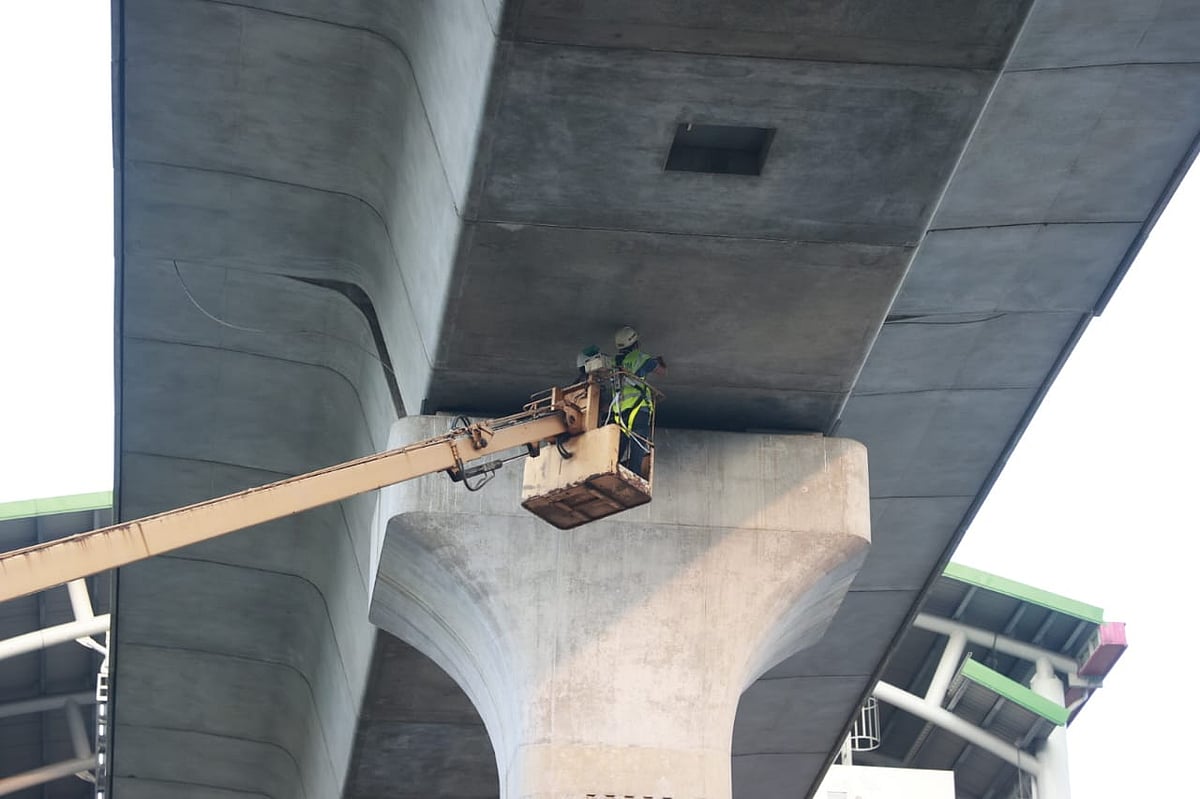
A bearing pad is a rectangular component made of layered rubber and steel—a kind of structural cushion that sits between the viaduct (the elevated concrete structure on which the tracks are laid) and the piers (the vertical pillars supporting the viaduct).
Because both the viaduct and the piers are made of concrete, direct contact between them could cause friction, wear, or displacement. The bearing pad absorbs vibration and allows limited movement due to temperature changes or train-induced forces, thereby maintaining the structural integrity and safety of the system.
According to the Dhaka Mass Transit Company Limited (DMTCL), a company that operates the metro rail, each span—i.e. the section of track between two piers—rests on four bearing pads, meaning every pier supports four of them. These pads are made of alternating layers of rubber and special-grade steel.
How could such a heavy pad fall off?
Unlike bolts or welded joints, bearing pads are not mechanically fastened. Instead, they remain fixed by the immense weight of the viaduct and the piers—each span weighs several hundred tonnes. That such a component could be ejected from its base is, therefore, highly unusual and alarming, according to engineers. Such an incident is also rare.
DMTCL officials suspect that design flaws might be responsible for this. The design and supervision of the metro rail infrastructure were handled by NKDM Association, a consortium of Japanese consulting firms.
These incidents risk undermining the public’s confidence in the metro rail—one of the few recent projects that had generated widespread optimism.Professor Shamsul Hoque of the Civil Engineering Department at BUET
Speaking about this, professor Shamsul Hoque of the Civil Engineering Department at BUET (Bangladesh University of Engineering and Technology) told Prothom Alo, “The bearing pad is essential for the structure’s stability and safety. But if it falls off and kills someone, that suggests there could be a design flaw. Japanese consultants were hired at great cost. Were there errors in their design?”
He added that train movement generates constant vibration and dynamic load, any engineer knows that. “Any structure with such vibration requires periodic inspection of nuts, bolts, and joints. Even if the bearing pad rests under pressure, there should have been an additional safeguard to prevent it from slipping out.”
Location and possible contributing factors
DMTCL officials note that the section where both incidents occurred features a sharp curve and a change in elevation—the line rises gradually from Bijoy Sarani (a two-storey station) to Farmgate and Karwan Bazar (three-storey stations).
Some engineers believe these structural transitions may have increased stress on the components. However, professor Shamsul Hoque disagrees. “Curves and gradients are normal engineering challenges. They are accounted for during design, often at higher cost. That was the case with metro rail too. Despite this, why should there be security risks? It is unacceptable.”
He also questioned why Japanese technology, known for “Six Sigma compliance”—meaning only one defect in a million—has experienced multiple failures in Dhaka, “An independent safety audit is essential.”
He also questioned why Japanese technology, known for “Six Sigma compliance”—meaning only one defect in a million—has experienced multiple failures in Dhaka, “An independent safety audit is essential.”
Was it the same location as last time?
No, according to DMTCL. The first incident occurred near Pier 430, while Sunday’s tragedy involved Pier 433, both near Farmgate.
DMTCL managing director Faruque Ahmed told Prothom Alo that an inquiry has been launched. “We’ll investigate why the bearing pad fell and whether negligence or design faults were involved. Nothing is being ruled out.”
A five-member committee, led by the bridge division secretary, has been formed to determine whether the incident resulted from sabotage or construction flaws, road transport and bridges adviser Fouzul Kabir Khan told the media.
Why the metro rail matters?
The metro rail currently operates from early morning until after 10:00 pm, carrying around 450,000 passengers daily. Any suspension immediately worsens Dhaka’s already severe traffic congestion and causes major public inconvenience.
After the 2023 incident, services were suspended for 11 hours. This time, operations from Agargaon to Uttara resumed after several hours, but DMTCL could not confirm when full service to Motijheel would restart.
Officials added that if the fallen bearing pad can be safely reinstalled, services may resume sooner; however, if a replacement is needed, it could take longer—and it is unclear whether spare pads are readily available.
A costly system under scrutiny
Bangladesh’s first metro rail began operations on 28 December 2022, initially between Uttara and Agargaon, later expanding to Motijheel by the end of 2023. Extension work up to Kamalapur is now underway.
Approved in 2012 at a cost of Tk 21,985 crore (219.85 billion), the project cost has since risen to Tk 33,472 crore (334.72 billion). The Japan International Cooperation Agency (JICA) provided loans totalling Tk 19,718 crore (197.18 billion). Each kilometre of metro line has cost roughly Tk 1,500 crore (15 billion)—among the highest rates globally.
Given this scale of investment, professor Shamsul Hoque remarked that such safety lapses are “deeply troubling”.
“These incidents risk undermining the public’s confidence in the metro rail—one of the few recent projects that had generated widespread optimism,” he added.