The Institute of Epidemiology, Disease Control and Research (IEDCR) has confirmed cases of whooping cough in the capital. Government officials say there is no reason to panic, as treatment for the disease is available in the country.
Amid the ongoing measles outbreak, fresh cases of whooping cough have now been detected.
Whooping cough is a respiratory tract infection. Public health experts say the disease is preventable through vaccination and that its detection has further exposed the gaps in children’s access to vaccines. They say the development is a sign that people’s immunity in the country is weakening.
IEDCR Director Professor Kazi Ahmed Zaki told Prothom Alo on Saturday that cases of whooping cough have been detected in the capital. Five patients had been identified so far, and they were receiving treatment.
According to 2024 data from the World Health Organization (WHO), there were no cases of whooping cough in Bangladesh in 2017. Three cases were detected in 2018, 12 in 2019 and one in 2020. No cases were recorded in the country from 2021 to 2023.
No specific information was available on whether any cases had been detected after that period. However, noting that Bangladesh had remained free of whooping cough for several years, epidemiologist and former IEDCR director Professor Mahmudur Rahman told Prothom Alo, “Just as the measles outbreak has occurred because children did not receive vaccines, whooping cough has returned for the same reason. We had feared that diseases such as whooping cough, diphtheria and tetanus might return. The detection of whooping cough has now confirmed those fears.”
Besides Professor Mahmudur Rahman, this correspondent spoke to officials from the IEDCR, the Expanded Programme on Immunisation (EPI), the Disease Control Branch of the Directorate General of Health Services (DGHS), the WHO office in Dhaka, as well as several public health experts and vaccine specialists on Saturday. All of them said the return of whooping cough was concerning.
What is whooping cough and what are its symptoms?
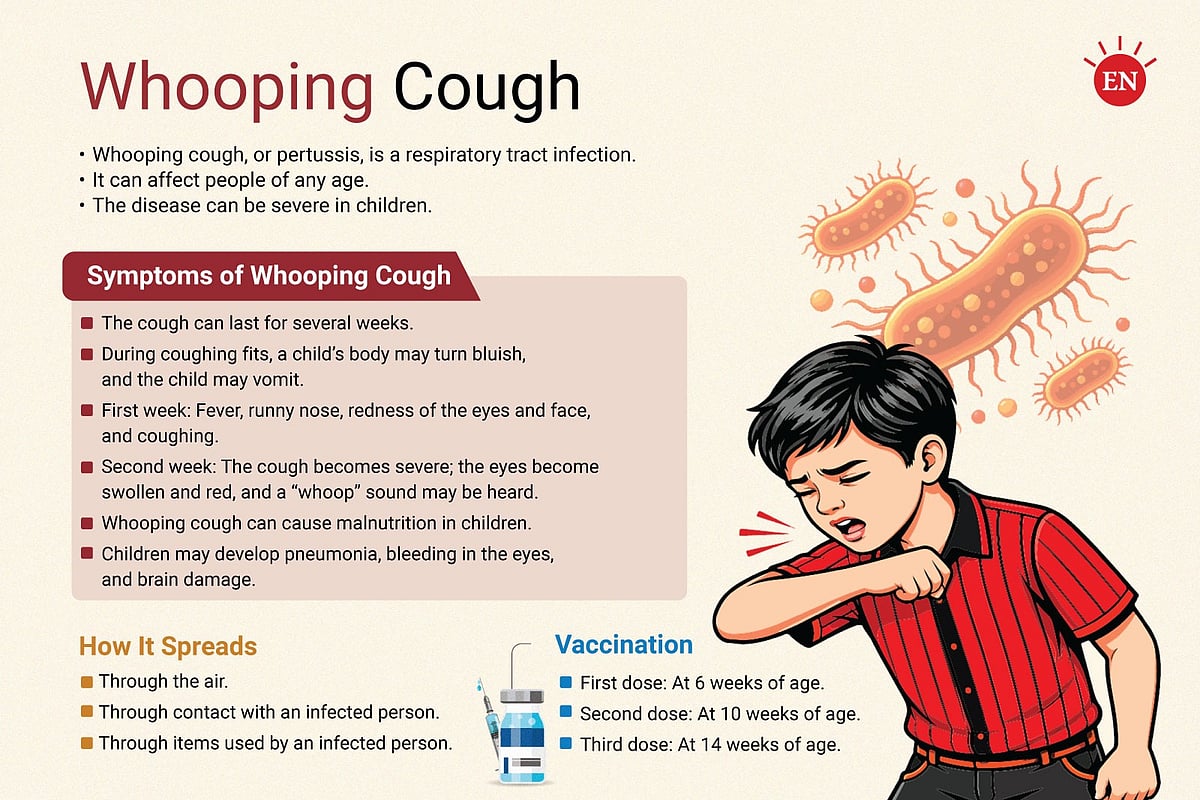
According to EPI documents, whooping cough is caused by an infection with a bacterium called Bordetella pertussis. The disease can affect people of any age, but it can be severe in children. The bacteria are present in the mouth, nose and throat of an infected person. The disease can cause coughing that lasts for several weeks. During coughing fits, a child’s body may turn bluish, and the child may vomit.
In the first week of whooping cough, patients develop a fever, have a runny nose, experience redness of the eyes and face, and begin coughing. In the second week, the cough becomes severe. The child experiences difficulty during coughing fits, the eyes become swollen and red, and the child makes a “whooping” sound while coughing. If a cough lasts for more than three weeks, whooping cough may be suspected.
One reason for concern is that whooping cough can leave children weak and malnourished. It can also cause pneumonia, bleeding in the eyes and brain damage.
Professor Halimur Rashid, director of the Disease Control Branch of the DGHS, told Prothom Alo that there was no reason to panic. Patients could be treated at all government hospitals. If a child shows symptoms of whooping cough, the child should be taken to a hospital.
The disease spreads through the air when an infected child sneezes or coughs. Its bacteria can also enter the body of a healthy child through contact with an infected child or even through items used by the infected child, such as towels and toys.
Prevention through vaccination
A vaccine is available to prevent whooping cough. However, it is administered along with vaccines for several other diseases. Children receive three doses of the pentavalent vaccine to protect against whooping cough, diphtheria, tetanus, hepatitis B and Haemophilus influenzae type b.
The first dose is given when a child is six weeks old, the second at 10 weeks and the third and final dose at 14 weeks. In other words, the vaccine is administered at intervals of four weeks. It is supposed to be injected into the front of the middle part of the child’s left thigh.
EPI field workers administer the pentavalent vaccine to children as part of the routine immunisation programme. Bangladesh has been providing the whooping cough vaccine since 1979.
The EPI’s latest assessment report on vaccine coverage was published in 2023. It showed that 99 per cent of children had received the first dose of the pentavalent vaccine, 98 per cent the second dose and 91 per cent the third dose. The report also showed that vaccination coverage was comparatively lower in urban areas.
The reality on the ground
Following the measles outbreak in March this year, it emerged that many children had not received the measles vaccine. Experts believe that the actual situation does not match the vaccination coverage figures presented on paper.
At a meeting held at the Prime Minister’s Office last Wednesday, public health and vaccine experts said there were flaws in the statistics on vaccination coverage.
Several reasons have been identified over the past nine months for children missing out on vaccines. These include a shortage of field-level vaccination workers, the suspension of vaccination programmes during the Covid-19 pandemic, people’s reluctance to get vaccinated, and several rounds of work stoppages by field workers in 2025 over various demands.
Measles was an early warning
A public health expert, speaking to Prothom Alo on condition of anonymity, said the measles outbreak was an indicator of what had happened to vaccination in Bangladesh and how vulnerable children in the country had become in terms of immunity.
The measles outbreak, the expert said, showed that more diseases could break out in the country, that there were major flaws in the health system, and that people had become vulnerable to diseases because of gaps in immunity.
Last month, a joint independent assessment by international and local experts warned that there could be outbreaks of whooping cough and diphtheria in Bangladesh.
Professor Abid Hossain Mollah, president of the National Immunisation Technical Advisory Group (NITAG) and a paediatrician, told Prothom Alo, “A few patients have been identified. The situation has not yet reached a point that warrants alarm. We must keep a close watch on the matter.”