Earthquake
Over 10m people felt strong shaking in Dhaka: USGS
Dhaka city shook with the intense tremor of the earthquake. The epicenter of this earthquake was in Madhabdi upazila of Narsingdi, 25 kilometers from Dhaka. The earthquake affected Dhaka and nearby districts as well.
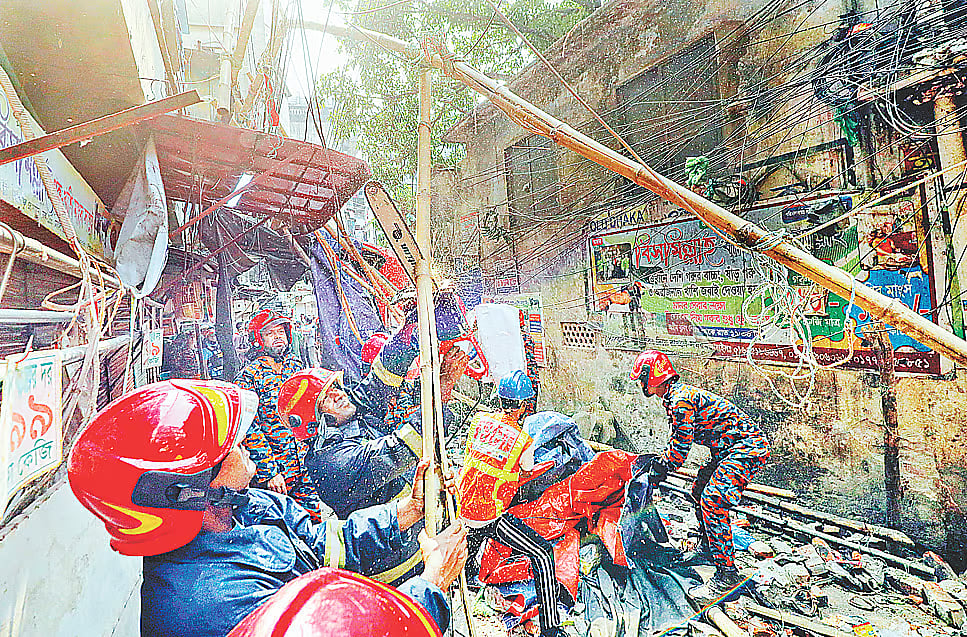
Due to the earthquake, walls collapsed in various places. Railings and parts of some buildings were seen falling off. Many people became sick out of fear. At least 10 deaths have been reported. Among them, 5 in Narsingdi, 4 in Dhaka, and 1 in Narayanganj. More than 600 people have been injured.
According to the Bangladesh Meteorological Department, the earthquake originated yesterday, Friday, at 10:38:26 AM in Madhabdi upazila of Narsingdi. Its magnitude on the Richter scale was 5.7. However, the US Geological Survey (USGS) says the magnitude was 5.5. Its origin was 10 kilometers deep below the surface.
Earthquake experts say this moderate 5.7-magnitude earthquake was unprecedented in terms of intensity in recent memory.
USGS says that although the northern and southeastern regions of Bangladesh are earthquake-prone, the central region remains relatively quiet. Since 1950 until now, there have been 14 earthquakes of magnitude 5.5 or higher within 250 kilometers of Dhaka—two of which were magnitude 6. And yesterday’s Madhabdi earthquake was only 25 kilometers from Dhaka.
When asked why the intensity of the earthquake felt so high, Mehedi Ahmed Ansary, professor of civil engineering at Bangladesh University of Engineering and Technology (BUET) and an earthquake expert, told Prothom Alo that this earthquake occurred very close to Dhaka. Earlier, no earthquake above magnitude 4 had occurred here.
Mehedi Ahmed Ansary said that earlier, in 2023, a 5.5-magnitude earthquake originated in Ramganj. That was about 200 kilometers from Dhaka. Compared with that, the distance between Dhaka and the epicenter of this earthquake is much shorter.
Many buildings developed cracks in this earthquake; several buildings and land areas subsided. In the past three decades, no earthquake has caused this type of damage. Though this earthquake was not catastrophic, the damage is considered significant.
Mehedi Ahmed Ansary said, “Major earthquakes tend to return every 150 years. From that perspective, the time for the return of 7-magnitude earthquakes has come. So after today’s (Friday’s) earthquake, everyone must remain aware and cautious.”
The Bangladesh Meteorological Department says that from 2015 to 2025—this one decade—20 earthquakes have struck Bangladesh. Among them, the second-highest magnitude earthquake occurred in Ramganj upazila of Lakshmipur on 2 December 2023. Its magnitude on the Richter scale was 5.5. The rest of the earthquakes averaged magnitude 4. The highest number—six earthquakes—struck Teknaf upazila of Cox’s Bazar.
Strong tremor felt in Dhaka
Yesterday, Friday, being a holiday, many people in Dhaka were at home in the morning. When the earthquake struck Narsingdi at 10:38 AM, its effects were felt in Dhaka and nearby districts.
Due to the strong tremor, many people in homes, hospitals, and multi-story markets in the capital rushed downstairs out of fear. They gathered in the alleys and roads in front of their residences. Some came down carrying sick people, others ran down with children in their arms. There is a shortage of open spaces in Dhaka. So even those who took shelter downstairs were anxious about whether any building might collapse.
Ashraful Alam, a resident of Niketan, told Prothom Alo, “I was sitting in a salon getting a haircut. Suddenly the chair was shaking so much that it felt like I would fall. Somehow I got out of the salon and stood on the street.” He said, this city is not safe at all. Even when people run outside to save their lives during an earthquake, they’re not safe there either. It’s a wonder how a city so unfit for living still continues to survive.
How intense was the tremor?
United States Geological Survey (USGS) has given an estimated calculation of how many people felt the tremor of this earthquake. Two and a half hours after the earthquake, the agency said that more than 70 million people felt a mild tremor. In addition, nearly 67.5 million more people felt a light shaking.
USGS has classified this earthquake in the orange category in terms of risk level. This means such an earthquake carries a notable risk of casualties. In terms of economic damage, it is categorised as yellow—meaning the risk is less than 1 per cent of Bangladesh’s GDP.
According to the agency’s estimates, more than 10 million people in Dhaka felt strong shaking. In the epicenter district Narsingdi, about 300,000 people felt high-intensity shaking.
The US agency has also provided data on the previous three earthquakes in Bangladesh on its website. It states that a magnitude-6 earthquake occurred on 30 December 1984, causing 20 deaths. A magnitude-5.2 earthquake on 22 July 1999 caused 6 deaths.
Greater risk in Dhaka’s low-lying areas
According to data from the “Urban Resilience” project conducted in 2024 by RAJUK with World Bank support, a 6.9-magnitude earthquake in Dhaka could collapse 864,000 buildings. Such an earthquake during the day could cause 220,000 deaths, and at night 320,000 deaths, according to the study.
Professor Akhtar Mahmud of Jahangirnagar University’s Department of Urban and Regional Planning believes the risk is greater in Dhaka’s low-lying areas.
He told Prothom Alo that from Old Dhaka to Tongi, and from there in a straight line to Madhupur’s red soil, the land is considered high ground. On the other hand, from east to west—from Progoti Sarani to the Balu River—is considered lowland. Since the 1990s, these lowlands have been filled with sand to build residential and commercial structures. In addition, Hazaribagh, Shaymoli, Dhaka Uddyan, Basila, Purbachal, and Uttara are also included among Dhaka’s lowlands.
He said that in a major earthquake, the buildings in these areas will be at greater risk than those in Dhaka’s elevated regions.