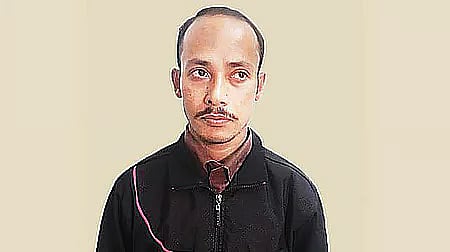
Badal Farazi, a Bangladeshi citizen who fell victim to a wrongful murder conviction and life imprisonment while visiting India, is being released on parole for four weeks.
Following his repatriation to Bangladesh under a prisoner exchange agreement, Badal Farazi had been held in domestic prisons. On 16 November, the Ministry of Home Affairs of Bangladesh granted his parole.
Badal Farazi has been released in accordance with clause 1(b) of the parole policy, which provides provisions for release through a special government decision.
He has been granted parole for four weeks. Prison authorities say the process of releasing him from Kashimpur High Security Central Jail in Gazipur is underway.
It is clear that Badal Farazi was arrested and wrongly convicted in the murder of an elderly woman in Delhi, India, due to a name mix-up. This is because he entered India two months and seven days after the murder took place.
On the other hand, human rights activists have said Indian police were looking for a man named ‘Badal Singh’, who worked as a domestic worker for the elderly woman who was killed. Due to the similarity in names, they arrested Badal Farazi.
Badal's father died while he was in prison. His mother, Shefali Begum, is now physically unable to move around.
Badal's sister, Aklema Begum, told Prothom Alo that they are waiting for his release. They hope he will not have to return to prison.
Badal Farazi's imprisonment has drawn attention in both Bangladesh and India. Prothom Alo has regularly published reports about him. Campaigns, including human chains, have been organised in both countries demanding his release.
A novel has also been written about his case. Published by Prothoma Prokashon, the novel is titled 'Badaler Karabas: Bhul Bichare 18 Bochor—Bharat theke Bangladesh' (Badal's Imprisonment: 18 Years of Wrongful Conviction—from India to Bangladesh). The author of the book is this reporter.
The efforts and movement for Badal's release in Bangladesh involved the Prochesta Foundation along with several journalists and lawyers. In India, human rights activist Rahul Kapoor and many others were involved.
Most recently, on 6 April, a human chain was formed in front of the National Press Club in the capital demanding Badal's release and urging a swift decision regarding his freedom.
How he ended up in prison
Badal's imprisonment began in 2008. On 6 May that year, 71-year-old Nirmala Madan was murdered at her home in Delhi. Police began searching for her domestic worker, a man named ‘Badal Singh’, in connection with the murder case.
Meanwhile, Badal Farazi travelled to India in July 2008 with plans to visit the Taj Mahal. The Indian High Commission in Dhaka had issued him a tourist visa. On 13 July that year, he entered India through the Benapole border and crossed into Haridaspur.
Soon afterwards, the Border Security Force (BSF) detained him. He was formally arrested in the murder case as ‘Badal Singh’ on 21 July.
Badal was 18 at the time and was a student. His family and human rights activists say he could not explain his identity because he did not know English or Hindi.
On 17 December 2012, the Bangladesh High Commission in New Delhi sent a letter to India's Ministry of External Affairs detailing Badal's passport and visa numbers, the date his visa was issued and his entry into India. His school authorities also issued a certificate in his favour. However, he was not released despite the submission of these documents and evidence.
On 21 July 2015, a Delhi court found Badal guilty. On 22 August that year, he was sentenced to life imprisonment. The Delhi High Court upheld the sentence the following year.
Imprisonment and campaigns for release
Badal spent nearly 10 years in Delhi's Tihar Jail. During his time there, he completed secondary, higher secondary and undergraduate studies. He was also involved in various activities in prison. Meanwhile, human rights activists in Delhi organised human chains and signature campaigns at different times demanding his release.
Under a prisoner exchange agreement, Badal was brought back to Bangladesh on 6 July 2018. The then home minister, Asaduzzaman Khan, had assured that efforts would be made to secure his release. However, after returning to Bangladesh, Badal was kept at Dhaka Central Jail in Keraniganj.
Prothom Alo published a report on 30 July 2022 titled ‘Prison sentence over, but no freedom for Badal Farazi’.
The report said a letter sent by the Department of Prisons to the prison directorate on 20 July 2022 stated that Badal had completed 14 years of his sentence on 20 July. It also noted that approval from the Indian government was required for his release after serving his sentence.
The government at the time, however, was uncertain about his release. Under Indian penal law, Badal's sentence was 14 years, while under Bangladesh's law, life imprisonment is 30 years. It was unclear which country's law would govern the execution of his sentence.
The Prothom Alo report also noted that the Home Ministry had written to the Indian government seeking information about Badal's release and recommending a remission of his sentence.
The then home minister, Asaduzzaman Khan, told Prothom Alo, “Even after knowing that the boy is innocent, we could not do anything. Because he was sentenced by an Indian court. Since he was sentenced by their court, he will be released in accordance with their law. However, we will take steps to expedite his release process.”
On 24 February 2019, Asif Nazrul, then professor of the Department of Law at Dhaka University and later law adviser to the former interim government, wrote a column in Prothom Alo titled ‘Badal othoba Badalder Golpo’, in which he raised demands for Badal's release.
Following the July Mass Uprising
After the July mass uprising in 2024, Badal Farazi was transferred to Kashimpur prison.
His family says efforts were made to secure his permanent release but they were unsuccessful. Documents show that Badal's release before the completion of his sentence was discussed at a meeting of Delhi government's Sentence Review Board on 23 February 2024. However, the board rejected the application.
Lawyers Sarthak Maggon, Vaibhav Bhardwaj and Ranjeet Kumar Sahu filed an application with the Delhi High Court seeking permission for Badal's parole under Indian law. On 29 September, the court said parole must be granted in accordance with the laws applicable in the relevant country.
Following the Indian court's order, the Ministry of Foreign Affairs sent a memorandum to the Home Ministry on 1 October. In response, the Home Ministry issued another memorandum on 11 October. Later, on 25 October, Badal's sister Aklema Begum applied for her brother's parole. The Law and Justice Division of the Law Ministry was subsequently consulted on the matter.
Finally, in a memorandum issued on 16 November by the Home Ministry's Prison-2 branch, the Gazipur deputy commissioner and district magistrate were requested to take the necessary steps to grant Badal Farazi four weeks of parole.
Mohammad Abdullah Al Mamun, senior jail superintendent of Kashimpur High Security Central Jail, told Prothom Alo that the process of Badal's release was underway.
‘His mother is waiting to see her son’
Badal Farazi went to prison at the age of 18. He is now 36.
After receiving the opportunity through the legal process, he called this reporter from prison on Wednesday and said, “After being released, I will go straight to my mother.”
Meanwhile, Badal's sister Aklema told Prothom Alo, “My mother is now waiting to see her son.”