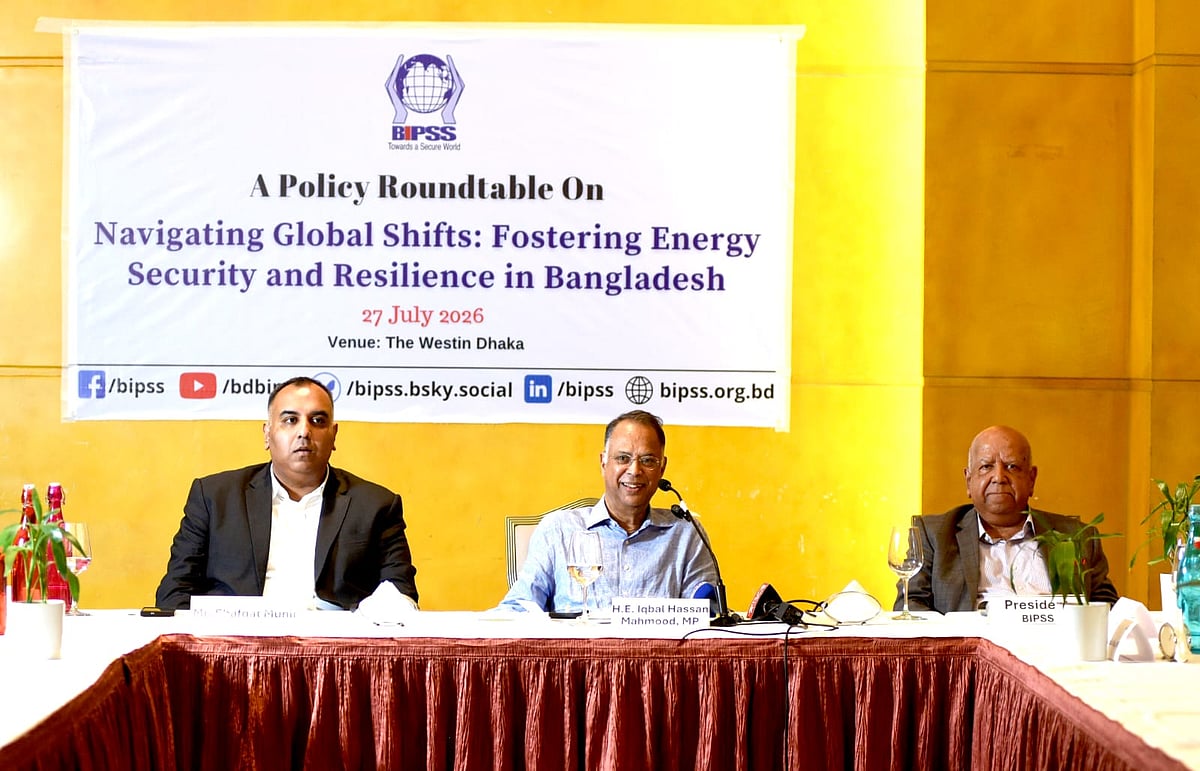
BIPSS roundtable
Focus on renewable energy to lessen pressure on fossil fuel: Iqbal Hassan Mahmood
There was a time when it had been said that Bangladesh was floating on gas. However, there has been no offshore gas exploration for the last 17 years. Today there is a gas shortage and liquefied natural gas is being imported. Fossil fuel is being imported. Over the last six months, a total of USD 6.65 million of fuel has been imported.
These observations were made by the Minister for Power, Energy and Mineral Resources, Iqbal Hassan Mahmood, at a roundtable held yesterday, Monday. The roundtable, 'Navigating Global Shifts: Fostering Energy Security and Resilience in Bangladesh,' was organised at a city hotel by Bangladesh Institute of Peace and Security Studies (BIPSS).
Among other issues, the crisis emerging from the situation at the Strait of Hormuz, has pushed prices of fuel up, putting pressure on the national exchequer. Bangladesh's energy sector also depends largely on coal which is being imported as a source of cheap power, he said.
He pointed to another disruption in import of LNG recently caused by a fire at one of the country's two Floating Storage and Regasification Units (FSRU). This will take about 15 days to repair, he said, adding that gas supply will restart within August.
"We have focussed on renewable energy," Minister Iqbal Hassan Mahmood went on to say, adding that the readymade garment industry should gradually turn more and more to renewable energy. He said they were eyeing the year 2030 as a target for the RMG sector to be using at least 30 per cent renewable energy.
The minister then went on to detail plans for rooftop solar power generation to reduce fossil fuel import and promote environment-friendly energy. A private-to-private arrangement, much in the manner of Wi-fi or cable services to households, is being considered. Another larger scale plan underway is for connecting solar-power generated energy to a grid. He said the government could provide land for investors to set up solar panels.
During an interactive session with the participants of the roundtable, the minister said that after time allowed for trial and error, they hoped that the Rooppur Nuclear Power Plant would be able to provide electricity by September or October this year. However, due to planning glitches made in the past, there remained a grid problem.
Coming to the point of gas exploration, he said BAPEX would be setting up two rigs for onshore exploration as it was not equipped to go to the sea. Talks were on with foreign companies regarding offshore gas exploration.
In reply to another question about loss and waste in the power sector, Iqbal Hassan Mahmood said, "Unfortunately wastage is a part of our history. It is simply theft." When he had been energy minister in a past term, he had reduced system loss from 12 per cent to 9 per cent. Now it is said to be 7 per cent, but he thinks it is probably more. "We are trying to rethink distribution. Distribution should not be the business of the government. The system loss would be much less if the distribution was privatised." He pointed to the examples of Kolkata and Mumbai where distribution had been privatised. In Delhi , system loss had been 22 per cent but was slashed to 4 per cent after distribution was handed over to the private sector, he said.
About further nuclear power plants, he said talks are on with UK, China and others in this regard. The government was considering small modular reactors (SMR) throughout the country. He said biodiesel was also being discussed.
He said that most importantly, the government was now taking tangible measures for energy security safeguards.
Speaking as moderator of the event, Maj. Gen. ANM Muniruzzaman (retd), President of BIPSS, said that while energy had traditionally be considered a utility, it was now linked to national security. Renewed tensions in the Middle East, Hormuz, Ukraine and other parts of the world had impacted the global supply chain. Natural gas reserves were depleting, climate change was effecting the overall situation and there was an increased pressure on energy consumption. This demanded a multi-pronged approach, including regional and sub-regional grids, a diverse energy system and other innovations. It was essential to insulate Bangladesh from external shocks.
Winding up the discussion, Shafqat Munir, Senior Research Fellow at BIPSS, said the energy sector was an integral part of national security. The stark reality was that renewable energy is a must. This called for regional partnerships and more. No single choke point could bring the sector to a halt. As electricity was the backbone of the economy, related infrastructure becomes the target. He concluded it was essential to look into the vulnerabilities of the sector as energy security was a vital pillar of overall national security.
The event was joined by distinguished participants, including diplomats, academicians, former civil and military bureaucrats, politicians, energy experts, journalists and more.