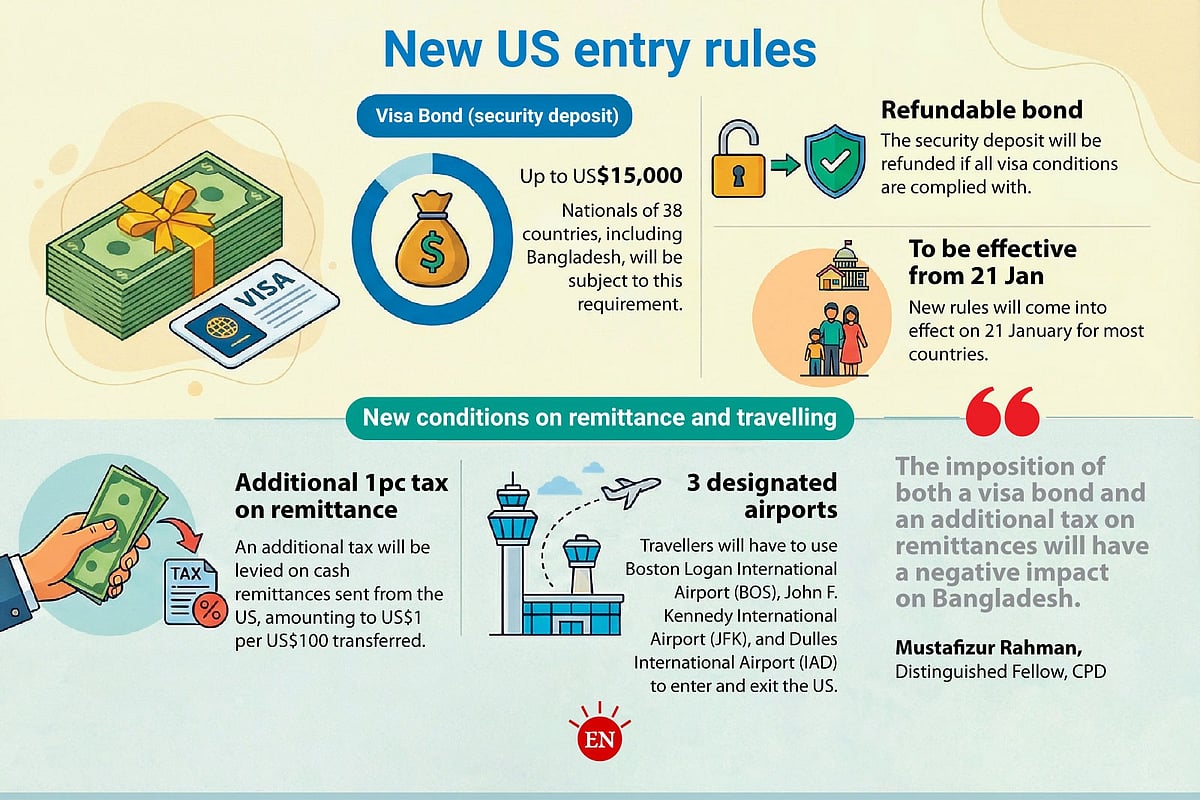
An announcement had already been made that, from the first day of the current year, an additional tax of US $1 per US $100 would be imposed on cash transactions for remittances sent from the United States to any country in the world.
Now, a further decision has been made requiring nationals of 38 countries, including Bangladesh, to provide a “visa bond” or security deposit of up to US $15,000 when applying to enter the country.
In addition, the bond conditions now include a requirement to use only three designated airports for travel to and from the US.
Diplomatic and economic analysts view the Trump administration’s tightening of rules on remittances, visas and travelling at the beginning of the new year as a fresh source of pressure for Bangladesh.
In their assessment, the additional tax on remittances will create an extra burden and may encourage the use of informal channels to send money to Bangladesh. Meanwhile, the requirement to provide a visa bond is likely to discourage Bangladeshis from travelling to the US.
However, former and serving diplomats note that, while president Donald Trump’s measures may be seen as a shock, they are not unexpected. During his election campaign, Trump repeatedly spoke of reducing the number of people travelling to the United States from various countries and of adopting a tougher stance on immigration.
These steps, therefore, should be viewed as the implementation of policies he had already announced, they said.
Diplomatic sources in both Dhaka and Washington also agree with this assessment.
According to information they have provided, the Trump administration has repeatedly signalled in recent days, both to Bangladesh and to other countries, that such measures were forthcoming.
In particular, the administration has taken a firm view of the practice of visa overstay in the United States. It has conveyed, through informal discussions, its intention to be stricter on this issue with Bangladesh and several other countries.
The US initially added six countries to the visa bond list in August last year. Subsequently, seven more countries were included. On Tuesday, a further 25 countries, including Bangladesh, were added.
Reference is also being made to a recent Trump administration list titled ‘Immigrant Welfare Recipient Rates by Country of Origin’ in connection with the visa bond decision.
On 4 January, president Donald Trump published a list showing which nationalities among immigrants in the US receive the highest levels of government welfare support.
He shared the list last Sunday on his social media platform, Truth Social. Among the 120 countries and regions listed, Bangladesh ranks 19th. The data indicate that 54.8 per cent of Bangladeshi immigrant households in the United States receive benefits from the US government.
Bangladesh on the visa bond list
The US department of state last Tuesday announced on its travel-related website that nationals of 38 countries must provide a visa bond of up to US $15,000 when applying to enter the United States. In Bangladeshi currency, this amounts to approximately Tk 1.835 million, calculated at an exchange rate of Tk 122.31 per US dollar.
The US initially added six countries to the visa bond list in August last year. Subsequently, seven more countries were included. On Tuesday, a further 25 countries, including Bangladesh, were added.
According to information published on the state department’s website, the bond requirement for most of the newly added countries will come into effect on 21 January.
Of the total 38 countries on the list, the majority are from Africa, although several countries from Latin America and Asia are also included. As a result of the new rules, obtaining a US visa will now become significantly more expensive for nationals of these countries. This represents the Trump administration’s latest move to further tighten already stringent entry restrictions.
The new tax on remittances and the visa bond will affect personal and family travel to the United States. They will create obstacles to normal contact and movement between the people of the two countries.M Humayun Kabir, former Bangladeshi ambassador to the US
Under the new rules, all US visa applicants will be required to attend an in-person interview.
US officials have endorsed the visa bond or security deposit requirement, which ranges from US $5,000 to US $15,000. They argue that the measure will play an effective role in ensuring that nationals of the listed countries do not overstay after their visa expires.
However, payment of the bond does not guarantee that a visa will be issued. If a visa application is refused, or if a visa holder fully complies with all visa conditions, the bond amount will be refunded.
The countries newly subject to the visa bond requirement are: Bangladesh, Algeria, Angola, Antigua and Barbuda, Benin, Burundi, Cape Verde, Cuba, Djibouti, Dominica, Fiji, Gabon, Cote d’Ivoire, Kyrgyzstan, Nepal, Nigeria, Senegal, Tajikistan, Togo, Tonga, Tuvalu, Uganda, Vanuatu, Venezuela and Zimbabwe.
Countries that were already on the list include Bhutan, Botswana, the Central African Republic, Gambia, Guinea, Guinea-Bissau, Malawi, Mauritania, Namibia, Sao Tome and Principe, Tanzania, Turkmenistan and Zambia.
The state department further stated on its website that individuals holding passports issued by these countries who are deemed eligible for a B1/B2 (tourism and business) visa must deposit a bond of US $5,000, US $10,000 or US $15,000. The amount of the bond will be determined at the time of the visa interview.
Applicants will also be required to submit Form I-352 of the US department of homeland security and agree to the bond terms through the US treasury department’s online payment platform, Pay.gov.
3 designated airports
The website specifies that visa holders must enter and depart the US through designated ports of entry. Failure to do so may result in denial of entry or the risk that departure records are not properly documented.
The designated airports are Boston Logan International Airport (BOS), John F. Kennedy International Airport (JFK) and Washington Dulles International Airport (IAD).
This is a direct blow to remittances. And the visa bond will not only discourage Bangladeshis from travelling to the United States, but will make it more difficult. I believe that both the tax on remittances and the visa bond will have a negative impact on Bangladesh.Mustafizur Rahman, distinguished fellow at the CPD
In August last year, US citizenship and immigration services (USCIS) updated its immigration policies as part of a broader effort to tighten immigration controls.
The updated policy notes that the Trump administration introduced social media screening in June 2024 as part of the visa application review process. This has since been expanded to include scrutiny for ‘anti-American activities’.
Speaking to Prothom Alo on Wednesday, former Bangladeshi ambassador to the US and president of the Bangladesh Enterprise Institute (BEI), M Humayun Kabir, said, “The visa bond is certainly not good news for us.”
Pointing out that the Trump administration has taken a number of initiatives to reduce or discourage immigration to the US, and this is one of them, he said, “As a result, the new tax on remittances and the visa bond will affect personal and family travel to the United States. They will create obstacles to normal contact and movement between the people of the two countries.”
The US visa bond programme, which is being implemented on a 12-month pilot basis, began on 20 August last year.
According to various government reports cited in a state department notice issued in August last year, data since 2000 show that many foreign nationals enter the United States on visas but have no recorded departure information. This indicates that every year thousands of non-immigrant visitor visa holders fail to leave the country within the stipulated period.
In a report submitted to Congress, the US homeland security department stated that in fiscal year 2023, approximately 39 million visa holders were expected to depart the country, yet around 400,000 people remained in the US after their visas had expired.
Analysts believe that these factors may have influenced the decision to introduce the visa bond. In their view, president Trump’s measures have delivered a jolt at the level of ordinary people.
Mustafizur Rahman, distinguished fellow at the Centre for Policy Dialogue (CPD), told Prothom Alo that the additional tax on cash remittances could increase the tendency to send migrant income through informal channels.
“This is a direct blow to remittances,” he said. “And the visa bond will not only discourage Bangladeshis from travelling to the United States, but will make it more difficult. I believe that both the tax on remittances and the visa bond will have a negative impact on Bangladesh.”