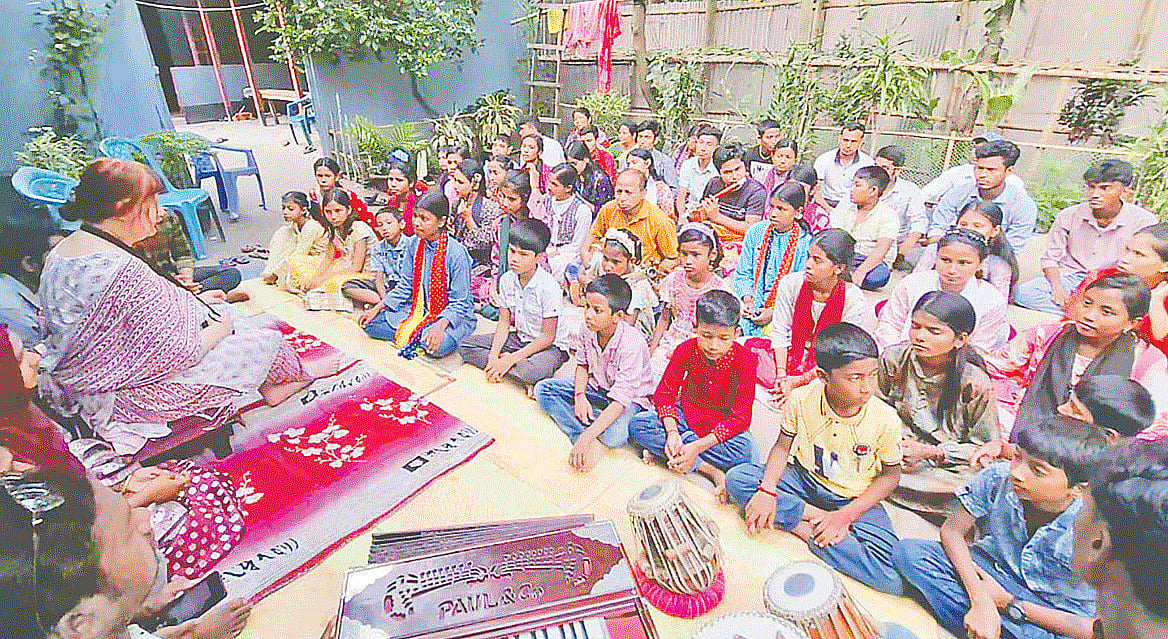
A Norwegian poet’s folk music school in the chars of Kurigram
Wera Sæther, 80, a Norwegian poet and researcher, first came to Bangladesh nearly three decades ago. During that visit, she travelled to Uttar Namazir Char in Roumari upazila of Kurigram to see how people affected by floods lived. The melody of the songs sung by the women of the char (river island) moved her deeply. She fell in love with the folk music of Bengal.
Over the years, her affection for Bangla folk songs has only grown stronger. Wera Sæther has even translated the songs of the mystic bard Fakir Lalon Shah into Norwegian. To spread the beauty of Bengali folk music among younger generations, she founded a cultural organisation called ‘Mayer Tori’ (Mother’s Boat) in 2016.
Wera Sæther believed that in turbulent times, folk music has the power to make people calm and humane again. This idea inspired her to establish Mayer Tori.
Mayer Tori now runs nine learning centres across Kurigram and Lalmonirhat, teaching around 600 children traditional folk songs and instruments. The children learn different genres of folk songs such as Lalon, Baul, Marfati, Murshidi, and Bhawaiya, alongside instruments including the flute, ektara, dotara, tabla, violin, and dhol.
Melody and rhythm flow through the Char
Wera Sæther believed that in turbulent times, folk music has the power to make people calm and humane again. This idea inspired her to establish Mayer Tori. To see its activities, this correspondent visited the organisation’s main training centre at Shitolirpath village in Chinai union of Rajarhat upazila in Kurigram.
At dawn on Saturday (18 October), children from Shitolirpath village were seen hurrying towards the training centre, carrying ektaras in hand. From a distance, one could hear the familiar tune rising from Mayer Tori’s ‘Gurugriha’ (house of learning), “Manush Bhojle Shonar Manush Hobi” (Worship humanity, and you’ll become a golden-hearted human).
Both of my daughters learn music at Mayer Tori. My elder daughter also plays instruments and has been invited to perform folk songs on Rangpur Radio. Without this centre, she would never have had such an opportunity.Aduri Rani, mother of two students
Inside, some children were singing while others practised playing instruments. The rhythm on the harmonium and tabla was led by the teacher, Narayan Chandra Roy, and his assistants.
Narayan Chandra Roy explained, “Here, children from marginalised families in Shitolirpath and nearby villages learn folk music and instruments free of cost. Many of our students now study music at different universities across the country. Children living in cities have access to music schools, but those in remote chars do not have that scope. Mayer Tori is bringing music, rhythm, and culture into their lives.”
How Wera found her way to Bengal
Yusuf Alamgir, the coordinator of Mayer Tori, shared the story of how Norwegian writer and photographer Wera Sæther became connected with the people of Bangladesh.
He said, “Wera first came to Bangladesh in 1998. During a visit to a flood-affected char in Kurigram, she heard women singing Marfati and Murshidi songs. Though she didn’t understand the lyrics, the melodies touched her soul. Captivated by those tunes, she fell in love with Bangla folk music. Later, with the help of local artists and organisers, she established Mayer Tori in 2016.”
Wera’s love for folk music also led her to translate 53 of Lalon’s songs into Norwegian, which were later published in a book. Eventually, she created Mayer Tori to bring the gift of folk music to the children living on the char.
Folk music isn’t just music, it’s a form of spiritual practice. It connects people to nature and nurtures humanity. I truly believe that folk music can be a cure for the restlessness of our times.Wera Sæther, Norwegian poet and researcher
Speaking over WhatsApp through Mayer Tori’s director, Sujan Kumar Bedey, Wera said, “Translating Lalon’s songs was not easy. They are filled with spirituality, love for humanity, and social critique. But, I wanted Norwegians to understand how deeply humanistic the music of Bengal is.”
“Today inner peace is rare and people keep running without knowing where they’re going. Folk music isn’t just music, it’s a form of spiritual practice. It connects people to nature and nurtures humanity. I truly believe that folk music can be a cure for the restlessness of our times,” added Wera, a professional psychologist.
“Worship humanity”
Mayer Tori works with local schools and cultural institutions in the chars. For children, it has designed a special Folk Music Learning Programme. Under this programme, local artistes teach singing and instrument playing at the Gurugriha every Friday and Saturday.
Mamtazul Haque, a teacher at a local school, said, “This initiative has helped people in the char rediscover pride in their own culture. Our children are learning that folk music isn’t something outdated or trivial, it’s the language of our soul.”
For people in these remote chars, the idea that their children could learn music was once unimaginable. Wera Sæther’s initiative has turned that dream into reality. Aduri Rani, a resident of Chinai union, expressed her gratitude, saying that both her daughters learn music at Mayer Tori.
“My elder daughter also plays instruments and has been invited to perform folk songs on Rangpur Radio. Without this centre, she would never have had such an opportunity,” added Aduri Rani.
Lalon said, “Manush Bhojle Shonar Mnush Hobi” (Worship humanity, and you’ll become a golden-hearted human). To become that ‘golden-hearted human’ is the greatest responsibility of all, said organiser Yusuf Alamgir. In his words, “If people learn to love nature, they also learn to love one another. Our work is to restore that love, and that’s exactly what Mayer Tori continues to do.”