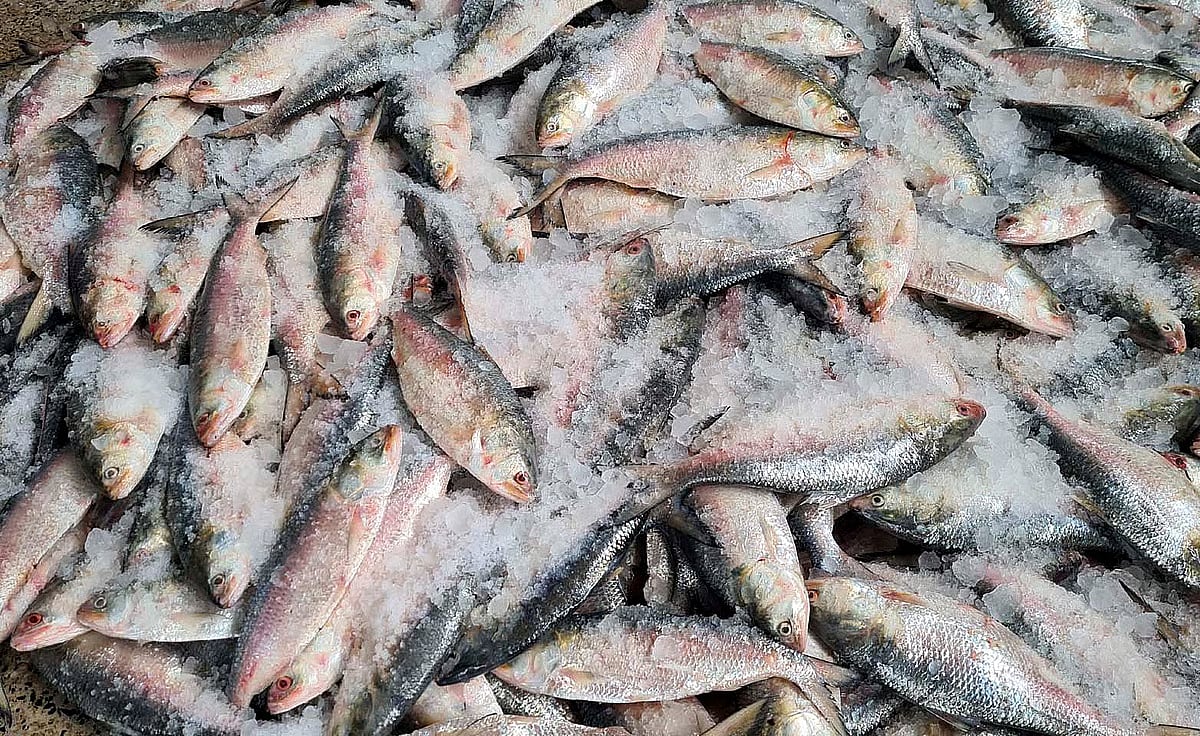
'Where have all the hilsa gone?'
Last Saturday, nearly 700 fishing trawlers laid moored side by side at Jetty no. 6 on the banks of the Bakkhali River in Cox’s Bazar town. Four fishermen- Nur Hasan, Abu Taiyab Majhi, Md Shafi, and Abdul Qayyum Majhi sat chatting idly inside one of them.
Each of them has between eight and twelve years of experience catching hilsa. But now, they say, there are simply no hilsa in the sea.
Even three years ago, a net cast into the Bay of Bengal would bring in hilsa by the shoal, they said. The money earned from selling those hilsa ran their households and paid for their children’s education. Now the hilsa are gone, and they can barely keep their families fed. Where have all the hilsa suddenly disappeared, question the fishermen.
Researchers say climate change has altered the rainfall patterns at sea and is causing frequent depressions there. As a result, there’s no hilsa in the sea like before. Fishermen from the Bakkhali River in Cox’s Bazar report that hilsa have been gradually declining for the past several years.
Empty nets, soaring prices
Further to north of the jetty, stands the Nuniachhara Fishery Ghat and the fish landing station for wholesale. About six to seven trawlers returning from the deep sea anchored there around 11:00 am with meager catch.
Two trawlers hauled in just 70 to 130 hilsa, each weighing 800–900 grams. Buyers paid Tk 2,300 per kilo for those hilsa on wholesale, with retail prices reaching Tk 2,500–2,800 in local Bahrcchara and Kanayar Bazar markets.
Sajibul Islam, the 52-year-old captain of one of those trawlers sighed, “I’ve never seen this in my 14 years of fishing hilsa in the sea. The sea is plagued by frequent depressions with two already in this September and six in August. But, there’s hardly any rainfall.”
Going to the fish landing station that afternoon, the pontoons were found empty. Traders said only two maunds of hilsa (about 80 kg) had been brought for sales between 7:00 am and 10:00 am.
Fishermen in despair
At the jetty, fisherman Nur Hasan sat idly. His home is in Khurushkul village of Cox’s Bazar Sadar upazila. At home waits his wife, along with his mother and three children. With no money in hand, he cannot return home. Meanwhile, the family survives on loans.
Nur Hasan, 37, said, “It’s supposed to be peak hilsa season now. But there seems to be no hilsa anywhere in the Bay of Bengal.” Over the past three months, he and 20 of his fellow fishermen have gone to the sea at least 10 times with their trawler. Each time they returned with only 100 to 200 hilsa.
A single trip lasts five to seven days, during which fuel and food expenses come to about Tk 400,000 (Tk 4 lakh). But the catch sells for only around Tk 100,000 (Tk 1 lakh). With there being no hilsa to catch, despair hangs heavy over the fishing villages. Some 70 per cent of fishing families are struggling to manage even one square meal a day.
Several trawler owners and fishermen reported that the presence of local and foreign trawling ships in deep waters has increased recently. Indiscriminate fishing with trawling nets, banned current nets and behendi nets, along with frequent depressions, may all be contributing factors.
Climate change and overfishing
Researchers say climate change has altered the rainfall patterns at sea and is causing frequent depressions there. As a result, there’s no hilsa in the sea like before. Fishermen from the Bakkhali River in Cox’s Bazar report that hilsa have been gradually declining for the past several years.
A fisherman from there, Md Shafi, 40, said that about two years ago his trawler netted hilsa worth Tk 2.5 million (Tk 25 lakh) in a single seven-day trip. Since then, he has never caught hilsa worth more than Tk 300,000 (Tk 3 lakh) in one go.
When the hilsa catch is plentiful, both the trawler owners and the fishermen profit. But when they are not, voyages end in losses and trawlers stay docked. This means fishermen’s incomes are declining every year, added he.
According to Md Delwar Hossain, general secretary of the Cox’s Bazar Fishing Boat Owners’ Association, there are more than 5,000 trawlers catching hilsa and other marine fish in the district’s Teknaf, Maheshkhali, Kutubdia, Sadar, Pekua and Chakaria upazilas.
The number of fishermen employed here is around 120,000 (1.2 lakh). But for the past six to seven months, catches have been very poor. Delwar said there should be research into why the reserve of hilsa in the Bay of Bengal is declining day by day.
Several trawler owners and fishermen reported that the presence of local and foreign trawling ships in deep waters has increased recently. Indiscriminate fishing with trawling nets, banned current nets and behendi nets, along with frequent depressions, may all be contributing factors.
Hilsa harvest declining
Figures from the Cox’s Bazar Fish Landing Centre show hilsa harvest is falling steadily. In the 2022-23 fiscal year, total 3,975 metric tonnes of hilsa were sold at the fish landing centre.
In 2023-24 it was 2,556 metric tonnes, and in 2024-25 it just 1,628 metric tonnes. Now, only 267 metric tonnes of hilsa have been sold in the first two months up to August in the current 2025-26 fiscal year.
Md Golam Rabbani, marketing officer at the fish landing centre, said that the decline in hilsa catches is also reducing government revenue. Besides the main fishery ghat, there are several other hilsa sales centres in Teknaf, Saint Martin’s island, Chakaria, Kutubdia, and Maheshkhali. The sales are very low there as well.
According to the District Fisheries Office, hilsa production in the district was 39,314 metric tonnes last year. This year, the target has been set at 45,000 metric tonnes.