The reciprocal trade agreement signed with the United States will lead to revenue losses for Bangladesh, force it to purchase goods at higher prices, compel it to align policies with US demands, and oblige it to comply with numerous mandatory conditions.
In contrast, the agreement will expand US trade, enable Washington to steer Bangladesh’s policies in line with its own geopolitical strategy, and require the United States to offer little in return. Overall, Bangladesh stands to gain very little from the deal, while the potential losses are significantly greater.
The reciprocal trade agreement between the United States and Bangladesh (Agreement on Reciprocal Trade—ART) was signed on 9 February, just three days before the national election. At the time, an interim government led by Dr Muhammad Yunus was in office; a new government headed by Tarique Rahman was formed on 17 February.
On 20 February, the US Supreme Court struck down the reciprocal tariff measures. These tariffs had been imposed under the International Emergency Economic Powers Act (IEEPA), a law typically used to address urgent national security threats such as terrorism, sanctions, and wartime situations.
The Court ruled that the US President had exceeded legal authority in imposing the tariffs, stating that a trade deficit cannot be treated as a national emergency to justify such measures. The power to impose tariffs, it noted, primarily rests with Congress.
Following the Supreme Court ruling, President Trump first imposed a 10 per cent tariff and then raised it to 15 per cent the next day. This was done under the Trade Act of 1974, which allows temporary additional tariffs of up to 15 per cent on imports in emergency situations. However, such measures can remain in effect for a maximum of 150 days, after which congressional approval is required.
Although the US Supreme Court annulled the reciprocal tariffs, Bangladesh had already entered into a separate agreement with the United States. However, the agreement has not yet come into force. This is because it stipulates that both parties must formally notify each other in writing once their respective legal procedures are complete; the agreement will take effect 60 days thereafter. The parties may also agree on an alternative date. In other words, the legal formalities required for implementation are still pending and have yet to be finalised.
Questions have been raised over why the agreement was signed just ahead of the national election. There is also ongoing debate over its one-sided obligations. Moreover, procurement deals are already being pursued even before the agreement has come into force.
For these reasons, various political parties and organisations are calling for the agreement to be scrapped, while economists argue that a more acceptable outcome should be negotiated through further discussions with the United States.
Procurement commitments under the agreement
The final section of the main agreement deals with various commercial matters. At its core are procurement commitments—and these commitments are made by Bangladesh. In other words, to keep the agreement in force, Bangladesh is obliged to purchase a number of specified goods. As outlined in the agreement:
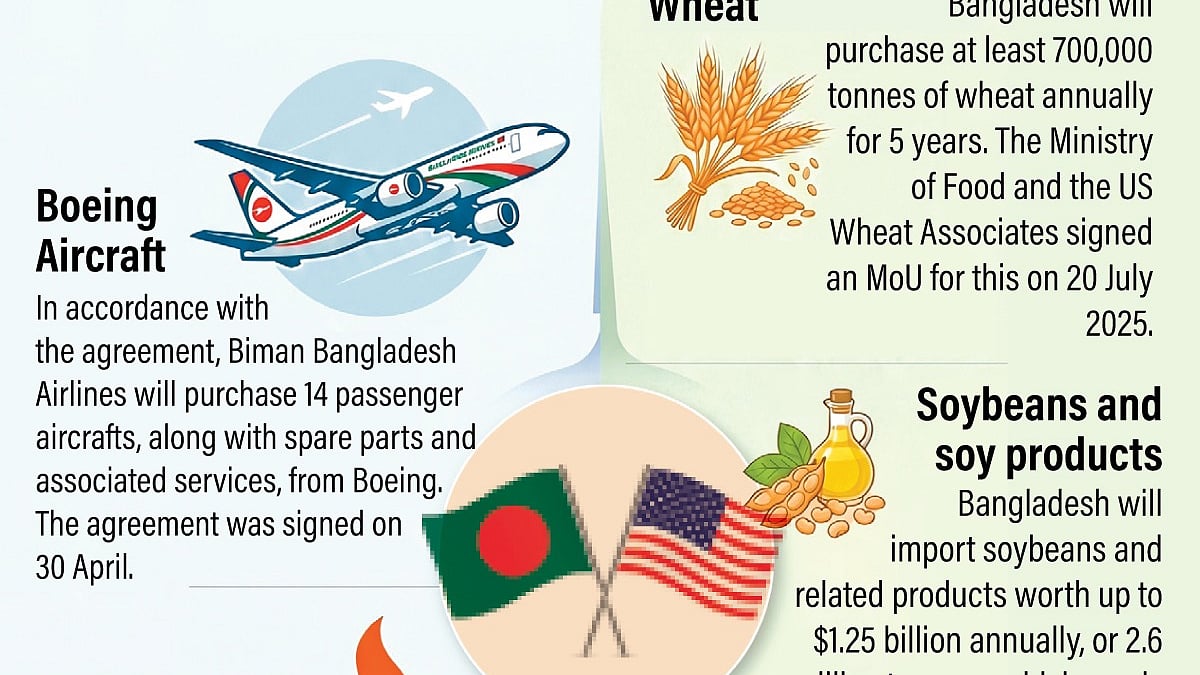
1. The state-owned carrier Biman Bangladesh Airlines will purchase more passenger aircraft, parts, and services from the United States. It has indicated plans to buy 14 Boeing aircraft and will also keep the option open for additional purchases.
2. Bangladesh will assist domestic companies in importing energy from the United States, including liquefied natural gas (LNG). This will involve long-term purchase agreements. The estimated value over 15 years is around $15 billion.
3. Bangladesh will support local companies in purchasing US agricultural products, including wheat, soybeans, soy-based products, and cotton. It will import at least 700,000 metric tonnes of wheat annually for five years.
For soybeans and related products, Bangladesh must import either a minimum of 2.6 million metric tonnes annually or goods worth at least $1.25 billion—whichever is lower. The total estimated value of these agricultural imports is about $3.5 billion.
4. Bangladesh will increase its purchases of US military equipment, while also reducing procurement from certain other countries.
5. Within six months of the agreement coming into force, Bangladesh will notify the World Trade Organization (WTO) of all subsidies it provides domestically.
Higher-cost imports
Under the agreement, Bangladesh will need to import 700,000 tonnes of wheat annually and either $1.25 billion worth or 2.6 million tonnes of soybean products each year over the next five years.
The total cost of these agricultural imports alone could reach approximately $3.5 billion annually. Currently, Bangladesh imports less than $1 billion worth of such products from the United States each year.
In addition, the agreement includes commitments to import LNG, purchase 14 Boeing aircraft, and acquire US military equipment, while limiting purchases from certain other countries.
Bangladesh currently sources wheat, soybeans, LNG, and cotton from other countries because they are comparatively cheaper and quicker to obtain. Importing from the United States may involve higher costs and longer delivery times. If the government procures these goods at higher prices, the additional burden will ultimately fall on taxpayers. Moreover, encouraging the private sector to import from the United States may require government incentives or subsidies.
As a result, the obligation to import roughly $3.5 billion worth of agricultural goods annually and $15 billion worth of energy over 15 years could create significant financial pressure on Bangladesh.
The agreement also contains an inherent contradiction: while it discourages state subsidies that distort competition, Bangladesh may need to provide subsidies to make US products competitive in its domestic market.
Procurement before the deal coming into effect
Even though the agreement has not yet formally come into force, Bangladesh has already signed separate deals for purchases. Several of these agreements and memorandums of understanding were concluded during the tenure of the former interim government, while the Boeing aircraft deal was finalised under the BNP-led government.
The trade agreement itself includes a commitment to purchase 14 Boeing aircraft. On 30 April, Biman Bangladesh Airlines signed a deal to acquire these 14 aircraft at a cost of $3.7 billion (approximately Tk 454.08 crore). In a report published the same day, Reuters described the move as a shift away from Europe’s Airbus towards Boeing, driven by trade pressure from Washington.
It is worth noting that under the previous Awami League government, a policy decision had been taken in 2023 to purchase 10 Airbus aircraft from France. However, following the fall of Sheikh Hasina’s government during the mass uprising of 2024, and amid strategic pressure to reduce the trade gap with the United States, the interim government opted in favour of Boeing. The deal was ultimately signed under the current BNP government.
Earlier, on 20 July 2025, Bangladesh signed an agreement to import wheat from the United States. Under a memorandum of understanding between the Ministry of Food and US Wheat Associates, Bangladesh will import 700,000 tonnes of wheat annually from the United States over the next five years—exactly the same provision later included in the main trade agreement, which was signed more than six months afterward.
Bangladesh imports around 7 million tonnes of wheat annually, most of which comes from the Black Sea region—primarily Russia and Ukraine—due to lower prices. Imports from the United States have so far remained limited.
On 4 November 2025, five Bangladeshi private companies signed agreements to import $1.25 billion worth of soybeans and soybean meal from the United States within a year. The deal was concluded with the United States Soybean Export Council, with the stated aim of helping reduce the roughly $6 billion trade deficit between the two countries.
An agreement to import liquefied natural gas (LNG) from the United States was also signed on 24 January 2025. On that day in Washington, Bangladesh and the US company Argent LNG entered into a preliminary agreement to supply up to 5 million tonnes of LNG annually. The import of LNG was later incorporated into the main trade agreement.
Costs and benefits for Bangladesh
Economists say the overall economic impact of this reciprocal tariff agreement between Bangladesh and the United States is mulTicfaceted. In a competitive market, decisions about sourcing energy, aircraft, or agricultural products are typically based on price, logistics, and long-term supply security. However, under this agreement, Bangladesh is required to procure such goods from the United States.
When a country is obliged to purchase fixed quantities from a specific supplier, it often raises production costs in domestic industries and deprives the government of the ability to procure goods at competitive prices. These commitments may also affect Bangladesh’s relations with its existing supplier countries.
Several provisions in the agreement extend beyond trade policy and could influence Bangladesh’s foreign policy and strategic autonomy. Decisions such as entering into free trade or digital trade agreements with other countries, or sourcing nuclear technology and energy, will need to take US interests into account.
At the same time, conditions related to technology transfer, source code, state subsidies, and disclosure of subsidy data could constrain Bangladesh’s policy-making independence.
Another area of concern is the intellectual property provisions in the agreement. The requirement to join 12 international treaties may limit small farmers’ ability to save and exchange seeds, potentially increasing production costs. In the pharmaceutical sector, additional requirements related to FDA approvals and patents could put pressure on the generic drug industry.
These conditions may also reduce the benefits Bangladesh currently enjoys as a least developed country (LDC). Notably, Bangladesh’s LDC status does not appear to have been adequately considered at the time the agreement was concluded.
In conflict with WTO rules
The United States’ reciprocal tariffs conflict with the rules-based trading system of the World Trade Organization (WTO). Under the Most Favoured Nation (MFN) principle, the same tariff rate should apply to the same product for all countries. However, the US has imposed additional tariffs that vary by country.
The MFN principle is a fundamental WTO rule, meaning that any tariff or advantage granted to one country must be extended to all WTO members for the same product.
Experts argue that the basis for the US reciprocal tariffs is weak. The calculation considers only the trade deficit in goods, while ignoring the large US surplus in services trade. The United States earns substantial global revenue from technology, financial services, intellectual property, and digital sectors.
For example, in December 2025, the US goods trade deficit stood at $99.3 billion, but it recorded a $29 billion surplus in services. Therefore, judging a country as an unfair beneficiary based solely on goods trade is economically one-sided.
Despite the inconsistency of these tariffs with WTO rules, the agreement requires Bangladesh to support the US position at the WTO. For instance, Bangladesh is asked to support the proposal for a permanent moratorium on tariffs on electronic transmissions—something that may run counter to Bangladesh’s own interests. Bangladesh is also required to implement agreements on fisheries subsidies and trade facilitation, yet its special privileges as a least developed country (LDC) and developing country remain unclear.
Under the agreement, Bangladesh is effectively granting duty-free access to most US products, while the United States is not offering equivalent concessions. This could prompt other countries to demand similar treatment, and if denied, Bangladesh may face allegations of violating the WTO’s MFN principle.
Widening tariff gap
According to the agreement, US reciprocal tariffs on Bangladeshi goods will be set at 19 per cent. In many cases, this will be added on top of existing MFN tariffs. Excluding products exempted from reciprocal tariffs, the weighted average tariff on Bangladeshi exports to the US could rise to around 34 per cent—comprising roughly 15 per cent MFN tariffs and 19 per cent reciprocal tariffs. This means Bangladeshi exports will face higher overall tariff barriers in the US market.
In contrast, the average import tariff on US goods in Bangladesh currently stands at about 6.2 per cent. After accounting for tax concessions, the effective average tariff is around 2.2 per cent. Once the new agreement is fully implemented, tariffs on most US goods are expected to fall close to zero. As a result, the tariff disparity between the two countries will widen significantly.
Revenue losses for Bangladesh
Under the agreement, Bangladesh will gradually reduce or eliminate tariffs on a wide range of US products. Five categories have been defined for this purpose. For example, products in the EIF category will become duty-free from the very first day of implementation. In the B-5 category, tariffs will be cut by half initially, with the remaining portion phased out over five years. In the B-10 category, tariffs will similarly be reduced by half at the outset and then eliminated over ten years. Products that are already duty-free will remain so, while items in the X category will see no concessions and will continue under existing MFN rates.
According to a study by Professor Mustafizur Rahman, distinguished fellow at the Centre for Policy Dialogue (CPD), Bangladesh will remove MFN tariffs on 7,132 tariff lines of US products over the next ten years. Of these, 4,922 items will become duty-free immediately upon implementation, while another 2,210 items will see tariffs eliminated within five to ten years.
A significant portion of these concessions will take effect right away. This means Bangladesh will begin losing revenue from the outset, as tariffs on many US products are reduced or eliminated. Only 326 US products will remain outside the duty-free list, but Bangladesh currently imports very little of these items.
On the other hand, the United States has excluded 1,638 Bangladeshi tariff lines from reciprocal tariffs. However, MFN tariffs will still apply to these products, and their commercial value for Bangladesh is limited.
Currently, Bangladesh exports only 10 to 15 of these items in small quantities. The country’s main export products—especially garments—do not benefit significantly from this list.
In the 2024–25 fiscal year, the United States collected approximately $1.24 billion in tariffs on Bangladeshi goods. In contrast, Bangladesh collected about $180 million in tariffs on US products—meaning US tariff revenue was nearly six times higher.
With the new agreement in place, US tariff revenue on Bangladeshi exports could rise from $1.24 billion to around $2.85 billion. Meanwhile, Bangladesh’s tariff revenue from US imports—currently about $180 million—is expected to fall close to zero.
Impact on the garment sector
Under the agreement, certain garments made from US cotton and man-made fibres will be exempt from reciprocal tariffs. However, the existing MFN tariff—around 16 per cent—will still apply.
Currently, about 40 per cent of Bangladesh’s cotton imports come from African countries, around 25 per cent from Brazil, and 15 per cent from India.
Only about 7 per cent comes from the United States, where cotton is 10 to 20 pe rcent more expensive, in addition to higher transport costs. Approximately 19 per cent of Bangladesh’s total garment exports go to the US market.
The agreement states that “certain specified textile and apparel products” imported from Bangladesh will not be subject to additional tariffs, but only up to a “quantity to be determined later.”
Therefore, the actual benefit to the garment sector will ultimately depend on unilateral decisions by the United States. Even where concessions are granted, most of these products are unlikely to become fully duty-free.
Three Pressure Points from the United States
Throughout the agreement, the United States has effectively issued three warnings: if Bangladesh fails to comply with certain conditions, Washington may revoke the deal and reinstate higher tariffs.
The first warning concerns digital trade and technology. Bangladesh cannot enter into digital trade agreements with other countries—especially those that may affect US interests—without prior consultation. If US concerns are not addressed, it reserves the right to withdraw from the agreement.
The second warning relates to agreements with so-called non-market economies. If Bangladesh signs trade deals with countries where prices are not fully determined by market forces—and if such deals weaken the US agreement—Washington may terminate the pact.
The US Department of Commerce lists countries such as China, Russia, Vietnam, and others in this category. This raises a broader question: does Bangladesh now need US approval for certain strategic trade decisions, such as energy imports?
The agreement also includes a clause restricting Bangladesh from purchasing nuclear reactors, fuel rods, or enriched uranium from countries deemed to threaten US interests—unless no alternative suppliers exist or prior agreements are already in place.
The third warning is broader. Even with the agreement in place, the United States can impose additional tariffs citing unfair trade practices, sudden import surges, or national security concerns. If Bangladesh is deemed non-compliant, previously imposed reciprocal tariffs can be reinstated.
Thus, it appears that the trade agreement could limit Bangladesh’s ability to make sovereign decisions on trade. For instance, if Bangladesh seeks to expand its Russia-assisted nuclear power projects in the future, procuring reactors from Russia may come under US scrutiny. Similar complications could arise in relation to China. Yet China remains Bangladesh’s largest source of imports, with the private sector relying on it for relatively cheaper, competitive, and faster supplies.
How other countries compare
The United States announced reciprocal tariffs on 57 countries and regions, but signed separate agreements with only nine, including Bangladesh, Malaysia, Cambodia, Argentina, Taiwan, Indonesia, and Ecuador.
Comparatively, Bangladesh’s agreement appears more stringent. While agreements with other countries are generally more reciprocal and focused on expanding trade, Bangladesh’s deal is characterised by: heavier conditionality, compliance-driven obligations, mandated purchases, and higher risks of revenue loss.
Bangladesh–US trade snapshot
The United States has long been one of Bangladesh’s largest export destinations. Exports stood at $10.42 billion in FY2021–22, then declined to $8.52 billion and $7.60 billion in the following two years, before recovering to $8.69 billion in FY2024–25. Currently, about 18 per cent of Bangladesh’s total exports go to the US
The export basket is heavily concentrated in ready-made garments, which accounted for $7.55 billion in FY2024–25. Other exports include caps ($260 million) and home textiles ($150 million).
On the import side, Bangladesh imported $2.71 billion worth of goods from the US in FY2024–25, up from $2.54 billion the previous year. This resulted in a trade surplus of $5.98 billion in Bangladesh’s favour.
Remittances from the US are also significant, rising from $3.44 billion in FY2021–22 to $4.73 billion in FY2024–25.
How the agreement will be implemented
Just 11 days after Bangladesh signed the deal, on 20 February, the United States Supreme Court struck down most of the reciprocal tariff measures. Following this ruling, Malaysia stated that its own reciprocal arrangement with the US had effectively become inoperative, with lawmakers there calling for a suspension of ratification.
Bangladesh’s Commerce Minister Khandaker Abdul Muktadir told Prothom Alo last Wednesday that formalities for implementing the Bangladesh–US reciprocal trade agreement are still pending. In the first week of May, Brendan Lynch—Assistant US Trade Representative for South and Central Asia—is scheduled to visit Dhaka, where detailed discussions on the agreement are expected.
Responding to a question on why Bangladesh is increasing imports of wheat, edible oil, liquefied natural gas (LNG), cotton, and similar goods from the United States—even before the trade agreement becomes operational—the commerce minister said that these are essential commodities that Bangladesh has to import from one source or another regardless.
Experts call for using TICFA
Experts suggest leveraging the Trade and Investment Cooperation Forum Agreement (TICFA), signed in November 2013, which provides a formal platform for addressing trade and investment issues between the two countries. The most recent TICFA meeting—the seventh—was held in Dhaka on 20 September, 2023.
Economist Mustafizur Rahman noted that the US court ruling has created an opportunity for renewed negotiations. Bangladesh, he said, should use this opening to clearly communicate its concerns through detailed discussions with the US
At the same time, he emphasised that the United States remains Bangladesh’s most important single export market, a major source of foreign investment, and a promising destination for future trade. Therefore, maintaining engagement is crucial—and platforms like TICFA should be actively utilised to manage and strengthen this relationship.
(End)