DUCSU ballot printing in Nilkhet: VC says vendor didn’t inform authorities
Vice-Chancellor (VC) of Dhaka University, Niaz Ahmed Khan, has claimed that the associate vendor did not inform the university authorities about the printing of Dhaka University Central Students’ Union (DUCSU) ballot papers in Nilkhet. However, he stated that the location or quantity of ballot papers does not affect the DUCSU election in any way.
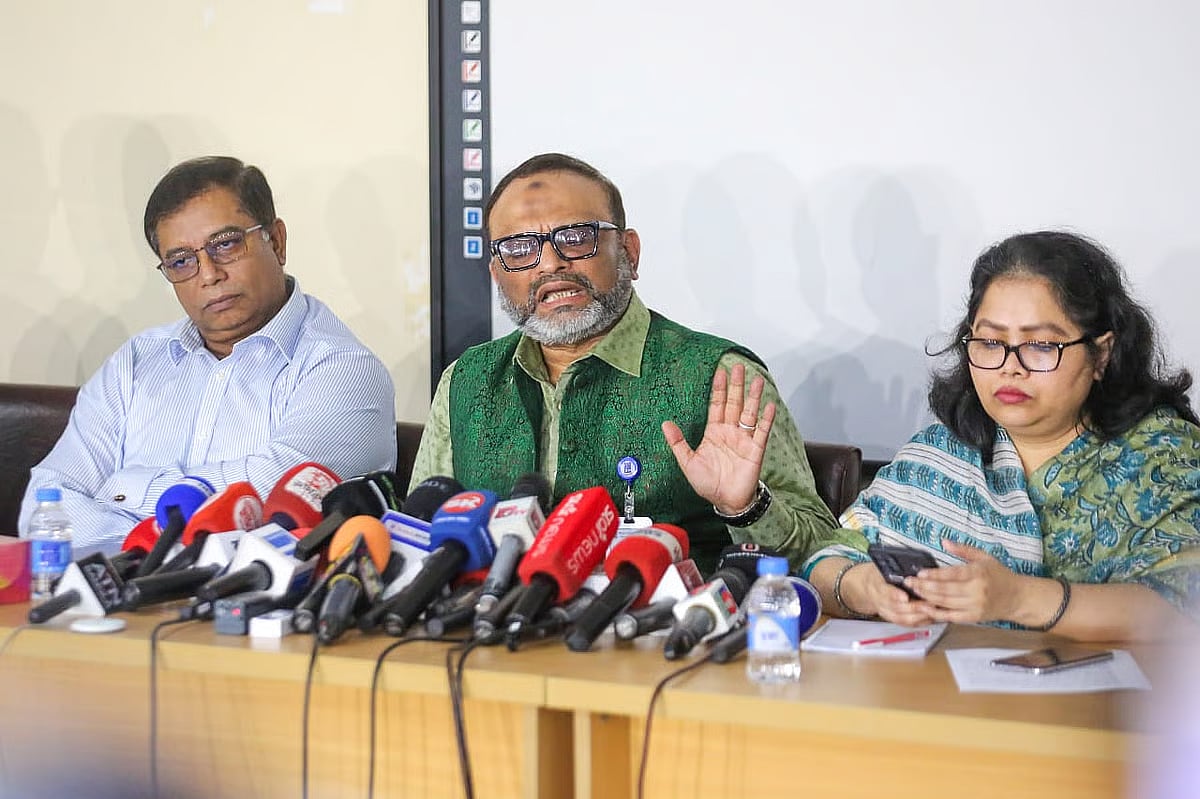
He said this while speaking at a press conference at the university’s Professor Abdul Matin Chowdhury virtual classroom Sunday morning. The Dhaka University (DU) administration organised the press conference to address various post-election issues regarding the DUCSU and hall union elections.
According to the associate vendor, the associate organisation printed 88,000 ballots in Nilkhet using 22 reams of paper, said VC Niaz Ahmed Khan. From those, 86,243 ballots were packed, sealed, and delivered to the university following the printing, cutting, and pre-scan processes.
VC Niaz Ahmed Khan said that the responsibility of printing the ballot papers were given to an experienced institution through a competitive tender process following all regulations.
To print the ballots in the shortest time possible considering the record number of voters and candidates, a suitable associate vendor was included in the same tender by discussing it with the main vendor.
The vice-chancellor claimed that the associate vendor did not inform the university authorities about the ballots being printed in Nilkhet. He then read out the explanation the vendor gave to the university authorities.
According to the associate vendor, the associate organisation printed 88,000 ballots in Nilkhet using 22 reams of paper, said VC Niaz Ahmed Khan. From those, 86,243 ballots were packed, sealed, and delivered to the university following the printing, cutting, and pre-scan processes.
Excess ballots were destroyed using standard procedures. The vendor also stated that after the cutting was done in Nilkhet, ballots were taken to their main office for pre-scanning before being packed in specified numbers, sealed, and delivered to the university.
They said they ensured maximum security in the ballot preparation process and transportation, in accordance with the terms of the contract. However, they did admit that due to the busy schedule, they forgot to inform the university about the printing and cutting done in Nilkhet.
The vice-chancellor emphasised that the location of printing or number of printed ballots does not affect a fair election in any way. Because, there are several steps required to make ballots ready for voting.
After the ballot papers are printed they have to cut in specific sizes. Then security codes are added to the ballots and they are pre-scanned in OMR machines making them machine readable.
Then the signature and seal of the Chief Returning Officer are added with signature of the returning officers in-charge of the polling centre. Only after completing these steps are ballots suitable for voting. The entire process was conducted with utmost care, the VC added.
Regarding the demand to release CCTV footage and the signed voter lists, the vice-chancellor said that if any candidate wishes to review CCTV footage of a specific period or a relevant incident, they must apply through the proper procedure.
At the press conference, VC Niaz Ahmed said that in accordance with the work order, a total of 239,244 ballots were finally prepared for voting through the above-mentioned process.
The total number of voters was 39,874, with six ballots allocated per voter. In total, 29,821 voters cast their votes, using 178,926 ballots. The number of unused ballots was 60,318.
Regarding the demand to release CCTV footage and the signed voter lists, the vice-chancellor said that if any candidate wishes to review CCTV footage of a specific period or a relevant incident, they must apply through the proper procedure.
The footage may be viewed or examined at a designated location determined by the university, in the presence of experts or individuals nominated by the authorities.
VC Niaz Ahmed Khan further stated that they have had further discussions with the university’s legal advisers concerning the demand to show the signed voter lists.
They advise that if a candidate, for specific and valid reasons, wishes to examine the signature of any particular voter, this too must be applied for through the proper procedure. Then they can review it in the presence of authorised experts or individuals, nominated by the authorities.