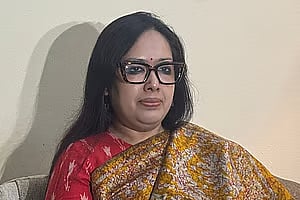
Interview: Rumeen Farhana
I have not become an MP alone, my five lakh voters have become MPs
Rumeen Farhana won the Brahmanbaria-2 constituency as an independent candidate by a margin of 38,000 votes. After failing to secure a nomination from the Bangladesh Nationalist Party (BNP), she contested as an independent and was later expelled from the party. The BNP had instead supported a candidate from an allied party against her.
At 12:30 pm today, Friday, this widely discussed candidate spoke to Prothom Alo at her residence in Shahbazpur village of Shahbazpur union in Sarail upazila of Brahmanbaria. The interview was conducted by Shovonkar Karmakar and Badur Uddin.
So how do you feel about this victory?
First of all, I express my gratitude to the Almighty Creator. Despite all adversities, He gave me the strength and courage to stay in the field. I am personally grateful to the leaders and activists of my area, as well as to every voter in the constituency. They gave me courage, strength, and stood by my side. They supported me financially and contributed their labour. It is difficult to express in words how much hardship each activist has endured. They worked day after day, from morning until late at night. Many could hardly sleep properly. This victory is not mine alone, it belongs to my leaders and activists.
I am even grateful to those who did not vote for me, who criticised me harshly or attacked me with inappropriate language. Because their behaviour inspired many ordinary people to stand more firmly in my favour. I am grateful to each of the nearly five hundred thousand voters in my constituency.
How satisfied are you with the voting process?
I will say emphatically that without the support of the Bangladesh Army, a fair election would not have been possible in this area. The administration was entirely against me. It tried, at any cost, to ensure the victory of the BNP alliance candidate. From the very beginning, the administration behaved in a discriminatory and disrespectful manner towards me. Even though BNP leaders and activists repeatedly violated the law, the administration turned a blind eye. It acted as if it were deaf and blind. However, without the active role of the army, I would not have been able to contest the election. The police also cooperated. Whenever there were irregularities, I informed the army, and they responded quickly. No one asked me for any underhand favour, and I did not offer anything to anyone.
You were involved in BNP politics. After not receiving the party’s nomination, you contested as an independent candidate. Wasn't there any impact of not having the sheaf of paddy symbol?
It had a positive impact. The reason is that, over the past 18 months, whatever the BNP has done, had I contested as their candidate, I would have had to bear some responsibility for those actions. However, I openly criticised many of those issues during that time. So, in a way, not receiving the party nomination turned out to be a blessing for me. My victory came from my personal work, my family legacy, and the trust of the people in my area. I believe that not being directly associated with BNP worked to my advantage.
You and your associates were expelled during the election. What will be your position if the party seeks to bring you back in the future?
I haven’t made any final decision on that yet. Time will decide.
How significant was the role of women voters in your victory?
The role of women was the most significant. Many have said that while their husbands may have supported other candidates, the wives chose to vote for me. I assured women voters that they would have easy access to me and that they could share their problems, and I would stand by them, which may be difficult for many other candidates. Women placed their trust in me. It can be said that I received their overwhelming support. That is why my sense of responsibility toward them is also much greater.
Did the party not know my standing in my constituency? And if it did not, then that is the party’s failure. But the party did not nominate me. I had to stand on my own, relying on faith in Allah and the people
During the campaign, you received financial support from many ordinary people. Could you tell us more about that?
Over the past two weeks, there were 40-50 campaign events in my area, sometimes two or three in a single week. Not a single taka was taken by the leaders and activists from me. During the election, poor people came forward with contributions of one thousand taka. Middle-class supporters donated one to two lakh taka. Many marginalised people brought their entire year’s savings. I did not want to accept it, but they insisted. That is why I say I have not become an MP alone, my five hundred thousand voters have become MPs.
As a Member of Parliament, what will your priorities be?
My first priority is infrastructure, especially roads. Secondly, ensuring gas supply in Brahmanbaria. We have gas fields here, yet many households do not have access to gas. I want to ensure that the people of Brahmanbaria benefit first. Thirdly, I want to modernise health centres, schools and colleges, madrasas, temples and mosques, as well as other educational and social institutions. Ashuganj is a commercial hub, with gas resources, power plants, a fertiliser factory, and a river port. I want to utilise these potentials to increase investment and create employment opportunities.
How much importance will be given to upgrading Sarail and Ashuganj upazila headquarters into municipalities?
It will certainly receive the highest priority. I want to take swift steps by fulfilling the necessary conditions.
Women’s representation in parliament is again low this time. How vocal will you be about women’s rights and equality?
I will certainly be vocal. But it must also be remembered that no one hands over rights to others, rights have to be earned. For example, my party did not give me a nomination. Did the party not know my standing in my constituency? And if it did not, then that is the party’s failure. But the party did not nominate me. I had to stand on my own, relying on faith in Allah and the people. The BNP often speaks of equality for women. That is one of the reasons I joined the party, to ensure I would not face discrimination as a woman. Then why do they allocate only 3 per cent of nominations to women? Had I known that this was the reality for women in the BNP, I would never have joined the party.
You will be an independent member of parliament. Would you be more benefitted if you were in the ruling party?
I do not feel so. The allocations are equal for all. If you want to work honestly, you can do so as an independent member. If anyone tries to obstruct you, the people will speak up.
Thank you.
Thank you too.