Jamaat wants chief adviser to join discussion as referee
Jamaat-e-Islami welcomes the advisory council’s proposal for political parties to hold discussions among themselves to resolve differences over the implementation of the July National Charter.
However, the party’s Nayebe Amir, Syed Abdullah Muhammad Taher, believes there could be a lack of a ‘referee’ for these discussions.
Abdullah Muhammad Taher said, “We welcome the decision taken by the advisory council. But I want to add one point. If the council thinks that they have no further responsibility and will do nothing, leaving it entirely to the parties to resolve among themselves, then there could be a lack of a referee. That is why I am saying that we will also try, and I hope that the chief adviser, in particular, will continue to play the role of a referee here, as before.”
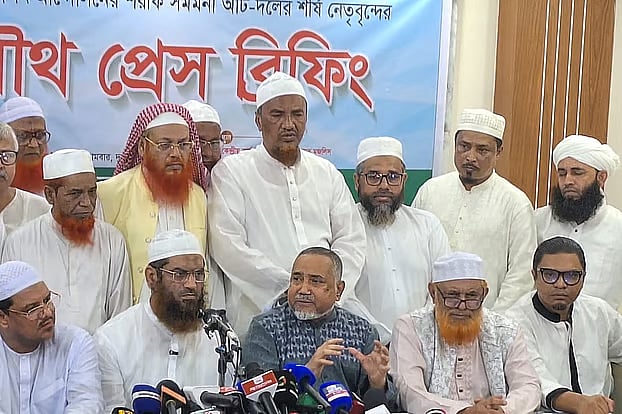
Abdullah Taher made the remarks in response to a question from journalists at a joint press conference of eight like-minded party leaders, held immediately after the advisory council’s press briefing of the interim government on Monday. The conference took place at the central office of Bangladesh Khelafat Majlis in Paltan, Dhaka.
Earlier, at an ‘urgent meeting’ of the advisory council, concerns were raised over disagreements among political parties regarding the implementation of the July Charter. Following this, law adviser Asif Nazrul said at the press conference that the government would no longer take the initiative for discussions.
Urging the political parties to engage in dialogue among themselves and provide unified guidance, Asif Nazrul said that if the parties fail to reach a joint decision within a week, the government will make its own decision.
Regarding the recommendations issued by the National Consensus Commission for implementing the July Charter, BNP and Jamaat-e-Islami hold opposing positions on several issues, including the timing of the referendum. The National Citizen Party (NCP), a party of youth leaders who led the uprising, also differs with them on certain points.
In response to a question at the press conference, Abdullah Taher said, “Just yesterday, I called for a discussion among the parties. Today, the advisory council has conveyed a similar invitation to all parties. Now we want to see how the main stakeholders, the core parties, respond to this call. If they respond in the same way we have, then we have no objection to sitting together. Once we sit, I hope a way forward will emerge, Insha Allah.”
In response to another question about BNP, Jamaat’s Nayebe Amir said, “Among the parties that had reached a consensus, one party has suddenly stepped back. Within that party, there are differing views on reforms and the referendum. Some leaders claim reforms are unnecessary. Others, while supporting the July Charter, have sought mention of dissenting opinions. Yet others want the legal basis of the Charter but also demand both a general election and a referendum simultaneously. Their party’s position needs to be clarified. If they take the initiative to resolve these issues at the discussion table, the complexities will lessen. Jamaat and the like-minded parties would welcome that.”
Explaining his party’s position, Abdullah Taher said, “If the July Charter is not implemented, holding a referendum either before or after the general election is pointless. The Charter itself is the main issue. A referendum is essential for the Charter. Only if it is held separately can public opinion be properly gauged. If any ‘conspiracy or tactical manoeuvre’ is made to combine the two, no one’s attention will be on the referendum on the day of the general election.”
The press conference was called to announce the new programme of the eight parties. However, after the advisory council press briefing, journalists sought the parties’ reactions on the issue.
Maulana Mamunul Haque, ameer of Bangladesh Khelafat Majlis, said, “We are sincere. We want to give political parties the space to reach a point of consensus through discussion, and we are moving forward sincerely while keeping that space open.”
Syed Muhammad Rezaul Karim (Pir of Charmonai), ameer of Islami Andolan Bangladesh, also called on BNP and other political parties that participated in the July uprising to come to the discussion table.
Prior to this press conference, the top leaders of the eight parties met at the central office of Khilafat Majlis. The parties were Jamaat-e-Islami, Islami Andolan Bangladesh, Khelafat Majlis, Bangladesh Khelafat Majlis, Bangladesh Khelafat Andolan, Bangladesh Nizam-e-Islam Party, National Democratic Party (JAGPA), and Bangladesh Development Party.