Chittagong Port: New consortium, including firms linked to two MPs, seeks NCT contract
After the proposal from the UAE-based DP World and local conglomerate MGH Group, a new consortium of three Bangladeshi companies has now proposed to operate Chittagong Port’s New Mooring Container Terminal (NCT). Two of the consortium’s member companies are owned by members of the current parliament.
The consortium, named Saif-Cosmos-Everest Port Services Consortium, formally submitted its proposal to the Ministry of Shipping on 28 April, seeking to operate the terminal for 15 years. The proposal has come to light more than a month later.
The proposal emerged at a time when the process of granting a long-term lease of NCT to DP World has become active again. Coincidentally, MGH Group also submitted a proposal to operate the terminal on the same day, 28 April.
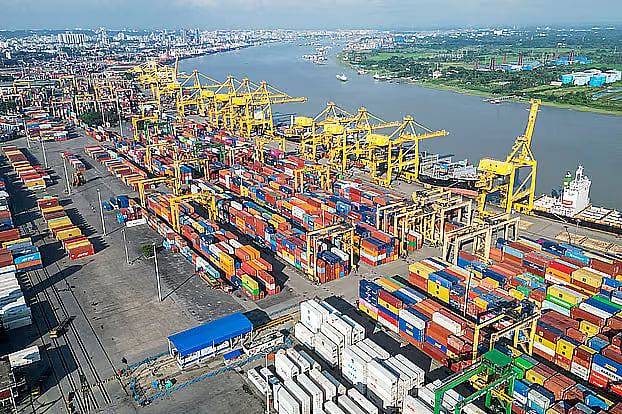
NCT is the largest among Chittagong Port’s four operational container terminals. Last year, it handled 44 per cent of all containers loaded and unloaded at the port.
Who is in the new consortium?
The consortium is led by Saif Powertec Limited, the current operator of the Chittagong Container Terminal (CCT). The other partners are berth operators Cosmos Enterprise and Everest Port Services Limited.
All three companies have been involved in cargo and container handling at the port for between two and three-and-a-half decades.
ABM Ashraf Uddin Nizan, a ruling-party MP from Lakshmipur-4 and a parliamentary whip, is the chairman of Cosmos Enterprise. Meanwhile, Shahadat Hossain Selim, managing director of Everest Port Services, is currently a BNP MP from Lakshmipur-1.
Port-related stakeholders say that although the Awami League government initiated efforts to hand over NCT to a foreign operator, no domestic group formally submitted an alternative proposal at the time. No such proposals emerged during the interim government period either. New domestic proposals have begun appearing only after the new government assumed office.
According to the people involved with the consortium, there was no realistic opportunity to submit alternative proposals during the previous government or the interim administration because the process of handing the terminal over to a foreign operator was already moving forward. They argue that the new government has now created room for local entrepreneurs to make competing proposals.
What does the new proposal contain?
Under the consortium’s proposal, it would operate NCT for 15 years while ownership and control remain entirely with the port authority.
The consortium would bear all operating costs, including personnel, maintenance, fuel, and day-to-day expenses. However, all vessel- and container-related charges would continue to be collected by the Chattogram Port Authority.
In return, the consortium has proposed an operating fee of USD 69 per container.
Citing information from the port authority’s audit reports, the proposal states that the port currently earns USD 161.82 per container, incurs expenses of USD 56.15, and retains a net income of USD 105.67.
The consortium claims that, if its proposal is implemented, the port would still retain USD 92 in revenue per container without making any additional investment. It also argues that the port would be relieved of fuel, maintenance, and staffing costs for the next 15 years.
The proposal further notes that German consultancy Hamburg Port Consulting had estimated the terminal’s annual capacity at 1.1 million containers, yet domestic operators are currently handling around 1.33 million containers annually.
How does it differ from DP World and MGH?
Three proposals have so far been submitted for operating NCT.
The first came from DP World of the United Arab Emirates. Under its proposal, the entire terminal would be leased for 15 years through a public-private partnership (PPP) and government-to-government (G2G) framework. The operator would manage terminal operations, collect charges, and conduct commercial activities, while the port would receive an agreed share of revenue.
MGH Group has proposed a similar PPP arrangement. It reportedly offered the port USD 5 more per container in revenue than DP World.
The new consortium’s model is fundamentally different. Rather than seeking a lease, it wants to provide operational services. Under its proposal, control of the terminal and authority to collect revenue would remain entirely with the port authority, while the consortium would be responsible only for operations and maintenance. In exchange, it would receive a per-container service fee from the port over the proposed 15-year term.
What are the consortium partners saying?
The proposal submitted to the Ministry of Shipping was signed by Tarfdar Md Ruhul Amin, Managing Director of Saif Powertec; Hasin Bin Ashraf, Managing Partner of Cosmos Enterprise; and Shahadat Hossain, Managing Director of Everest Port Services.
Saif Powertec currently operates CCT and also managed NCT from 2007 until 6 July, 2024. The company claims that during that period it handled approximately 23 million containers and 15,156 container vessels.
The company began operations at the port in 2006 and later secured contracts to operate both CCT and NCT through competitive tenders under the caretaker government and the Awami League administration.
Speaking to Prothom Alo, Saif Powertec Managing Director Tarfdar Md Ruhul Amin said the three consortium members collectively possess decades of experience at the port. He argued that if local companies operate the terminal, the money generated will remain in Bangladesh and national capacity will grow. According to him, the terminal is capable of handling 1.7 million containers annually.
Cosmos Enterprise has been conducting stevedoring—now known as berth operations—since 1989. According to company data, it has handled nearly 20 million tonnes of cargo and 47,806 containers. Hasin Bin Ashraf, who signed the proposal on behalf of Cosmos Enterprise, is the son of ruling-party MP and whip ABM Ashraf Uddin.
Everest Port Services, operating since 1988, currently manages a container jetty at the General Cargo Berth (GCB). The company says it has handled 5.5 million containers to date.
Speaking to Prothom Alo, Everest Port Services Managing Director Shahadat Hossain said that under existing port regulations and public procurement rules, there is no scope for handing an operational terminal to a foreign company. He argued that assigning the terminal to a domestic consortium would save foreign currency. He also maintained that NCT occupies a strategically sensitive location and that national security considerations favor a local operator.
What happens next?
Although the new proposal has been submitted, it has not yet reached the evaluation stage because the government’s discussions with DP World remain ongoing.
The process, initiated under the Awami League government, had advanced to the negotiation stage during the interim administration. However, it was suspended on 9 February due to labor unrest, political controversy, and objections raised by members of the negotiating committee.
The government is now restarting negotiations with DP World through a newly formed evaluation committee.
A senior Ministry of Shipping official told Prothom Alo that the new proposals cannot currently be considered because discussions with DP World are still underway. However, if those negotiations fail, a fresh tender process will be launched, at which point proposals from both domestic and foreign companies may be taken into consideration.