World Press Freedom Day
Media credibility at rock bottom, owners’ interference to blame: Kamal Ahmed
Media credibility in Bangladesh has reached rock bottom, largely due to interference by owners, said Kamal Ahmed, Consulting Editor of The Daily Star.
“We have not felt any pressure from the government so far… but we do see it from the owners’ side,” he said.
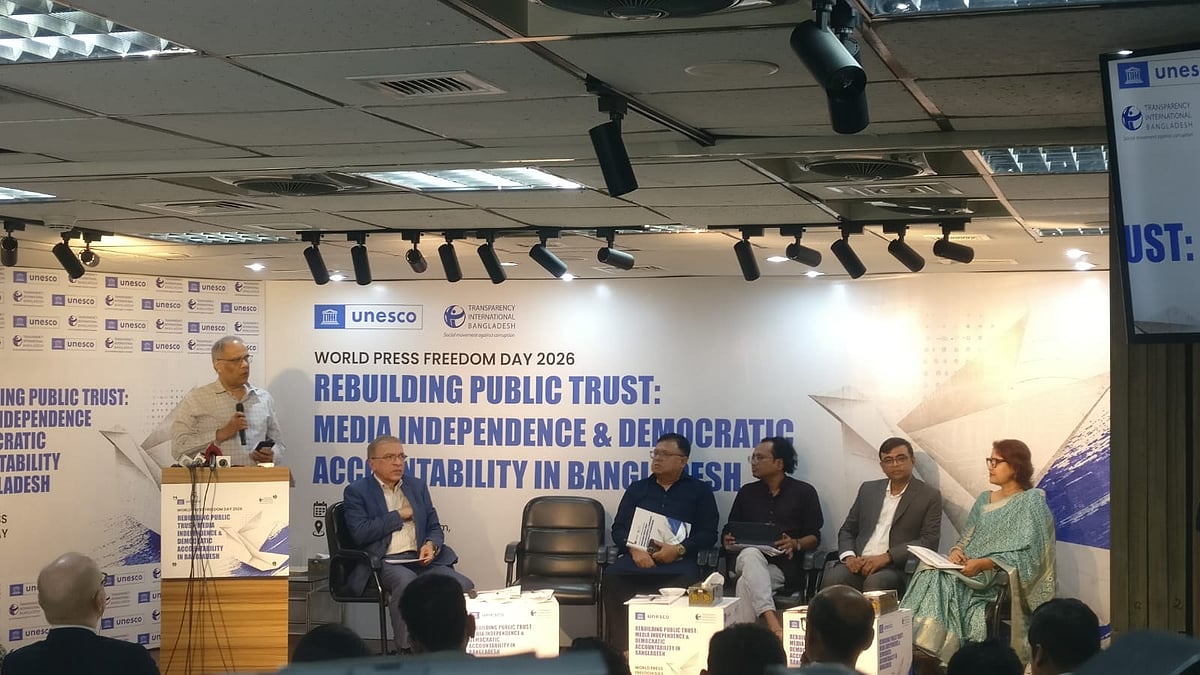
Kamal Ahmed made the remarks at a discussion, Rebuilding Public Trust: Media Independence and Democratic Accountability in Bangladesh, at the Transparency International Bangladesh (TIB) office in Dhanmondi, Dhaka, on Sunday.
UNESCO and TIB jointly organised the event marking World Press Freedom Day.
Kamal Ahmed said the credibility crisis stems from the media’s inability to operate with sufficient independence. “This independence has been undermined from two directions,” he noted. “One is the control and intimidation of the previous authoritarian regime. The other is economic—owners’ influence and corporate interests.”
According to him, in some media outlets, editorial independence is constrained by ownership control. He cited instances where, during parliamentary question-and-answer sessions, the Prime Minister disclosed the names of persons as alleged money launderers and loan defaulters, those were not fully published by the media.
“Some outlets omit certain names, particularly those linked to their own ownership, while publishing the rest of the list. When that happens, where does credibility stand?” he asked.
He also identified misinformation and disinformation on social media as a major factor eroding public trust. Much of this content, he said, is driven by political, business or group interests aimed at discrediting individuals or institutions. When readers encounter conflicting versions of the same event—one on social media and another in mainstream outlets—it becomes difficult for them to determine what to believe.
Warning that the crisis could deepen further, he stated that this situation was not something unique to Bangladesh; rather, the whole world has been going through such a critical phase.
To overcome the situation, Kamal Ahmed stressed the need for a sustainable economic model for the media.
“If outlets become dependent on financial support from the government or other groups, their independence will inevitably be compromised,” he said, urging the industry to find pathways to financial autonomy.
He also called on editors who compromise with owners to retain their positions to act responsibly and stand by professional ethics. “Otherwise, the future is bleak,” he warned.
Reiterating TIB Executive Director Iftekharuzzaman’s statement that the 31-point reform strategies of the newly formed government mentioned about ensuring media freedom, he said if the government does not abide by what it said earlier, “we will have to hold them accountable”.
Kamal Ahmed also spoke about friends among the international community–media freedom coalition–that spoke about various issues in Bangladesh. “Whenever they speak about Bangladesh, their credibility becomes questionable because they remained completely silent and have not uttered a single word about the genocide in Palestine and killing of 260 journalists there by Israel.”
Criticising the step as selective amnesia, he said all these issues must be taken into consideration for rebuilding public trust in the mainstream media.
He also spoke about drawing up a code of ethics and creating a facilitatory body, an independent media commission, to enforce that code to rebuild people’s trust in the media in Bangladesh.
TIB Executive Director Iftekharuzzaman moderated the discussion that was opened with remarks by Susan Vize, Head of Office and UNESCO Representative to Bangladesh.
Among others present were Prime Minister’s Information Adviser Zahed Ur Rahman; Paola Castro Neiderstam, First Secretary, Human Rights, Democracy and Gender Equality, Embassy of Sweden; and Rudiger Lotz, Ambassador of Germany also addressed.
Apart from Kamal Ahmed, other panel speakers were Fahim Ahmed, Chairman, Broadcast Journalists Centre (BJC); Shahnaz Munni, Senior TV Journalist; and Reaz Ahmed, Editor, Dhaka Tribune.