Mohammad Jahangir went to a roadside fruit stall on Dhanmondi’s Road 15 in the capital on Sunday afternoon to buy fruit. He wanted to buy oranges because a relative of his was suffering from dengue.
Fruit seller Mohammad Badshah was asking Tk 450 a kilogram (kg) for oranges. He made it clear that he would not reduce the price even by even a single taka.
Speaking to Prothom Alo, Jahangir said, “Fruit prices are unusually high. They are beyond the reach of middle-class people like us.”
Five slightly larger oranges bought from the market weighed just over a kg. That means each orange cost Tk 100.
The price of oranges is one example of how high fruit prices have become in the market. Fruit traders said the imported fruit used to sell for around Tk 150 a kg in Dhaka before 2022.
In 2022, amid a dollar shortage, additional taxes were imposed on fruit to restrict imports. The price of the dollar also rose. All these factors made imported fruit unaffordable for general public. Domestic fruit is not cheap either.
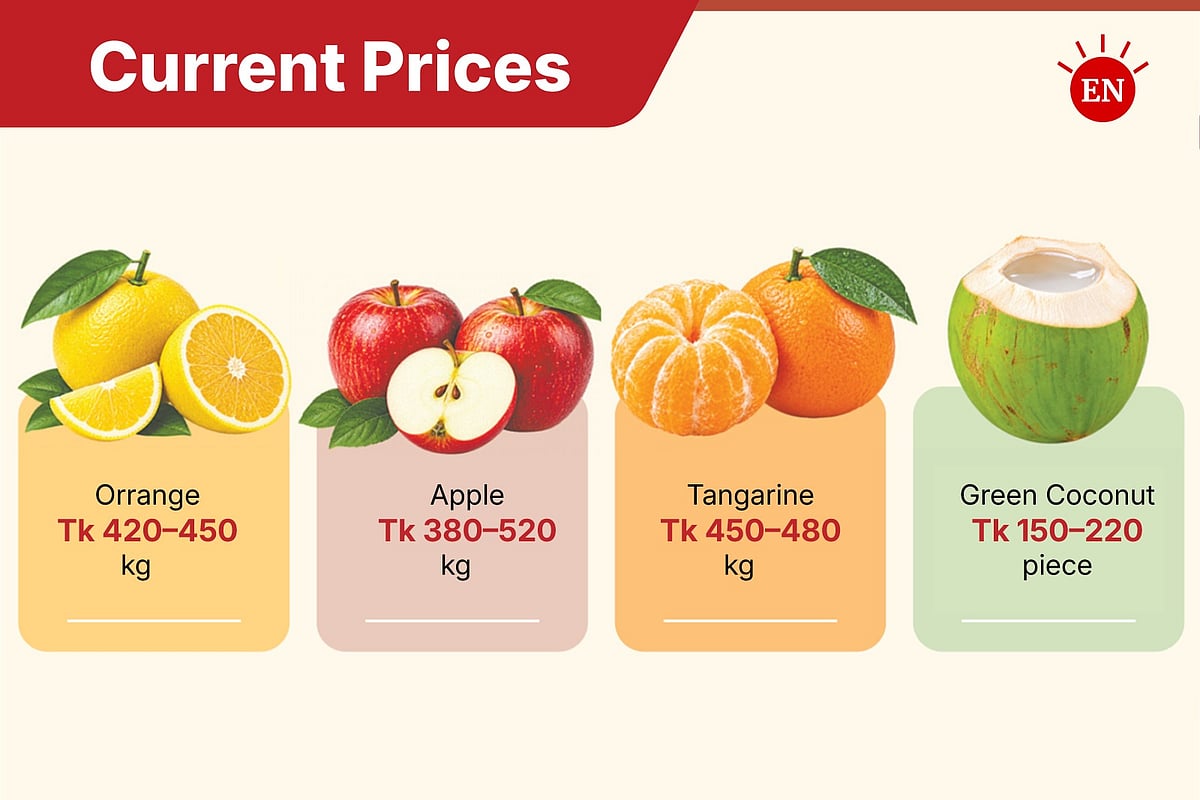
Visiting the market, it was found that tangerines were selling for Tk 450–480 a kg. Pomegranates were even more expensive, ranging from Tk 450 to Tk 650 a kg depending on size and quality. Apples were priced at Tk 380–520 a kg, while a kg of grapes cost Tk 480–550.
There are some locally grown fruits in the market, including ripe papaya, guava, pomelo, hog plum and green oranges. But these are not cheap either. Good-quality ripe papaya costs around Tk 120 a kg. A medium-sized papaya costs more than Tk 150.
For a family of five, a single papaya can be finished in one sitting. So, even locally grown fruit is not inexpensive.
Five slightly larger oranges bought from the market weighed just over a kg. That means each orange cost Tk 100. The price of oranges is one example of how high fruit prices have become in the market.
Why are prices so high?
Traders say the unusually high price of fruit over the past few weeks is due to increased demand. The rise in demand is linked to dengue. Physicians encourage dengue patients to drink the juice of various fruits, including oranges and tangerines.
So far this year, 184 people have died after suffering from dengue, a disease transmitted by Aedes mosquitoes. A total of 61,972 dengue patients have been admitted to hospitals so far.
Dengue specialist Professor Robed Amin told Prothom Alo that patients experience heavy sweating during the early stages of dengue fever. As a result, the body loses a significant amount of fluid and salt.
Patients are therefore advised to drink oral saline, fruit juice, green coconut water and soup, which contain some salt, he added.
The price of green coconuts has risen sharply amid the dengue outbreak. Green coconuts were found being sold at roadside stalls and markets in Dhaka for Tk 150, Tk 180 and Tk 220 each, depending on their size.
Fruit prices were already high even before the recent increase. The reasons include high duties and taxes and the rise in the price of the dollar.
The total duties and taxes on imported fruit currently stand at 122 per cent. This means that for every Tk 100 worth of fruit imported, Tk 122 is paid in duties and taxes. Meanwhile, the dollar was worth Tk 86 in 2022, but now it stands at Tk 123.
Patients experience heavy sweating during the early stages of dengue fever. As a result, the body loses a significant amount of fluid and salt. Patients are therefore advised to drink oral saline, fruit juice, coconut water and soup, which contain some salt, he added.Professor Robed Amin, dengue specialist
When asked about the issue, economist and former Bangladesh Bank governor Ahsan H Mansur told Prothom Alo that the need for the measures taken to control imports because of the dollar shortage had already ended during his tenure as governor.
As a result, efforts to restrict imports had been withdrawn. However, the decision to reduce duties and taxes rests with the National Board of Revenue (NBR), he added.
When asked whether the 122 per cent duties and tax burden on fruit imports was acceptable, Ahsan H Mansur said it was not acceptable at all.
He said such high duties and taxes had been kept in place for revenue generation. But imposing high duties and taxes does not necessarily increase revenue; rather, it creates opportunities for dishonest officials to line their pockets.
Ahsan H Mansur said he could eat no fruit other than apples and pears, as physicians had advised him against eating other fruits.
Currently, 38 types of fruit are imported into Bangladesh. Bangladesh Bank said the requirement to deposit 100 per cent of the value as a margin against letters of credit (LCs) for fruit imports was withdrawn last month.
According to NBR data, 23,717 tonnes of oranges, apples, tangerines and grapes were imported into the country in July. The figure rose to 41,186 tonnes in August. Meanwhile, 23,536 tonnes of fruit were imported in the first 19 days of September.
It is clear that imports are not low. Yet prices remain high.
The total duties and taxes on imported fruit currently stand at 122 per cent. This means that for every Tk 100 worth of fruit imported, Tk 122 is paid in duties and taxes.
Has fruit consumption declined?
According to the Household Income and Expenditure Survey 2010 conducted by the Bangladesh Bureau of Statistics (BBS), average per capita fruit consumption in the country was 45 grams at the time.
According to the 2016 survey, it had fallen to 36 grams. The 2022 survey showed that fruit consumption had increased to 95.4 grams.
However, there are questions about the BBS survey. Meanwhile, there is no data on whether fruit consumption has declined since 2022 due to rising prices.
Economist Ahsan H Mansur believes that everyone, including the rich and poor as well as all the children, needs to eat fruit for proper nutrition. The government needs to take steps to reduce fruit prices.