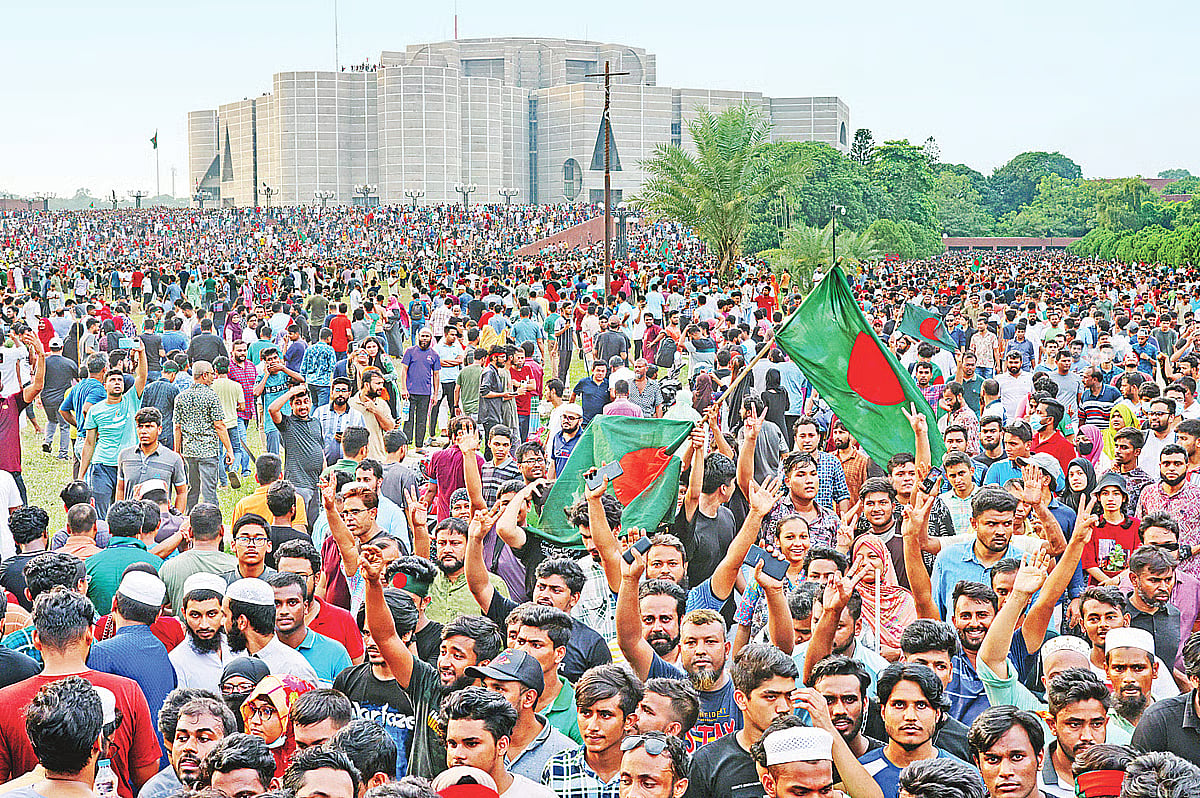
First anniversary of July Uprising
Sheikh Hasina tried to crush the uprising even on the night before the fall
On the night before the fall of her government, intelligence agencies and other sources were relaying messages to the then Prime Minister Sheikh Hasina warning that hundreds of thousands of people would flood the streets of Dhaka the following day, 5 August.
The intelligence reports also indicated that the law enforcement agencies would be unable to contain the situation. Senior officials from the police and other forces also warned about the impending crisis but Sheikh Hasina remained resolute in clinging to power. She pressured the security forces to bring the situation under control, even if it meant more bloodshed. Until late into the night on 4 August, she attempted to deploy state forces to suppress the movement.
Information on Sheikh Hasina’s actions and decisions on 4 and 5 August 2024 comes from the confessional statement of the then Inspector General of Police (IGP), data from International Crimes Tribunal investigations, intelligence reports, and conversations with multiple officials who were present at the Gonobhaban.
All the information suggests that despite the inevitability of her government’s fall, Sheikh Hasina was unwilling to relinquish power. In fact, when the topic arose the previous day (4 August), she became furious. Even on the night before fleeing the country, she insisted that the uprising must be crushed at any cost.
In a recent hearing at the International Crimes Tribunal, 4 August was described as “extremely volatile and frightening” in the lead-up to Sheikh Hasina’s fall in the face of the student-public uprising.
Information on Sheikh Hasina’s actions and decisions on 4 and 5 August 2024 comes from the confessional statement of the then Inspector General of Police (IGP), data from International Crimes Tribunal investigations, intelligence reports, and conversations with multiple officials who were present at the Gonobhaban.
In his testimony, former IGP Chowdhury Abdullah Al-Mamun, who is now-incarcerated, stated that Sheikh Hasina held two meetings at Gonobhaban on 4 August—one during the day and another at night—with heads of various security forces and intelligence agencies.
The first meeting, held at 11:00 am, was attended by Chowdhury Abdullah Al-Mamun himself, the chiefs of the three services, the then law minister, home minister, and members of the national security committee.
The meeting discussed the deteriorating movement and strategies for suppression. The intelligence reports presented there confirmed that the situation had already turned very intense and required urgent containment.
In his statement, Chowdhury Abdullah Al-Mamun said, “We tried to provide the government with accurate information. But the government was unwilling to acknowledge its vulnerabilities. While we were in the meeting, the situation continued to deteriorate across various locations, prompting the meeting to be adjourned.”
The second meeting took place around 10:00 pm on 4 August. According to the former IGP, this meeting was attended by Sheikh Hasina, her sister Sheikh Rehana, the home and law ministers, the heads of the army, navy, and air force, the Rapid Action Battalion (RAB) director general, and himself. Lieutenant General Mujibur Rahman—then Quartermaster General and a close confidant of Sheikh Hasina—was also present there. An open discussion followed.
Former IGP Chowdhury Abdullah Al-Mamun noted that the focus of the meeting was how to suppress the next day’s planned mobilisation and protests.
In his confessional statement, he said, “After the meeting, we moved to the army’s operations control room where further discussions were held on troop deployment. The meeting, attended by the chiefs of three services, Lt. Gen. Mujib, RAB DG, intelligence agencies, DMP commissioner Habibur Rahman and myself, ended around 12:30 am. A decision was made to enforce a hardline stance throughout Dhaka and its entry points.”
However, a senior source within the military confirmed that during the night meeting, a high-ranking army officer had told Sheikh Hasina, “This discussion is pointless. Time has run out.”
Meanwhile, diplomatic sources from an influential country reported that around 2:30 am on 5 August, then Law Minister Anisul Huq and PM’s advisor Salman F Rahman informed their embassy that Hasina had decided to resign.
A source close to Army Headquarters stated that around 4:00 am on 5 August, the army chief had instructed the director general of DGFI (Directorate General of Forces Intelligence) to contact political parties so that they attend a meeting at Army HQ in the afternoon that day. During that meeting, the DGFI chief reportedly told the army chief that Hasina was leaving the country.
On 25 May, at a hearing in the International Crimes Tribunal, Chief Prosecutor Mohammad Tajul Islam recounted the incidents of the night of 4 August as “extremely volatile and frightening”.
Chief prosecutor Tajul Islam further stated at the hearing that on 4 August, parliament Speaker Shirin Sharmin Chaudhury reportedly advised Sheikh Hasina to resign with dignity and address the nation. But Obaidul Quader and State Minister for Information Mohammad Ali Arafat strongly opposed her suggestion.
He said that there were multiple heated meetings between Sheikh Hasina, her ministers, senior leaders, and top officials of various forces.
Recounting the incidents of that day at the hearing, it was also said that during a meeting with the three service chiefs, Hasina’s security advisor, Maj. Gen. (retd.) Tarique Siddique, raised the issue of her resignation. Hasina became furious and insisted that she would not relinquish power under any circumstances. She ordered the army chief to “stand firm and take a hardline” to suppress the protests.
Tarique Siddique reportedly supported Hasina’s stance, saying, “A few bullets from the army will kill some people, and the protest will collapse.”
He also suggested using helicopters for aerial shooting. This made the air force chief angry; he rebuked Tarique Siddique, telling Sheikh Hasina, “This man has already sunk you and will do more.”
The chief prosecutor told the tribunal that this extreme stance was advised by a group known as the “Gang of Four”, Awami League General Secretary Obaidul Quader, former Home Minister Asaduzzaman Khan, former Law Minister Anisul Huq, and Adviser Salman F Rahman. They insisted that no compromise should be made.
Chief prosecutor Tajul Islam further stated at the hearing that on 4 August, parliament Speaker Shirin Sharmin Chaudhury reportedly advised Sheikh Hasina to resign with dignity and address the nation. But Obaidul Quader and State Minister for Information Mohammad Ali Arafat strongly opposed her suggestion.
Police remain aggressive until the end
As the meeting was ongoing at Gonobhaban, around 10:30 pm on 4 August, the then DMP Commissioner Habibur Rahman held a press briefing claiming saboteurs were operating under the guise of students and warning that no leniency would be shown.
Field-level police sources confirmed that following this, the police interpreted it as a sign that Hasina would stay in power. That is why, police aggression continued even after her departure.
The events of 5 August
Mentioning that there was a meeting on 5 August morning, International Crimes Tribunal chief prosecutor Tajul Islam told the court in the hearing, “Sheikh Hasina pointed at the IGP Chowdhury Abdullah Al Mamun and said ‘they are doing a great job, why can’t the army do the same?’. To which the IGP replied, ‘The way the situation is unfolding, it would not be possible for the police to maintain such a hard line for long. The police are out of ammunition, the forces are exhausted.’ Then the army officials advised Sheikh Hasina to relinquish power.”
Tajul Islam mentioned that Sheikh Hasina was moved to another room in Gonobhaban, where she was informed about the whole situation again and urged to step down. They told her that time was running out fast. With long marches converging on Gonobhaban from all sides of Dhaka, Sheikh Rehana tried to persuade her sister.
When that failed, senior military officials contacted Sheikh Hasina’s son Sajeeb Wazed Joy by phone. They warned him that resigning was the only way to save her mother’s life. Joy spoke with his mother, who finally agreed to step down.
Due to the time crunch, Hasina was given 45 minutes to prepare, the chief prosecutor told the court.
Tajul said in the hearing that at 11:00 am, ISPR informed the BTV director general that the army chief would address the nation at 2:00 pm. He ultimately did so at 4:00 pm.
However, the names of the other persons present at the 5 August meeting were not disclosed during the hearing at the Tribunal. Former IGP Chowdhury Abdullah Al-Mamun also did not say anything about the meeting in his confessional statement.
Biplob Barua, former Special Assistant to Prime Minister Sheikh Hasina and Office Secretary of the Awami League (activities banned), said in a recent interview (at an interview-based programme titled ‘Joto Kotha Nobonita Chowdhuryr Sathe’ on YouTube) that he learned around 10:30 am on 5 August that the army chief had arrived at Gonobhaban. When he later went there, he was informed that the army chief had already left.
How Sheikh Hasina left the country
Citing several sources, a 6 August report by Prothom Alo said, Sheikh Hasina and her sister were taken to the Tejgaon old airport’s helipad with several luggage. From there, they went to the Bangabhaban, the official residence of the President, and completed the formalities of her resignation. Then they were flown to Kurmitola’s Bangabandhu Airbase and boarded a military helicopter and left for India.
It was later learned that Sheikh Hasina did not go to Bangabhaban. Instead, under heavy security, Sheikh Hasina and Sheikh Rehana left Gonobhaban by car for the nearby trade fair grounds, from where they flew by helicopter to the Bangabandhu Air Base in Kurmitola. They then departed for India aboard a Bangladesh Air Force C-130 transport aircraft. The plane landed at the Indian Air Force’s Hindon Air Base in Ghaziabad, near New Delhi, at 5:36 pm local time on 5 August.
Indian media reported that the country’s National Security Adviser Ajit Doval received Sheikh Hasina upon arrival.
According to the latest available reports, Sheikh Hasina remains in India. Several of her audio messages have circulated on social media. Law enforcement agencies also believe that numerous former ministers, MPs, and Awami League leaders are currently in India.