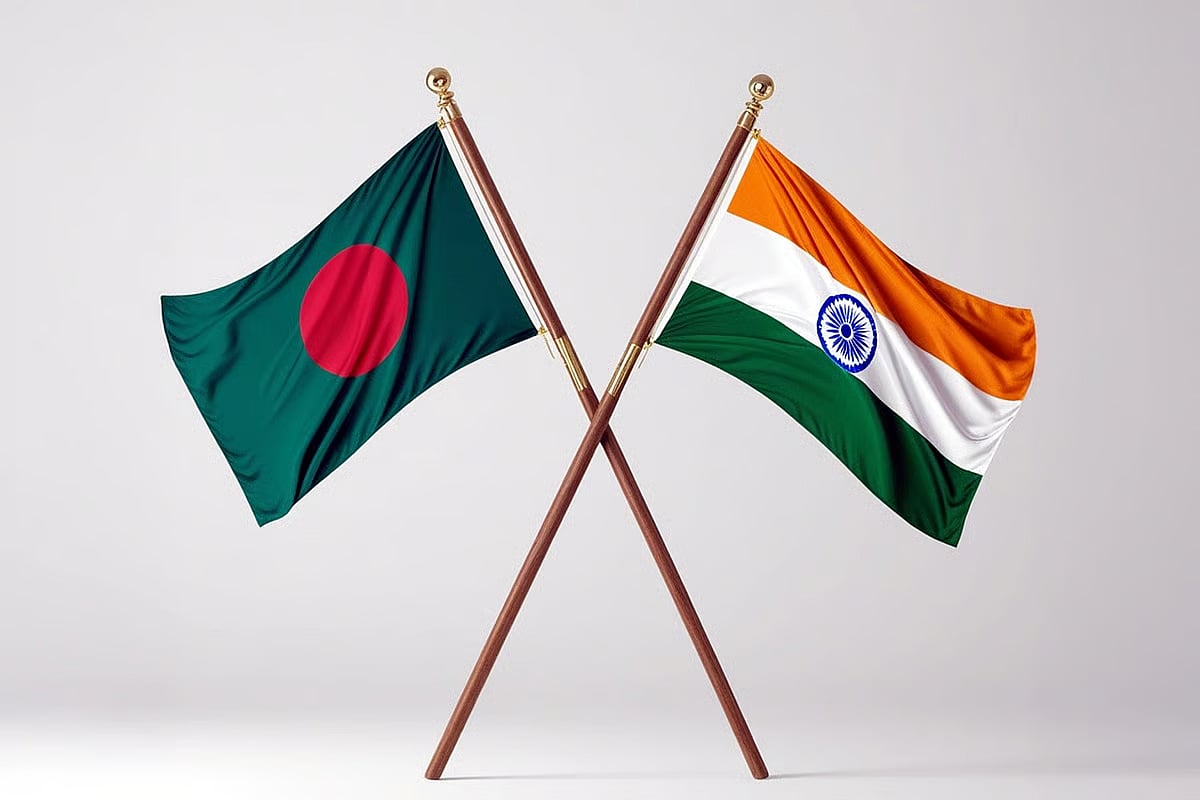
Analysis
Will India move away from its reliance on Awami League?
Tensions have persisted in Bangladesh–India bilateral relations for the past 16 months. Over the last 10 days, they have deepened into a serious crisis. The two countries have continued summoning each other’s diplomats and issuing counter-statements.
At the same time, Hindutva groups have staged protests targeting Bangladesh missions in Delhi, Kolkata, Mumbai and Agartala, leading to clashes with law enforcement agencies.
Citing security concerns, Dhaka has suspended visa services in India at least four locations, including Delhi. India had also temporarily halted visa services at four locations, including Dhaka.
Against this backdrop, the future of the so-called “golden chapter” in Dhaka–Delhi relations during Sheikh Hasina’s 15-year authoritarian rule now faces serious uncertainty.
In July 2024, amid a mass uprising, former prime minister Sheikh Hasina was unseated from power and fled to India. An interim government took charge, marking the beginning of bitterness in bilateral ties. Even in December last year, relations were strained, though not to this extent.
At that time, the two countries’ foreign secretaries met in Dhaka. Alongside those talks, protests were also held in various parts of India targeting Bangladesh missions.
This December’s situation has been far more volatile—particularly since 11 December, when Bangladesh announced the schedule for the parliamentary election and referendum—triggering renewed tensions and a fresh crisis in bilateral relations.
Since August last year, Hindutva organisations, including the Vishva Hindu Parishad (VHP), an affiliate of India’s Sangh Parivar, have determined to frame allegations of minority persecution in Bangladesh as a major issue.
Sections of India’s mainstream media have joined in. India sought to project globally that minorities were being persecuted on a large scale in Bangladesh following the political upheaval of August. However, these claims failed to gain credibility within the international community.
India’s support for Sheikh Hasina and her party, the Awami League (whose activities are now banned), has also remained uninterrupted. Party leaders and activists who fled to India have continued to participate in rallies via social media. India has also enabled Sheikh Hasina to deliver speeches and issue statements online. At one point, she began giving regular interviews to Indian media, through which she has challenged Bangladesh’s interim government. Dhaka believes these statements are disrupting the country’s electoral environment and has repeatedly urged India to restrain her activities.
On 17 November, the International Crimes Tribunal sentenced the deposed prime minister Sheikh Hasina to death for crimes against humanity, including killings committed during the July mass uprising.
Before and after the verdict, Bangladesh repeatedly requested India to hand her over under the extradition treaty. Dhaka has also raised, in talks with Delhi, the issue of repatriating the killers of martyred Sharif Osman Bin Hadi, who fled to India. As a result, alongside Hasina’s extradition, the demand to return Hadi’s killers has added a new dimension to the tensions.
Meanwhile, on 18 December, garment worker Dipu Chandra Das was brutally killed in Bhaluka, Mymensingh. He was beaten to death after being accused of blasphemy. Following the killing, Delhi highlighted the incident as evidence of “minority persecution” in Bangladesh. Using the issue as a rallying point, the VHP called for protests across India, leading to demonstrations around Bangladesh missions in Delhi, Mumbai and Agartala.
On 14 December, Indian High Commissioner to Bangladesh Pranay Verma was summoned to the foreign ministry in Dhaka, where he was informed that Bangladesh wanted an immediate end to Sheikh Hasina’s anti-Bangladesh activities from India. Dhaka also urged India to arrest and repatriate any suspects involved in the attempted murder of Hadi (who was undergoing treatment at the time) if they entered India.
Two days later, on 17 December, India summoned Bangladesh High Commissioner to India M Riaz Hamidullah to the Ministry of External Affairs in Delhi. That same afternoon, a group called July Unity had announced a programme titled “March to Indian High Commission” in Dhaka.
Despite calls from diplomatic analysts to de-escalate tensions, reality has moved in the opposite direction. Even after repeated requests, Sheikh Hasina’s speeches, statements and interviews from Delhi continue unabated—because India has allowed them. At the same time, India has refused to extradite her.
On 6 December, Indian External Affairs Minister S Jaishankar said at an event in New Delhi that whether Sheikh Hasina—who sought refuge in India under special circumstances—would remain there was entirely her own decision. This stance has further fuelled public anger in Bangladesh, compounded by the fact that suspects in the Hadi killing fled to India.
On the night of 20, 20 to 25 December people suddenly staged a protest opposite Bangladesh House (the high commissioner’s residence) in Chanakyapuri, bypassing its tight security perimeter. The incident shocked many, given that Bangladesh House is located in one of Delhi’s most heavily secured zones.
Reports on the protest were published in Bangladesh on 21 December. In response, Indian foreign ministry spokesperson Randhir Jaiswal dismissed the reports as “misleading” and simultaneously demanded justice for garment worker Dipu’s killing, while raising concerns about minority security in Bangladesh.
According to diplomatic sources, Jaiswal’s statement effectively endorsed the protesters’ position. Bangladesh strongly protested the demonstration by a Hindutva group in front of its diplomatic premises in Delhi and rejected the Indian foreign ministry spokesperson’s claims.
Foreign Affairs Adviser Touhid Hossain told journalists that Bangladesh House is located in a highly secured area, questioning how a group of 20–25 people was allowed to enter such a zone at night.
Former Bangladesh ambassador to the United States M Humayun Kabir told Prothom Alo, “I have never seen such levels of suspicion and mistrust between Dhaka and Delhi. Under established international norms, both countries must ensure the security of each other’s diplomatic missions.”
Security concerns and strategic challenges
India’s parliament has also discussed Bangladesh’s changing political situation. On 18 December, the parliamentary standing committee on external affairs tabled a report in the Lok Sabha on the future of Bangladesh–India relations, describing the current state of ties as the most significant strategic challenge since 1971.
Ashok Swain, professor of peace and conflict research at Sweden’s Uppsala University, told the BBC that a large section of India’s media has exaggerated developments in Bangladesh, portraying the country as sliding toward communal chaos. Bangladesh’s stability, he said, is crucial for India’s security—particularly for its northeastern region.
Call to rebuild ties by accepting reality
The Brussels-based non-profit research organisation International Crisis Group (ICG) has published a 53-page report titled “After the Golden Chapter: Resetting Bangladesh–India Relations.” The report states that Sheikh Hasina’s removal from power in August 2024 was a major shock for India, as she had been its most reliable ally during her 15-year rule.
Delhi’s support helped the Awami League survive three controversial elections. However, India’s close association with an increasingly unpopular ruler further stoked anti-India sentiment in Bangladesh. After Hasina was forced out through a mass uprising, the situation became unfavourable for India.
The report warns that if relations deteriorate further in the post-Hasina era, it could fuel violence, destabilise the two countries’ shared border and hinder economic development.
Bangladesh’s political parties should therefore refrain from exploiting anti-India sentiment for electoral gain. At the same time, Delhi should avoid escalating tensions and stop underestimating potential partners in Bangladesh.
Drawing on his experience working with India, Humayun Kabir believes that India must accept reality and take the initiative to rebuild relations with Bangladesh, as the two neighbouring countries are mutually interdependent.