Approver’s testimony
July mass killings ordered by Hasina, Asaduzzaman Khan
Sheikh Hasina has ordered the direct use of 'lethal weapons' to suppress the movement.
Asaduzzaman Khan's order was that the movement must be suppressed at any cost.
The order to pick someone up and kill them came from the then Prime Minister's Office.
Former Prime Minister Sheikh Hasina directly ordered the use of “lethal weapons” to crush the anti-discrimination student movement, according to a statement by Chowdhury Abdullah Al-Mamun, who was then Inspector General of Police (IGP).
In his testimony, Al-Mamun said he received the order on 18 July 2024 from then–Home Minister Asaduzzaman Khan, who conveyed Hasina’s directive. From that day, security forces began using deadly weapons against protesters. The carnage, he said, was carried out under the orders of Sheikh Hasina and Asaduzzaman Khan.
Al-Mamun gave his statement on Tuesday before International Crimes Tribunal-1, becoming the first accused in the tribunal’s history to confess to crimes against humanity and testify as an “approver.”
He himself, along with Sheikh Hasina and Asaduzzaman Khan, has been charged in a crimes against humanity case over atrocities committed during the July–August 2024 mass uprising. On 10 July 2025, Al-Mamun pleaded guilty and applied to turn approver. His application was approved that day, but his full statement was recorded yesterday, Tuesday. So far, 36 witnesses, including him, have testified in the case.
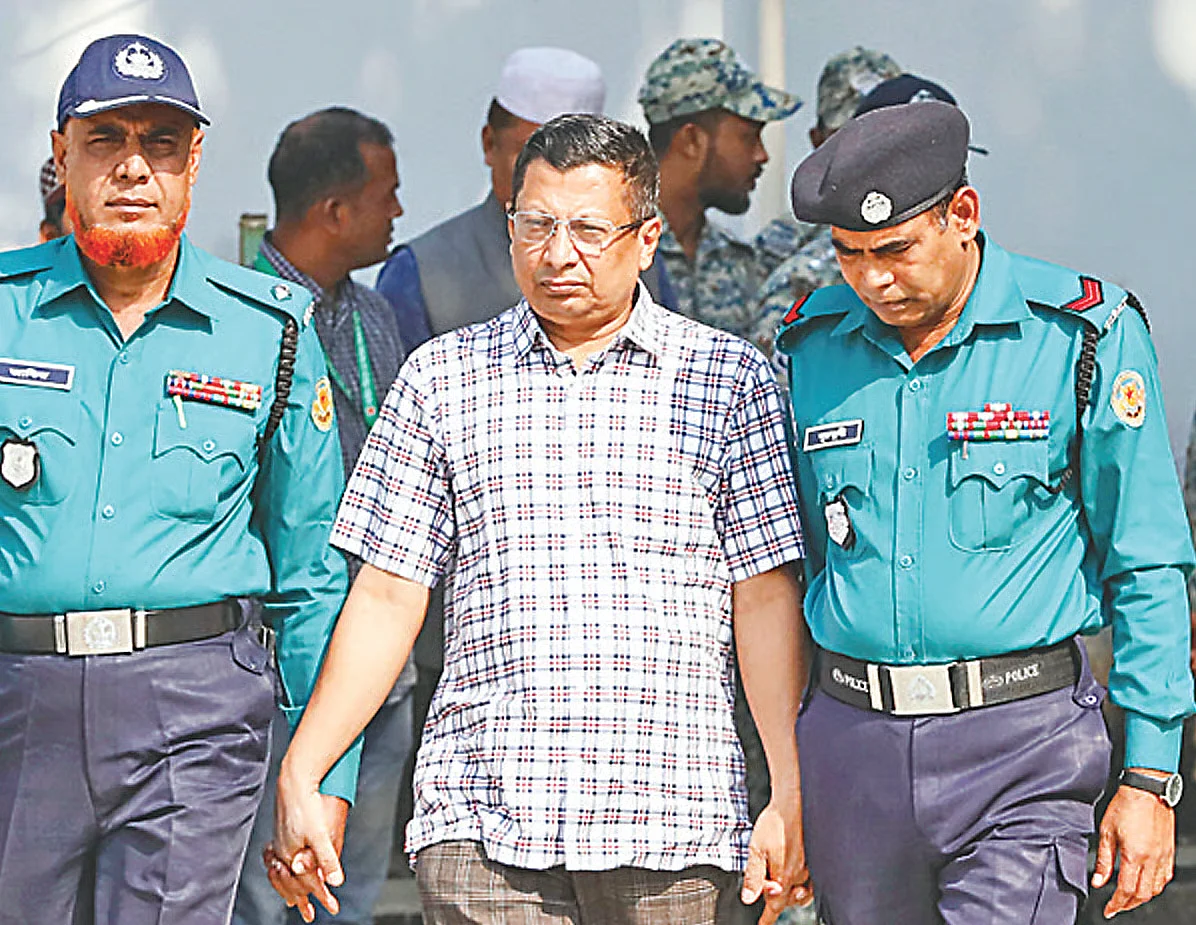
On Tuesday morning, Al-Mamun was brought from prison to the tribunal and escorted in at about 11:30 am. Initially seated with the accused, he was later taken to the witness stand, where he read his testimony from several pages of notes. He appeared calm, occasionally referring to his papers.
In his statement, Al-Mamun described how he learned of the order. On 18 July 2024, Home Minister Asaduzzaman Khan phoned him at police headquarters and said Sheikh Hasina had instructed the “direct use of lethal weapons” to suppress the movement.
At the time, Additional DIG Proloy Kumar Joardar was with him. Proloy later relayed the order nationwide, including to then–Dhaka Metropolitan Police (DMP) Commissioner Habibur Rahman. From that day, lethal weapons were deployed.
The protest areas were divided into zones for “blockades,” he said. Helicopters, drones, and lethal weapons were then used to kill and injure large numbers of students and civilians. Al-Mamun claimed that pro–Awami League intellectuals, journalists, cultural activists, and businessmen also encouraged the government to crush the movement.
Al-Mamun testified that Habibur Rahman and former DMP Additional Commissioner Mohammad Harun Or Rashid were particularly eager to use deadly force. He added that Asaduzzaman Khan had ordered suppression of the movement “at any cost.”
According to Al-Mamun, Sheikh Hasina was encouraged to authorise the use of deadly weapons by Obaidul Quader, Asaduzzaman Khan, Anisul Haque, Salman F Rahman, Rashed Khan Menon, Hasanul Haque Inu, Jahangir Kabir Nanak, Mirza Azam, Fazle Noor Taposh, and Mohammad Ali Arafat.
The UN High Commissioner for Human Rights’ fact-finding team also documented the July crackdown in its February 2025 report, which examined events in Bangladesh between 1 July and 15 August 2024.
The report cited evidence of grave human rights violations, including extrajudicial killings, indiscriminate shootings, mass arrests, torture, and denial of medical care—directly implicating the Hasina government and Awami League leadership.
RAB DG Harun suggests using helicopters
Al-Mamun further testified that helicopters and drones were used to track protesters, locate them, and target them with gunfire. He said the decision to use helicopters and drones for repression came from a political directive of the government, and that the idea was proposed by then–RAB Director General Harun-Ar-Rashid.
Please forgive me. If the truth is revealed through my true and complete statement, and if Allah grants me more life, I will be free from guilt for the rest of my life.Abdullah Al Mamun, former IGP
The protest areas were divided into zones for “blockades,” he said. Helicopters, drones, and lethal weapons were then used to kill and injure large numbers of students and civilians. Al-Mamun claimed that pro–Awami League intellectuals, journalists, cultural activists, and businessmen also encouraged the government to crush the movement.
According to the latest gazette from the interim government, 836 people were killed and 13,800 injured in the July mass uprising.
4 August meetings at Gonobhaban
Al-Mamun’s statement also described key meetings at Gonobhaban on 4 August 2024. At 11:00 am, Sheikh Hasina chaired a Security Coordination Committee meeting attended by 27 senior officials, including the Home and Law Ministers, chiefs of the three security services, the heads of SB, DGFI, and NSI, as well as Al-Mamun himself.
Intelligence agencies presented updates on the worsening situation, but the meeting was adjourned as unrest spiralled.
That night, another meeting took place at Gonobhaban. Present were the Home and Law Ministers, the heads of the three services, RAB DG, former Lt. Gen. Mujibur Rahman, and Al-Mamun. Sheikh Rehana was also in attendance, while the DGFI and SB chiefs waited outside.
The meeting focused on preventing the planned “March to Dhaka” on 5 August 2024. It was decided that police and army would coordinate operations.
Afterward, Al-Mamun went to the army’s operations control room, where the same group of senior figures met again. They resolved to take a hard line at Dhaka’s entry points. The meeting ended at 12:30 am on 4 August.
Hasina flown out as regime collapsed
On 5 August 2024, Al-Mamun reported to police headquarters as usual. But by midday, students and masses were streaming into Dhaka through Uttara, Jatrabari, and other routes. Between 12:00 pm and 1:00 pm, he learned Sheikh Hasina would be stepping down.
That afternoon, an army helicopter landed at police headquarters, airlifting him and others to Tejgaon Airport and from there to the officers’ mess at Dhaka Cantonment. Along with him were the DMP Commissioner, SB Chief, and DIG Amena Begum. In a later flight, Additional DIGs Proloy Kumar Joardar, Lutful Kabir, and others were also taken to the cantonment.
Al-Mamun said his contract as IGP was terminated on 6 August 2024. While confined at the cantonment, he was formally arrested on 23 September 2024.
DB’s Harun tasked with detaining coordinators
Former IGP Chowdhury Abdullah Al-Mamun has revealed that from 19 July 2024, the “core” committee of the government met almost nightly at the Dhanmondi residence of former Home Minister Asaduzzaman Khan. These meetings issued various directives to suppress the anti-discrimination student movement.
Al-Mamun said that in one such meeting, the Directorate General of Forces Intelligence (DGFI) proposed detaining the coordinators of the movement. Although he initially opposed it, he later agreed on the Home Minister’s insistence.
The task of detention was handed to then–Detective Branch (DB) chief Harun Or Rashid. Acting on the Home Minister’s decision, the DGFI and DB jointly detained the coordinators and brought them into DB custody.
The former IGP testified that the detained coordinators were pressured to compromise with the government. Their relatives were also brought in and subjected to pressure. Coordinators were forced to withdraw from the movement and deliver statements on television, with DB chief Harun playing a leading role.
Al-Mamun added that Asaduzzaman Khan used to refer to DB chief Harun as “Djin.”
Ballot stuffing in 2018 election
In his statement, Al-Mamun also recalled the 2018 parliamentary election, when he was DIG of Dhaka Range. He said that at the time, Javed Patwary was the IGP of Police. Patwary advised Sheikh Hasina to pre-fill 50 percent of ballots in ballot boxes the night before the election.
The instruction was passed down to deputy commissioners, superintendents of police, UNOs, assistant commissioners (land), OCs, and ruling party officials and activists, who carried it out. Police officers who implemented the directive effectively were rewarded by the state, Al-Mamun testified.
Secret detention centres and kill orders
Al-Mamun, who served as Director General of RAB from 14 April 2020 to 30 September 2022, disclosed the existence of a detention facility called the TFI Cell (Task Force Interrogation Cell) inside the RAB-1 office in Uttara, overseen by RAB headquarters. He said many similar facilities operated under other RAB units, where political dissidents and government critics were held.
According to his statement, kidnappings, secret detentions, torture, and extrajudicial killings (“crossfire”) were coordinated by the Additional Director General (Operations) of RAB and directors of RAB’s Intelligence Department.
Al-Mamun testified that he learned orders to pick up, detain, or kill individuals came directly from the Prime Minister’s Office (PMO), specifically through Sheikh Hasina’s Defense Adviser Tarique Ahmed Siddique. These instructions bypassed the formal chain of command and were sent straight to the ADG (Operations) and RAB intelligence directors.
Admission of responsibility
In his testimony, the former IGP accepted responsibility for the crimes committed during the July–August 2024 uprising. Apologising to the families of the martyrs and the injured, to the people of Bangladesh, and to the International Crimes Tribunal, he said:
“Please forgive me. If the truth is revealed through my true and complete statement, and if Allah grants me more life, I will be free from guilt for the rest of my life.”
Al-Mamun noted that he served in the police force for 36 and a half years. While allegations were often made against the police institutionally, he claimed no personal accusations had ever been brought against him until the massacre that unfolded during his tenure as IGP.
Al-Mamun testified yesterday before the three-member International Crimes Tribunal-1, headed by Justice Golam Mortuza Majumder. The other two members were Justice Shafiul Alam Mahmud and Judge Mohitul Haque Enam Chowdhury.
Separately, Sheikh Abzalul Haque—a former police sub-inspector and accused in another tribunal case concerning the burning of six bodies in Ashulia, Dhaka—will also testify as an approver. However, testimony in that case has not yet begun.
“Irrefutable Evidence”
Following Al-Mamun’s deposition, Chief Prosecutor Mohammad Tajul Islam told reporters that the former IGP had provided detailed testimony on how decisions were made within the state, how instructions were received and implemented step by step, and how the command structure operated.
“This is irrefutable and overwhelming evidence,” Tajul said. “He has presented an indisputable record before the tribunal regarding crimes against humanity, including disappearances and murders, not only in July–August 2024 but also throughout the past 15–16 years.”
Commenting on the testimony, retired District and Sessions Judge Saifuzzaman Hero told Prothom Alo that public witnesses in Bangladesh’s criminal justice system are rare. He said he was unaware of any precedent for an approver in such cases, except in the trial of Ershad Sikder, who was executed.