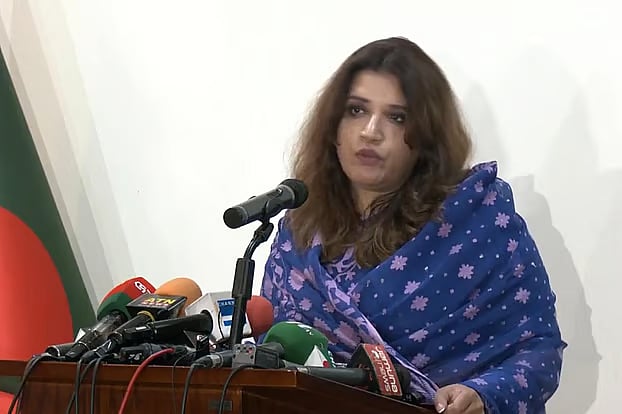
India must decide its stance: Shama Obaed
State Minister for Foreign Affairs Shama Obaed Islam said that when a convicted individual makes remarks from Indian soil claiming that militancy is spreading in Bangladesh, and the Indian government allows such statements, it raises concerns among the people of Bangladesh about the future direction of bilateral relations. She added that it is ultimately up to India to decide what kind of relationship it wants with Bangladesh.
The state minister made the remarks while briefing journalists at the Ministry of Foreign Affairs on Thursday afternoon, in response to a question about ousted former prime minister Sheikh Hasina speaking directly to the media in Delhi on Wednesday.
A journalist asked the state minister for her reaction to attempts by convicted individuals based in India to portray Bangladesh as a “militant state.”
In response, Shama Obaed said the government had tried to convey, in diplomatic language, as much as possible through the statement issued by the Ministry of Foreign Affairs last night. She said Bangladesh had repeatedly told India that it needed to make its position clear regarding what kind of relationship it wanted with Bangladesh.
“This theory of militancy is an old, dirty political tactic of the Awami League. They are now trying to revive the same tactic while sitting on foreign soil. It is now up to the Indian government to decide whether it will allow this to continue,” she said.
Shama Obaed further said that throughout Sheikh Hasina’s 17-year rule, whenever an incident occurred, attempts were made to create a narrative around extremism and terrorism. At the same time, she said, enforced disappearances, killings and extrajudicial killings were carried out by the government itself.
Interested in talks, but India has to decide
The state minister said both the governments and people of Bangladesh and India wanted bilateral relations to improve.
“But if authoritarian, fascist, convicted Awami League figures, including the head of the Awami League, continue such ‘conspiratorial activities’ while staying on Indian soil, and if the Indian government does not stop this immediately, it will become a matter of concern for the people of Bangladesh,” she said.
Noting that many bilateral issues between the two countries need to be resolved through discussions, dialogue and meetings, Shama Obaed said, “We want to sit down and talk. But India has to make the decision now.”
Within 24 hours of Bangladesh lodging a strong protest over India’s role in the matter, the Indian high commissioner visited the Secretariat and met the power minister.
Asked about this, Shama Obaed said, “This proves that relations between the governments of the two countries are multifaceted. Killer Hasina or her associates will naturally want us to remain stuck in that particular issue. But Bangladesh cannot remain stuck in one place. Discussions will continue on issues such as energy cooperation, water sharing and border management.”
At the same time, however, the state minister said the issue of statements made by convicted Awami League leaders was “not simply a matter of 24 to 36 hours.” Rather, she said, it directly hurt the sentiments of the July uprising’s fighters and their families, as well as the 170 million people of Bangladesh.
India needs to be more sensitive to the issue and make a prudent decision about what it wants to do in the future, she said.
Asked whether relations would continue at the level of high-level visits if similar incidents continued to recur in Delhi despite repeated protests from Bangladesh, Shama Obaed said, “India is a democratic country, and it is up to India to decide what its foreign policy toward Bangladesh will be. We want to maintain good relations. But those relations must be in the interest of the people, based on equality and mutual respect, while safeguarding our respective interests.”
Asked whether Prime Minister Tarique Rahman would accept an invitation to attend the BRICS summit to be held in New Delhi, the state minister said Bangladesh was interested in participating in such multilateral forums as it currently holds the chairmanship of BIMSTEC.
However, whether the prime minister would ultimately attend would depend on his commitments and schedule, she said.
India has sent two separate invitations to the prime minister—one for a bilateral meeting and another in his capacity as chair of BIMSTEC. Bangladesh has also already sent a letter in this regard, the state minister said, advising journalists to wait patiently for the final decision.