Analysis
Tension over the upper chamber, referendum, and July Charter
After tensions surrounding the method of appointments to constitutional posts, the powers of the Prime Minister, and the role of the President, the focus of reform discussions shifted to a larger question—how the balance of state power will be constructed. At that stage, the discussions of the National Consensus Commission brought to the center the issue of a bicameral parliament, especially the method of formation of the upper chamber and its effectiveness.
From this perspective, the Constitutional Reform Commission considered the upper chamber as an “additional supervisory” layer. With the idea that this would reduce the absolute dominance and exclusive power of the ruling party in the lower house of parliament, or in parliament as a whole, the Constitutional Reform Commission proposed the formation of a bicameral legislature.
Almost all parties, including the BNP, agree on making the parliament bicameral. This commitment is also included in the BNP’s 31-point outline. However, there are political differences regarding the structure and powers of the upper chamber.
The proposal of the Constitutional Reform Commission was that elections to the upper chamber (Senate) would be held through proportional representation or the PR system. That is, in proportion to the votes a party receives nationwide in general elections to the lower house, that party would receive seats in the upper chamber.
On the other hand, the BNP wanted that seats in the upper chamber would be distributed in proportion to the number of seats a party obtains in the lower house. That is, it would be similar to the current method by which reserved women’s seats are allocated.
The formation of an upper chamber in parliament does not in itself establish balance. Rather, it will depend on the method by which the upper chamber is elected and what kind of powers it has. The proposal suggests that the upper chamber would mainly be given authority regarding constitutional amendments.
If the PR system described in the July Charter is introduced, no single party will have exclusive control in the upper chamber. As a result, the upper chamber will be balanced and will have comparatively broader representation of parties. Under this system, the possibility of any party achieving a single majority is low. To obtain a single majority, a party would need to secure more than 50 per cent of the votes cast in the lower house elections. In none of the acceptable elections in the country has any party secured more than 50 per cent of the vote alone. In the 13th national parliamentary election, the BNP received 49.97 per cent of the vote under the sheaf of paddy symbol.
The interim government gave special importance to forming the upper chamber through the PR system. A source of that government told Prothom Alo at the time that Chief Adviser Professor Muhammad Yunus personally requested the BNP to accept the proposal. But ultimately, the BNP did not accept it.
Powers of the upper chamber
The proposal of the Constitutional Reform Commission stated that the upper chamber would not have the power to initiate legislation. However, except for finance bills passed in the lower house, all bills must be presented in both chambers. The upper chamber will not be able to permanently block any bill. If the upper chamber holds a bill for more than two months, it will be considered approved by the upper chamber.
The upper chamber will be able to review and analyse a bill and approve or reject it within a specified time. If the upper chamber approves a bill, it will be sent to the President for assent.
The upper chamber will be able to reject a bill and send it back to the lower house for reconsideration along with recommendations for amendment. The lower house will be able to accept or reject the amendments proposed by the upper chamber in full or in part. If a bill passed in two consecutive sessions of the lower house is rejected by the upper chamber, and if the lower house passes it again in a subsequent session, then the bill can be sent to the President for approval without the approval of the upper chamber.
In the model preferred by the BNP, if any party has a simple majority or a two-thirds majority in the lower house, it will also have the same in the upper chamber. This would maintain the exclusive control of the ruling party in both chambers, which would thwart the objective of establishing balance.
Although the approval of the upper chamber is not mandatory for ordinary bills, the July Charter proposes an important role for it in constitutional amendment bills. It states that in the case of constitutional amendments, the support of two-thirds of the lower house and a majority of members of the upper chamber will be required. However, in this case, the BNP has a note of dissent. They are against sending constitutional amendment bills to the upper chamber and having them passed there.
In the model preferred by the BNP, if any party has a simple majority or a two-thirds majority in the lower house, it will also have the same in the upper chamber. This would maintain the exclusive control of the ruling party in both chambers, which would thwart the objective of establishing balance.
This difference of opinion emerged in the discussion of the Consensus Commission on 29 June last year. On that day, Mahmudur Rahman Manna, president of Nagorik Oikya, said that if the upper chamber is formed in proportion to the seats of the lower house, then it will become a “replica” of the lower house.
On the same day, Akhter Hossen, member secretary of the NCP, said that if the upper chamber does not have power, then it has no necessity.
Why the proposal for bicameral parliament
In its report, the Constitutional Reform Commission explained the rationale for proposing a bicameral parliament, stating that since independence, Bangladesh has been operating under a unicameral legislature. However, in fulfilling constitutional responsibilities, its effectiveness has increasingly come into question. Due to weak oversight of executive functions, weaknesses in representation, and various structural and institutional limitations, parliament has not been able to play an adequately effective role. Because of the dominance of the executive branch, meaningful parliamentary discussion and scrutiny have been noticeably limited. The culture of boycotting parliament by opposition parties has significantly narrowed the space for accountability.
It further states that the unicameral system has also been criticised for the rapid enactment of weak laws without sufficient review and effective debate. Due to the lack of parliamentary oversight and control, the ruling party has been given the opportunity to take oppressive decisions, which has facilitated arbitrary lawmaking and the concentration of power. In this context, the Fourth Amendment and the Fifteenth Amendment of the Constitution are cited as examples. In 1975, through the Fourth Amendment, the country shifted from a parliamentary system to a presidential system and introduced one-party rule in place of multi-party politics. And in 2011, through the Fifteenth Amendment, the caretaker government system during elections was abolished.
Considering these factors, the Commission proposed a bicameral legislature to address the structural and institutional weaknesses of the unicameral system.
How much will the Prime Minister’s power be reduced
Under the parliamentary system in the country, there is still no restriction preventing one individual from simultaneously being the Prime Minister, the Leader of the House, and the head of the ruling party. Many believe that this results in exclusive control over the government, parliament, and party being concentrated in one person. To bring change here, the reform proposal states that no individual, while serving as Prime Minister, can be the head of a political party and the Leader of the House.
In discussions with the parties, the Consensus Commission decided that the same person cannot simultaneously hold the positions of Prime Minister and party chief. About three-fourths of the parties agreed on this issue. However, the BNP and several other parties dissented. The BNP said that if a party wins an election, deciding who will be Prime Minister and who will be party chief is a democratic prerogative of that party. This is not a constitutional matter.
As consensus has been reached in the reform proposals, in some areas the power of the Prime Minister will be reduced to some extent. For example, the formation of the election commission. A selection committee composed of representatives from the ruling party, opposition party, and the judiciary will select the Chief Election Commissioner and other election commissioners. Those selected by the committee will be appointed by the President. The President will also be able to make direct appointments to the Human Rights Commission, Information Commission, Press Council, and Law Commission. Here, the power of the Prime Minister will be reduced to some extent.
There is also consensus that one individual may serve as Prime Minister for a maximum of 10 years in their lifetime. At one stage of prolonged discussion, the BNP had proposed this, and consensus was reached.
However, the BNP had a condition in this regard—that it would accept the 10-year limit only if the method of appointments to constitutional posts is not included in the constitution.
The interim government gave special importance to forming the upper chamber through the PR system. A source of that government told Prothom Alo at the time that Chief Adviser Professor Muhammad Yunus personally requested the BNP to accept the proposal. But ultimately, the BNP did not accept it.
There will also be some changes in the Prime Minister’s power in the declaration of a state of emergency. Instead of the “countersignature of the Prime Minister,” the provision of “approval of the Cabinet” will be added. The presence of the Leader of the Opposition, or in their absence the Deputy Leader, will be included in cabinet meetings related to the declaration of a state of emergency. Almost all parties, including the BNP, agreed to this proposal.
If the proposals regarding appointments to constitutional institutions described in the July Charter are implemented, the exclusive power of the Prime Minister will be reduced. However, the BNP has notes of dissent on these proposals.
However, regarding the proposal of the Reform Commission, former professor of Chittagong University Nizam Uddin Ahmed expressed dissent and wrote an analysis in Prothom Alo. His argument was that the position of the Prime Minister is being made insignificant. I mentioned his arguments in the first part of this article.
In response to Nizam Uddin Ahmed’s article, Supreme Court senior lawyer Imran Siddiq wrote an analysis in Prothom Alo on 28 March. He served as a member of the Constitutional Reform Commission.
In that article, while refuting Nizam Uddin Ahmed’s arguments, Imran explained why a balance of power is necessary and how it has been proposed. Explaining the proposals of the Reform Commission, he wrote that no power has been given to the President that would render the Prime Minister insignificant.
Imran further wrote that the National Constitutional Council would be composed of: three members from the ruling party, three from the opposition, and three neutral members—the President, the Chief Justice, and a member of parliament who does not belong to either the ruling party or the main opposition party. This balanced structure will ensure that no single group can control the entire council.
According to Imran, including representatives of different organs of the state in this appointment process does not make it less democratic; rather, it makes it more democratic. The Prime Minister may not always be able to make decisions in appointments according to their own will. But that is precisely why the National Constitutional Council is necessary—to ensure that the appointment process remains fair and is not under the control of any single individual.
How much will the President’s power increase
In its report, the Constitutional Reform Commission said that in order to consolidate democracy, it is essential to make every institution of the executive branch effective and complementary to one another. To achieve this goal, a balanced relationship and effective empowerment between the Prime Minister and the President are extremely important.
The National Consensus Commission proposed increasing the President’s power in various appointments. It proposed that the authority to appoint the chiefs of the army, navy, and air force, as well as the director generals of DGFI and NSI, along with 12 institutions, be directly vested in the President.
In the end, it was decided that the President will be able to make appointments on his own authority, without advice or recommendation from anyone, to the positions of governor, the Human Rights Commission, Information Commission, Press Council, Law Commission, and the Energy Regulatory Commission.
However, in this decision, six parties including the BNP gave a “note of dissent” regarding giving the authority to appoint the Governor of Bangladesh Bank and the Energy Regulatory Commission directly to the President.
Accountability in parliament
To bring balance of power, it has been decided to make the legislature or parliament bicameral and to elect the upper chamber through the PR system. Here, the BNP has dissent.
The Reform Commission had proposed amending Article 70 of the Constitution to give members of parliament the freedom to vote on any matter except finance bills. However, after discussions, it was finally decided that members of parliament will be able to vote independently on any issue except finance bills and votes of confidence.
However, here the BNP had proposed to add two more issues—constitutional amendments and national security (wartime situations). That is, the BNP’s position is that MPs will not be able to vote outside their party on finance bills, votes of confidence, constitutional amendment bills, and national security issues.
Women’s representation
The Constitutional Reform Commission and the Electoral System Reform Commission proposed increasing reserved women’s seats in parliament to 100 and introducing direct voting there.
Although almost all parties supported increasing women’s representation, there were significant differences over the election method for women’s seats. In the end, the parties could not reach agreement on direct voting for women’s seats.
It was decided that in the national election (13th parliamentary election) following the signing of the July Charter, political parties would nominate at least 5 per cent women candidates out of 300 seats, though this would not be mentioned in the Constitution. All parties agreed to this except Islami Andolon Bangladesh, Bangladesh Khelafat Majlis, and Nizam-e-Islam Party. However, no party nominated 5 per cent women candidates in the last election. The BNP’s total women candidates were 3.5 per cent. And the current main opposition party, Jamaat-e-Islami, did not field a single woman candidate.
Implementing the July Charter with dissent effectively means that the fundamental constitutional reform proposals will not be introduced. In that case, how far the goals outlined by the reform commission—such as preventing the establishment of constitutional authoritarianism, resisting any form of fascist rule, and ensuring decentralisation and adequate empowerment of state institutions—will be achieved remains an important question.
Further decisions on women’s seats include retaining the existing 50 reserved seats and making necessary amendments to the Constitution. In the next (14th) parliamentary election, parties will nominate at least 10 per cent women candidates in the general 300 seats. In this way, until the target of 33 per cent women candidates is achieved, the minimum nomination of women candidates will be increased by 5 per cent in each general election.
However, Bangladesh JASAD, CPB, the Socialist Party of Bangladesh (Marxist), and BASAD took positions in favour of increasing women’s seats to 100 and introducing direct voting.
Caretaker government system
The Reform Commission proposed retaining a caretaker government system in the Constitution during elections. All parties agreed on keeping this system. There were also long discussions in the Consensus Commission regarding the formation process of this government. Ultimately, the July Charter described a 15-step process for forming the caretaker government. Among these, seven parties including the BNP have notes of dissent on several steps. Jamaat also has a note of dissent on one step.
There were doubts as well
There were doubts about how much unity could be achieved among political parties on the question of reform. Especially, there was concern that discussions might collapse over the issue of appointment procedures to constitutional institutions among the fundamental reform proposals.
For example, in the discussion of the National Consensus Commission on 29 June, the Commission’s vice-chair Ali Riaz said, “We had dreamed that on the martyrdom anniversary of Abu Sayed (16 July, 2025), we would all sign the July Charter together. But how far that will be possible in reality depends on the political parties. We now have some concern about this.”
On that day, NCP member secretary Akhter Hossen also expressed concern about how much consensus would be achieved on fundamental reform proposals.
He said that on the issues presented as the basis of fundamental reforms, the BNP and several other parties have disagreements. Even after hours of discussion, the issue remains unresolved. This is creating a space for concern.
Earlier, after one day’s discussion, Gono Odhikar Parishad president Nurul Haque told journalists, “Some parties here are completely rigid in their positions. If it continues like this, I do not see any possibility of unity until doomsday.”
On 29 June, BNP standing committee member Salahuddin Ahmed said that a national charter would be signed on the issues on which the parties agree. He said, “If we are forced here that we must agree on all these issues, that would not be right.”
From doubt to initial success
When the National Consensus Commission was formed, a major question that arose was whether it was at all possible to build consensus within the existing political culture. I myself had considerable doubts about this. I also observed similar scepticism among some members of the Consensus Commission at the beginning. In particular, after the first closed-door meeting of the first phase with a major political party, some of them became discouraged.
However, in the end, the National Consensus Commission continued discussions on reforms for a long period with 30 political parties together. It also managed to prepare a charter. From that perspective, this is undoubtedly a significant achievement.
Broadly speaking, three factors seem to have contributed to the initial success of these discussions. First, the talks began immediately after a mass uprising, when the desire for reform or change was still very fresh.
Second, although the participating parties represented right-wing, left-wing, and centrist ideologies, all of them were forces supportive of the uprising. The Awami League and its political allies were not part of these discussions.
Third, the main discussions or meetings of the second phase were broadcast live on television. As far as I know, this arrangement was made based on the experience of the first phase. The objective was to ensure transparency and allow people to see the positions of different parties on reform issues.
Ultimately, discussions between the political parties and the Consensus Commission concluded on 31 July last year with the aim of preparing the “July National Charter” based on consensus on reforms. After that, a third phase of discussions began regarding the implementation process of the July Charter. However, before finalising the implementation process, arrangements were made to sign the July Charter.
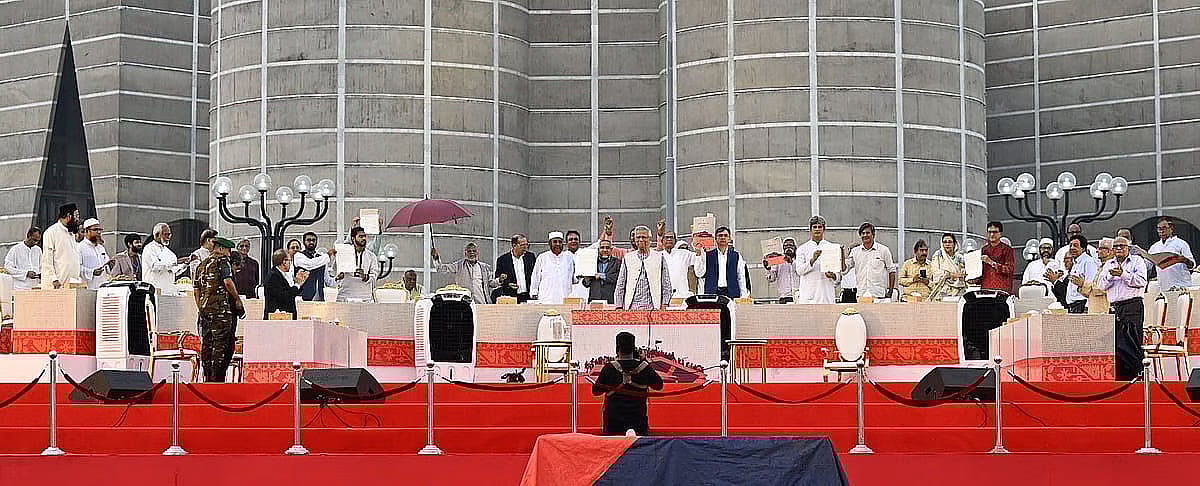
On 17 October, 24 political parties, including BNP and Jamaat, signed the charter at the south plaza of the parliament. Six parties, including NCP, did not sign it that day. Later, however, NCP and Gono Forum signed the charter.
Whether there would be dissent
There was political debate over whether dissenting views on various reform proposals would be allowed in the July Charter. Jamaat, NCP, and several other parties were opposed to including a note of dissent. Many political analysts were also against it, arguing that a note of dissent does not affect decisions—it merely records disagreement.
On the other hand, some argued that the charter should include only those issues on which consensus had been reached. For example, political analyst Zahed Ur Rahman opined that reform proposals carrying notes of dissent should not be included in the final July Charter; rather, it should be finalised only with issues on which all political parties agree (Prothom Alo, 3 August 2025).
According to sources concerned, the National Consensus Commission initially also considered excluding notes of dissent. Accordingly, the draft of the July National Charter was first sent to the parties without such provisions. Later, there was a plan to only mention which party had dissent on which proposal. However, BNP demanded that, in addition to mentioning dissent, a note be included stating: “However, if any political party or alliance secures a public mandate through its election manifesto, it may take action accordingly.”
A source from the Consensus Commission told Prothom Alo at the time that the commission did not agree with including such a note. But just before the signing of the July Charter, BNP took a firm stance on the issue. There was concern that BNP might refuse to sign if the note was not included. Eventually, to ensure that the signing ceremony did not collapse, the note was added.
Third phase on implementation mechanism
On the last day of the second phase of discussions on 31 July, several parties, including NCP and Jamaat, demanded discussions on the legal basis and implementation mechanism of the July National Charter. BNP stated that, according to the terms of reference of the National Consensus Commission, it did not have the authority to determine the implementation mechanism. However, if the commission chose to discuss it, BNP would participate.
Later, the Consensus Commission held both formal and informal discussions with political parties on the matter and also conducted multiple meetings with a panel of experts.
Initially, three different positions emerged among BNP, Jamaat, and NCP regarding implementation. BNP supported implementing constitutional proposals through Parliament within two years after its formation. Jamaat wanted the reforms implemented before the national election through a special presidential order or a referendum. NCP proposed implementation through the formation of a constituent assembly.
There was prolonged debate over the implementation mechanism. At one stage, political parties reached consensus on holding a referendum. However, BNP wanted the referendum to be held on the same day as the parliamentary election, while Jamaat, NCP, and some others wanted it earlier. At the same time, they remained firm in demanding a special constitutional order, while BNP argued that the President has no authority to issue such an order. It suggested that a gazette notification could be issued, followed by an ordinance to hold the referendum.
The Consensus Commission stated that the implementation mechanism would not be part of the July Charter. Instead, it would submit multiple recommendations to the interim government based on opinions from political parties and experts. On 28 October, it recommended two closely related alternative proposals to the government.
It states that, to implement the constitutional proposals of the charter, the July National Charter (Constitutional Reform) Implementation Order would first be issued, followed by a referendum, and if the “Yes” vote prevails in the referendum, a Constitutional Reform Council would be formed. Those elected in the parliamentary election would simultaneously be sworn in as Members of Parliament and as members of the Constitutional Reform Council. The council would complete the constitutional reform work within 180 days from the start of its first session. An alternative proposal states that if the council fails to do so within the stipulated time, the proposals would automatically be passed.
However, the commission’s recommendations also sparked political debate.
Implementation mechanism and issuance of order
On 13 November last year, the interim government issued the July National Charter (Constitutional Reform) Implementation Order. The provision for automatic constitutional amendment was removed. It was also announced that the parliamentary election and referendum would be held on the same day.
The order specified that a referendum would be held to implement the constitutional proposals of the July Charter. The referendum question was also fixed in the order. In presenting the proposals, notes of dissent were excluded on key issues such as the caretaker government system, appointment processes to constitutional bodies, formation of an upper house through proportional representation, and approval of constitutional amendments by the upper house. In other words, these proposals were to be implemented as outlined in the July Charter.
The issuance of this order also led to political disagreements. BNP had consistently argued that the President does not have the authority to issue such an order. However, it supported holding the election and referendum on the same day.
After the order was issued, BNP initially reacted against it but later did not strongly oppose it, giving the impression that it had accepted it. The party’s chairman, Tarique Rahman, also called for a “Yes” vote in the referendum.
However, after winning the election, BNP again opposed the order, describing it in parliament as “illegal” and “a document of endless deception by the interim government,” and made it clear that it would not take any initiative to implement constitutional reforms under this order. The referendum ordinance was also not approved in Parliament.
BNP stated that it would adhere strictly to the July Charter as signed, including the notes of dissent.
Why the referendum was held
The referendum was held mainly to approve two issues. Clause 3 of the Implementation Order states that, “for the exercise of the sovereign power of the people, this order and the constitutional reform section of the July National Charter shall be presented in a referendum.”
Clause 4 specified the question to be placed on the ballot: “Do you approve the July National Charter (Constitutional Reform) Implementation Order 2025 and the following proposals regarding constitutional reforms contained in the July National Charter?” (Yes/No):
(a) The caretaker government, Election Commission, and other constitutional bodies will be formed in accordance with the procedures outlined in the July Charter.
(b) The next parliament will be bicameral, with a 100-member upper house formed proportionally based on votes received by parties, and constitutional amendments will require approval by a majority of the upper house.
(c) The parties winning the next parliamentary election will be obliged to implement 30 reform proposals agreed upon in the July Charter, including increasing women’s representation, electing a deputy speaker and some committee chairs from the opposition, limiting the Prime Minister’s tenure, enhancing presidential powers, ensuring fundamental rights, judicial independence, and strengthening local government.
(d) Other reforms mentioned in the July Charter will be implemented according to party commitments.
According to the referendum question, notes of dissent by BNP on core issues—such as the caretaker system, appointments to constitutional bodies, structure and powers of the upper house, and amendment procedures—had no significance. These were passed as originally proposed in the July Charter, without including dissenting notes.
As a result, the referendum endorsed both the Implementation Order and the core reform proposals without dissent.
Before the vote, a source in the interim government indicated concern that BNP might secretly campaign for a “No” vote, which could result in rejection. Efforts were made to ensure BNP supported a “Yes” vote.
On 30 January, at an election rally in Rangpur, BNP Chairman Tarique Rahman urged voters to support both the party’s electoral symbol and vote “Yes” in the referendum in honour of the July Charter.
Referring to the interim government’s reform initiatives, Tarique Rahman said that day, “We have presented our reform proposals there. Broadly speaking, the proposals they have put forward are more or less the same as those we had presented to the public much earlier. There may be some differences with us on certain points. But if there are differences, we have not hidden them. We have openly told the people which ones we agree with and which ones we disagree with.”
However, after winning the election, BNP took a position against implementing the July National Charter Order and the results of the referendum. Home Minister Salahuddin Ahmed said on multiple days in the 13th parliament that since the first parliament began in 1973, the President no longer has the authority to issue such orders, and the July Charter Implementation Order is illegal.
The referendum ordinance issued under that order was also not approved in parliament. BNP stated that the referendum was conducted in a flawed manner, arguing that although there were four questions, there was only one option for answering.
However, BNP says it will fully implement the July Charter as it was signed, including the notes of dissent. Implementing the charter with dissent means that the core constitutional reform proposals will not be adopted. Instead, constitutional amendments will be made in line with BNP’s 31-point agenda and election manifesto.
Implementing the July Charter with dissent effectively means that the fundamental constitutional reform proposals will not be introduced. In that case, how far the goals outlined by the reform commission—such as preventing the establishment of constitutional authoritarianism, resisting any form of fascist rule, and ensuring decentralisation and adequate empowerment of state institutions—will be achieved remains an important question.
It also raises another question: how far such reforms are possible through changes in laws and regulations alone, without a transformation in political culture.