Public transport
Metro rail permanent card crisis yet to be resolved
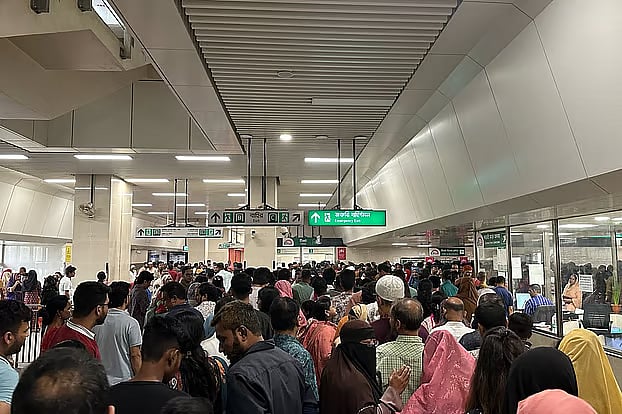
For the past month, Helena Zahid, a resident of Dakshin Khan in Dhaka, has been trying to buy a permanent metro rail card. She went to the Uttara North station several times but returned empty-handed each time. Eventually, she gave up.
Helena Zahid often needs to go to Gopibagh. She told Prothom Alo, “It’s very easy to take the metro from Uttara to Motijheel and then go to Gopibagh. But since I don’t have a permanent card, I have to travel using a single-journey card. Every time, I have to stand in line to buy a card. It takes more time and costs more.”
Many Dhaka residents like Helena are facing the same problem. They want permanent cards for regular travel but can’t avail these. Metro rail officials have said steps are being taken to resolve the shortage, but the matter remains unresolved.
The metro rail in Dhaka began operations in December 2022. Initially, the electric train ran from Uttara to Agargaon. It now operates up to Motijheel, and work is underway to extend the line to Kamalapur. At present an average of 400,000 passengers travel by metro rail every day.
There are two types of permanent cards for traveling on the metro rail, the Rapid Pass and the MRT Pass. The MRT Pass is owned by Dhaka Mass Transit Company Limited (DMTCL), which operates the metro rail. The Rapid Pass is owned by the Dhaka Transport Coordination Authority (DTCA). Both organisations are under the Ministry of Road Transport.
Despite being under the same ministry, a tug-of-war has been going on for the past year over which organisation will handle the sale and management of the permanent cards.
As a result, no new MRT Passes have been issued, and the card is no longer being sold. On the other hand, the number of Rapid Passes purchased by DTCA is insufficient to meet passenger demand. And so commuters suffer.
Under the Line-6 project of the metro rail operating between Uttara and Motijheel, DMTCL initially purchased 723,000 MRT cards and 319,000 single-journey cards. After the number of passengers increased, DMTCL bought another 440,000 single-journey cards. Around 250,000 single-journey cards are still in stock, meaning these can be sold according to passenger demand. However, after the MRT passes ran out last year, no new ones have been purchased.
Towards the end of the previous Awami League government, the responsibility for issuing permanent metro rail cards was handed over to DTCA. The aim was to create a card that would allow passengers to travel across all forms of public transport in the capital—including metro rail, buses, and trains—with a single card. It would even be possible to pay toll on bridges or for parking.
The project was implemented by Japan’s international cooperation agency, JICA. The plan was to have a clearing house, managed by a separate company. While the clearing house was established, the company was not.
According to DTCA sources, initially a technical team from JICA managed the clearing house. After the project ended, they left. Now, the clearing house is run by DTCA. For using this clearing house, DTCA receives 3 percent of the fare from every metro rail passenger using a permanent card.
So far in the country, no other public transport besides the metro rail has fully operational Rapid passes. As a result, the main demand for this card remains confined to the metro rail. After the metro rail began operations, DTCA purchased around 650,000 Rapid Passes in three phases. However, the contractors have never been able to deliver the full quantity on time.
Giving hope that the card shortage will be resolved, Faruque Ahmed, Managing Director (MD) of DMTCL, told Prothom Alo, “DTCA has supplied 50,000 Rapid passes and will supply more. Apart from that, they will soon issue a tender to purchase 100,000 MRT cards.”
However, a DTCA official said that as of 7 October 7, a total of 250,000 cards were supposed to arrive, but only 100,000 were received. From these, 50,000 cards were supplied to metro rail stations for sale. These cards will run out within a month. If no more cards arrive after that, the shortage will recur.
At the end of last month, DTCA handed over the secret code to the metro rail authorities. Now, anyone can transfer the unused balance from an old card to a new one
Meanwhile, DMTCL officials said that because they now have the secret code from DTCA, they can purchase MRT passes if needed. They have already received approval to buy 100,000 cards. However, acquiring these cards through a tender process could take three to six months.
Resolution for lost cards
Alongside the card shortage, another problem was faced by those whose old MRT cards were damaged or lost. This was because all permanent cards are managed through the clearing house, which is under DTCA’s control. Fares and unused balances from permanent cards are stored there, and the system’s secret code is also held by DTCA. As a result, any unused balance on lost or damaged cards could not be recovered.
Asif Ahmed, who regularly travels from Farmgate to Secretariat Station by metro rail, told Prothom Alo that he bought an MRT Pass right after the metro rail began operations. He lost it last August and later got a Rapid pass. However, the previous card had an unused balance of 400 taka, which could not be recovered.
At the end of last month, DTCA handed over the secret code to the metro rail authorities. Now, anyone can transfer the unused balance from an old card to a new one.
Faruque Ahmed, DMTCL MD, said that the unused balance from old or damaged MRT cards can now be transferred to Rapid passes.