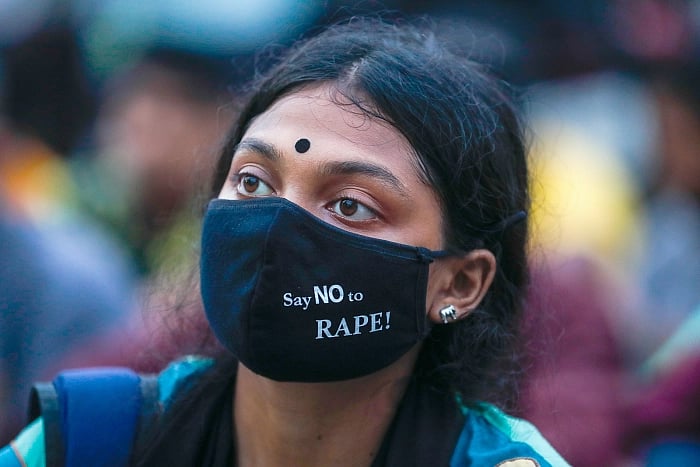
Women's Day 2026
Rape cases rise 27pc in one year
“If you want to understand people’s suffering and hardship, visit a court or a hospital”—this is an oft repeated observation. It is profoundly true. While visiting four Women and Children Repression Prevention Tribunals in Dhaka on 1 March, the sadness and anxiety etched on faces there were clearly visible.
The courtrooms could not accommodate everyone, so victim women and their relatives sat on benches placed along the verandas outside. As case numbers and names were called out, the women stood before the judge, visibly anxious.
In one tribunal, because a microphone was being used, the descriptions of abuse narrated by the victimised women could be heard clearly.
At Women and Children Repression Prevention Tribunal-4, a young woman was sitting on the back bench beside this reporter, waiting for her name to be called. This tribunal did not have a microphone, so the sorrowful and weary voices of the complainants could not be heard from outside. Only the voices of the judge and the lawyers were audible.
It was understood that one of the accused in a case involving the gang rape of a child had sought bail, which the judge rejected. The judge then rebuked the accused in the child rape case. Watching the scene, the young woman told this reporter sitting beside her that she had come to file a complaint against her boyfriend for rape by deception. She said she was going through immense mental distress. At one point during the conversation, she covered her face and burst into tears.
While applications and hearings over allegations of rape and violence against women and children were taking place in these Dhaka courts, a series of incidents involving rape and attempted rape followed by murder in different parts of the country have also drawn public attention.
In Pabna, a grandmother was killed and her teenage granddaughter was dragged into a crop field, where she was raped and murdered. In Narsingdi, the family of a girl who was gang raped had sought justice locally; the girl was later killed.
In Sitakunda, a seven-year-old child had her throat slit after being subjected to sexual violence. The bloodied child walked out of the forest alone, a sight that horrified many. She died in hospital after fighting for her life for a day and a half.
A student of Jahangirnagar University has also been subjected to rape and abuse by her former boyfriend. In a continuation of mob violence, an incident of harassment against women also occurred in the Dhaka University area. Two young women standing in front of the Teacher-Student Centre (TSC) were punched, kicked and assaulted by another student.
More incidents followed. On 3 March, in Cox’s Bazar’s Ukhiya, a housewife was gang raped inside her home when she woke up to eat sehri. She died at the scene.
Some of these incidents have led to cases being filed, while others have not. According to data from Police Headquarters, the number of cases filed under the Women and Children Repression Prevention Act has increased by 25 per cent over the past year. During this time, rape cases have risen by more than 27 per cent. Of all cases of violence against women filed last year, nearly one-third involved allegations of rape.
Amid this situation, Bangladesh is observing International Women’s Day today, Sunday, 8 March, with the slogan of hope. This year’s theme is: “Today’s action, tomorrow’s justice: Ensure the rights of women and girls.”
Minister for Women and Children Affairs A Z M Zahid Hossain believes that ending violence against women cannot be achieved by the government alone. Speaking to Prothom Alo at his office in the Secretariat on 24 February, he said preventing violence and hateful behaviour towards women is not solely the government’s responsibility; it is the responsibility of everyone.
According to him, collective engagement is needed to address the issue. Society as a whole must become more aware to protect women’s dignity. Leading media outlets can also play a major role in establishing women’s rightful place of respect in society.
Cases rising, but thousands still pending
According to Police Headquarters, 21,939 cases were filed across the country in 2025 under allegations of violence against women and children. Under the Women and Children Repression Prevention Act, cases can be filed under nine categories of offences. These include rape and death resulting from rape, sexual relations established through a promise of marriage, sexual harassment, dowry, abetment of suicide, abduction, ransom, maiming a child for the purpose of begging, and crimes committed using corrosive substances.
Among the cases filed in 2025, 7,068 involved allegations of rape. Of the victims, 5,171 were adult women and 1,897 were children.
Compared with 2024, the number of cases involving violence against women increased by 25 percent last year. In 2024, a total of 17,571 cases were filed, including 5,566 rape cases. Earlier, 18,941 such cases were filed in 2023, 21,766 in 2022, and 22,136 in 2021.
According to data from the High Court, as of 31 December last year, 132,107 cases were pending in 99 Women and Children Repression Prevention Tribunals across the country. Among these, 30,365 cases have remained pending for more than five years.
Dhaka’s nine tribunals have the highest number of pending cases—11,567 in total, including 3,091 that have been pending for more than five years.
Shireen Parveen Haque, chief of the Women’s Affairs Reform Commission formed during the tenure of the interim government, told Prothom Alo, “Violence against women, threats of violence, harassment and abuse seem to have become routine matters. Violence against women is one stage of the tendency to control them. Men often carry the confidence that they have the right to commit violence against women and that they will get away with it.”
Emphasising the need for a major social movement against violence towards women, Shireen Parveen said the central message of such a movement should be: recognise women as human beings, know them and respect them.
According to her, the government must treat violence against women as a national problem. Measures should be taken with the same urgency as those adopted during a state of emergency.
Law amended twice in five years
The rape and murder of an eight-year-old child in Magura in March last year sparked protests across the country. In response, significant amendments were introduced in the trial process for rape cases through the Women and Children Repression Prevention Ordinance, 2025, issued on 25 March that year.
While rape committed under the promise of marriage remains within the rape provision (Section 9), it has been placed under a separate subsection (9B) with a different title: “Punishment for sexual acts through inducement of marriage.” The maximum punishment under this provision has been set at seven years of rigorous imprisonment.
The ordinance also removed the mandatory requirement of DNA testing of both the victim and the accused. It stated that if the court believes a trial can proceed based on a medical certificate without DNA testing, then such testing will not be required.
The time limit for investigation and trial in rape cases (excluding Section 9B) has also been halved. Investigations must be completed within 15 days and trials within 90 days, although judges may extend the timeframe if necessary.
Under the law, the maximum punishment for rape remains death or life imprisonment with rigorous labour.
With these changes, the Women and Children Repression Prevention Act enacted in 2000 has been amended for the second time in the past five years. Earlier, in 2020, following nationwide protests over two gang rape incidents in Sylhet and Noakhali, the then Awami League government set the maximum punishment for rape at death. At the same time, DNA testing was made mandatory to identify the accused in rape cases.
Responding to a question, Shireen Parveen Haque said, “The continued occurrence of violence against women also reflects some failure of the women’s movement. We are not always able to sustain the momentum. In 2020, women of different generations came together to stage major protests after the gang rape in Begumganj. Had that protest movement been sustained, perhaps we could have seen some changes. However, there is no lack of effort in the women’s movement.”
Investigation must also be monitored
Senior Supreme Court lawyer Sara Hossain believes that violence against women and children in the country has reached an alarming level. She told Prothom Alo that when such incidents occur, there is widespread outcry.
However, there is little follow-up on whether the victim receives support or whether the investigation and trial are proceeding properly. In many cases, there are attempts to cover up the incidents, and the victim is blamed.
The Police Bureau of Investigation (PBI) reported that it found no evidence supporting 44 per cent of rape allegations in more than 11,000 cases it investigated. These cases were filed at police stations and courts between 2016 and 2023. The PBI published the report in February last year.
However, officials said that at least 30 per cent of the cases that remained unproven were actually genuine but could not be established due to lack of evidence, the complainant’s reluctance, or the incompetence of investigating officers.
Sara Hossain said attention must be given not only to monitoring the judicial process but also to the investigation process. Authorities need to ensure that investigations are completed within the stipulated time. Professional witnesses such as police officers and physicians often fail to appear in court. Many are transferred elsewhere and receive no travel expenses to attend hearings. This issue requires coordination, and witness protection is essential.
She also emphasised that violence against women must be treated as a priority issue. According to her, victims require financial, legal and medical assistance. Large-scale programmes should be undertaken to operate one-stop crisis centres and related support cells with their own dedicated funding.