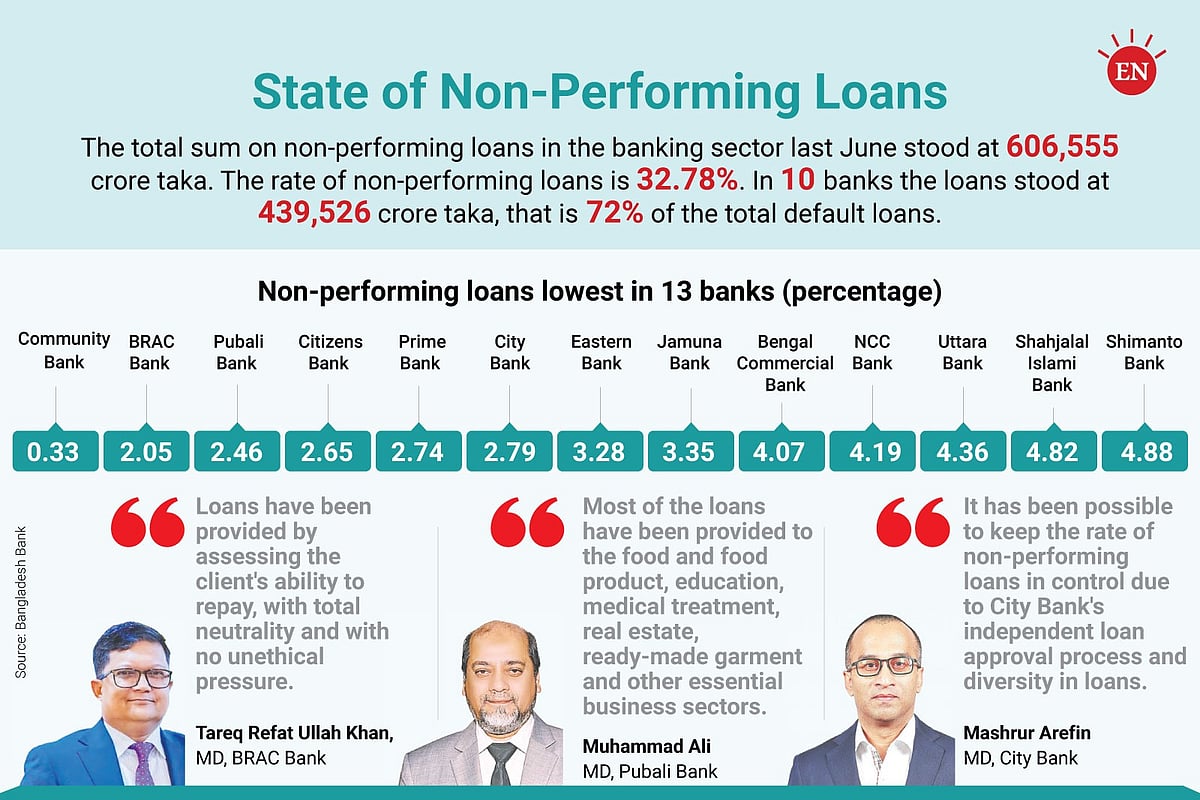
Nearly Tk 33 out of every Tk 100 in loans disbursed by the country’s banking sector are now classified as non-performing, meaning that 33 per cent of loans are in default. By the end of June, non-performing loans (NPLs) had risen to more than Tk 600,000 crore (Tk 6 trillion). Even amid such a crisis, 13 private banks stand out as exceptions, with each reporting an NPL ratio of below 5 per cent.
Senior officials of these banks say that disciplined and independent loan approval processes, careful assessment of borrowers’ repayment capacity, and a focus not only on large corporate loans but also on small and medium-sized enterprises (SMEs) and consumer lending have helped keep NPLs under control.
According to the central bank’s latest data as of June, all 13 banks with NPL ratios below 5 per cent are from the private sector. The group includes both newer-generation banks and first-generation banks. The banks are Community Bank, BRAC Bank, Pubali Bank, Citizens Bank, Prime Bank, City Bank, Eastern Bank, Jamuna Bank, Bengal Commercial Bank, NCC Bank, Uttara Bank, Shahjalal Islami Bank, and Shimanto Bank.
According to the International Monetary Fund’s (IMF) Financial Soundness Indicators and the World Bank’s non-performing loan indicators, Bangladesh currently has the highest level of NPLs in the world. Banking-sector stakeholders say that despite Bangladesh having one of the highest levels of loan defaults globally, some banks in the sector continue to maintain good corporate-governance practices. As a result, these banks have strengthened their financial foundations and have also performed better in terms of profitability.
Banks that are ahead on various financial indicators are also seeing their deposits grow at higher rates than those of other banks. At the same time, these banks have relatively lower levels of non-performing loans.
13 banks with low non-performing loans
According to Bangladesh Bank data, Community Bank has the lowest rate of non-performing loans (NPLs) in terms of percentage. The total amount of loans disbursed by this new-generation bank is also relatively low. As of the end of last June, out of the bank's total disbursed loans of Tk 1,633 crore (Tk 16.33 billion), Tk 5 crore (Tk 50 million) was non-performing. This puts the bank's NPL ratio at 0.33 per cent.
BRAC Bank holds the second position, with an NPL ratio of 2.05 per cent. As of last June, the bank's total disbursed loans stood at Tk 75,621 crore (Tk. 756.21 billion) of which Tk 1,548 crore (Tk 15.48 billion) was classified as non-performing. BRAC Bank is currently the top profit-earning institution among locally-owned banks. Recently, BRAC Bank was featured in US magazine Forbes’ list of the world''s top 500 best-performing banks.
When asked, Tareq Refat Ullah Khan, Managing Director (MD) of BRAC Bank, said: "In credit risk management and loan approval, good governance and proper risk assessment are the main tasks. This is the key to maintaining the quality of BRAC Bank's loans. Loans have been extended by assessing borrowers'' repayment capacity in a completely neutral manner without any unethical pressure. As a result, we have been able to keep non-performing loans under control."
Pubali Bank ranks third on the list of banks with the lowest level of non-performing loans (NPLs) in the country. At the end of last June, the bank’s NPL ratio stood at 2.46 per cent. By then, out of the bank’s total outstanding loans of Tk 72,576 crore (Tk 725.76 billion), Tk 1,789 crore (17.89 billion) was classified as non-performing.
Speaking to Prothom Alo, Pubali Bank Managing Director Mohammad Ali said, “No loan at this bank has been granted based on the sole advice or personal recommendation of me or any senior official. Loans are approved through a fully institutional and systematic assessment process. The borrower’s personal or political identity is also not taken into consideration when granting loans.”
Mohammad Ali further said, “Most of the bank’s large loans have been provided to essential business sectors such as food and food products, education, healthcare, housing, and garments. As a result, a relatively small proportion of our loans have become non-performing. We are now increasing our focus on consumer lending.”
Citizens Bank, a new-generation bank that ranks fourth on the list, had an NPL ratio of 2.65 per cent at the end of last June.
Prime Bank ranks fifth. At the end of last June, the bank’s NPLs amounted to Tk 948 crore (Tk9.48 billion), equivalent to 2.74 per cent of its total loans.
Prime Bank is followed by City Bank in sixth place. At the end of last June, City Bank’s non-performing loans (NPLs) amounted to Tk 1,514 crore (Tk 115.14 billion), equivalent to 2.79 per cent of the bank’s total outstanding loans.
Speaking to Prothom Alo, City Bank Managing Director Masrur Arefin said, “City Bank’s independent loan approval process and diversified lending portfolio have enabled us to keep the NPL ratio under control. SME and consumer lending are providing us with significant comfort. Banks that are placing greater emphasis on SME and consumer lending are performing well.”
Eastern Bank ranks seventh in terms of the lowest NPL ratio. At the end of last June, the bank’s NPLs stood at Tk 1,520 crore (Tk 15.20 billion), representing 3.28 per cent of its total outstanding loans.
From eighth to 13th place are, respectively, Jamuna Bank, Bengal Commercial Bank, NCC Bank, Uttara Bank, Shahjalal Islami Bank, and Shimanto Bank. Among them, the NPL ratio was 3.35 per cent at Jamuna Bank, 4.07 percent at Bengal Commercial Bank, 4.19 per cent at NCC Bank, 4.36 per cent at Uttara Bank, 4.82 per cent at Shahjalal Islami Bank, and 4.88 per cent at Shimanto Bank.
72pc of non-performing loans concentrated in 10 banks
According to Bangladesh Bank data, the total amount of non-performing loans (NPLs) in the country’s banking sector stood at Tk 606,555 crore last June. This represented 32.78 per cent of the banks’ total outstanding loans. Of this amount, Tk 439,526 crore in NPLs was concentrated in 10 banks, accounting for 72 per cent of the total non-performing loans.
Islami Bank, a private-sector bank, had the highest amount of NPLs. The bank had NPLs of Tk 98,914 crore, (Tk 989.14 billion) equivalent to 52.15 per cent of its total loans. Janata Bank, a state-owned bank, had the second-highest amount of NPLs, at Tk 75,728 crore (Tk 757.28), representing 75.05 per cent of its total outstanding loans.
The merged banks have the highest NPL ratios. Among them, 97.08 per cent of First Security Islami Bank’s loans, 96.78 per cent of union Bank’s loans, 78.15 per cent of Social Islami Bank’s loans, and 70.81 per cent of EXIM Bank’s loans are currently classified as non-performing.
At National Bank, 65.74 percent of loans are classified as non-performing, compared with 63.38 per cent at IFIC Bank and 56.4 percent at AB Bank. In addition, 43.98 per cent of the loans at state-owned Agrani Bank are now classified as non-performing.
Anis A Khan, former chairman of the Association of Bankers, Bangladesh (ABB) and former managing director of Mutual Trust Bank (MTB), spoke to Prothom Alo about the overall situation regarding non-performing loans in the country’s banking sector. In his view, “Despite the high level of NPLs in the banking sector, the banks that are performing well continue to follow good corporate-governance practices. Even a look at the composition of the boards of directors of these banks shows what they are like.
"Customers now take such factors into consideration when deciding where to deposit their money. At the same time, these banks have skilled bankers working with them. This is why their levels of non-performing loans are lower.”