District trade and commerce—1
Husking mills losing ground to polished rice
Commercial husking mills, or small rice mills, began operating in Dinajpur—once known as the city of rice—in the 1980s. Paddy used to arrive at these mills from districts including Mymensingh and Netrokona, and the business flourished steadily.
After 2000, the number of such mills rose to more than 2,500. However, after 2015, the industry gradually began losing its prominence.
Field visits and conversations with small mill owners and workers revealed that this labour-intensive industry is now on the verge of disappearing due to labour and capital shortages, growing demand for polished rice, technological limitations, competition from large corporate firms and strict government policy conditions.
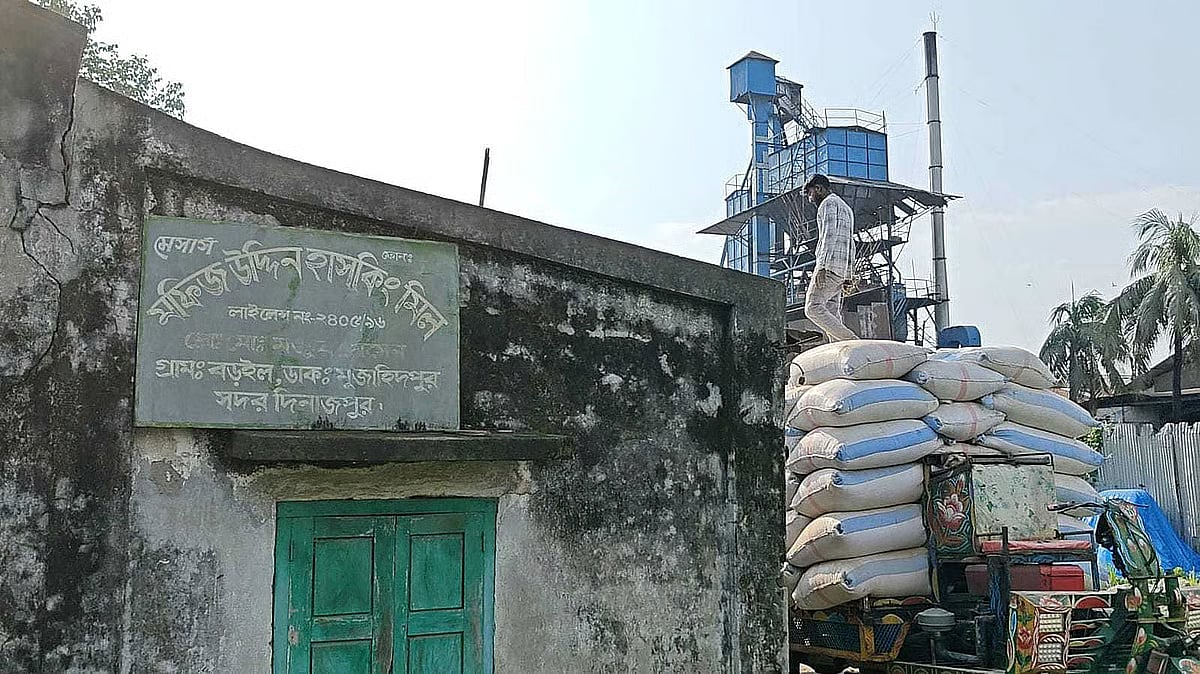
A visit to a husking mill in Dinajpur’s Raniganj area showed little activity there. Its owner, Hafizur Rahman, told Prothom Alo that he had established the mill on nearly two acres of land around 1990. During harvesting seasons in the past, 15 male and female workers regularly worked there. Paddy steaming, drying and milling continued day and night.
Now, not only is the labour shortage acute, but market demand for the reddish rice they produce has also declined. The government, too, no longer purchases rice from such mills.
Over the past five years, the number of husking mills in Dinajpur has fallen from 2,180 to 703.
Small mills are struggling as they fail to meet conditions for government rice procurement.
The 65-year-old mill owner said he is burdened by unpaid rice sales, loan pressure and worries about keeping the mill operational. He has already developed heart disease and must travel to Dhaka soon for a stent procedure.
Expressing frustration, he said, “Ninety-nine per cent of the people involved in this business have left. These mills will not survive anymore.” In his view, the labour shortage is the main reason. He believes the mills could have survived had the government procured their rice.
Hafizur Rahman’s son, Selim Hossain, is also disappointed that the family business cannot be sustained. He said they are trying to retain the licence by renovating part of the yard and drying maize there.
The situation is similar at the husking mill established by Moslem Uddin in 1985. At one time, 30 to 40 workers were employed there. The mill, located in Chandganj, which remained operational until two years ago, has now been rented out for drying maize.
Moslem Uddin has also fallen ill. His son, Russell Rana is the one managing the mill now. He told Prothom Alo that erratic weather patterns have made operations more difficult. Paddy cannot be dried without sunlight, and work comes to a halt during rain.
Reddish rice produced by husking mills contains higher levels of nutrients and minerals. Consuming excessively polished rice over a long period may weaken immunity.Maruf Ahmed, professor, Department of Food Processing and Engineering, Hajee Mohammad Danesh Science and Technology University
When there is no work, labourers employed on contracts and paid based on the ammount of work done are hard to find. Meanwhile, auto rice mills continue production uninterrupted. In addition, the supply of paddy to husking mills has declined because of the agents of the auto rice mills. Altogether, the traditional drying yard-based business model is collapsing.
The stories of Hafizur Rahman and Moslem Uddin are echoed across almost all husking mills in Dinajpur. Visits to 12 mills in Dinajpur Sadar, Birol, Bochaganj and Birganj upazilas over the past few days revealed the same picture.
Some owners have rented out their mills as warehouses or drying yards; some are producing cattle feed from rice husk, while some are making fuel from milling waste. Many mill workers have left the trade and are driving auto-rickshaws now.
Government statistics reflect the same trend. According to the district food office, Dinajpur had 2,180 operational husking mills in 2019. By 2025, the number had dropped to 703. In other words, two-thirds of the mills have shut down within five years, leaving only one-third still standing.
However, many mills that remain officially operational on paper no longer produce rice. Some survive by purchasing rice from auto rice mills and supplying it to government warehouses, while others have rented out their licences to middlemen.
According to government policy conditions, broken grains in rice cannot exceed 2 to 6 per cent and dead grains cannot exceed 0.5 per cent. There cannot be more than one types of grain of paddy per kilogram of rice and semi-boiled grains cannot exceed one per cent.
Trapped by conditions
Since 2010, the number of technologically advanced auto rice mills has increased steadily in the country. Large corporate companies entered the sector with heavy investment. These mills produce polished rice through a process known as “sottering”. In contrast, rice from husking mills remains slightly coarse and reddish.
In 2015, the Ministry of Food introduced new guidelines for rice procurement. At the time, Qamrul Islam was the food minister. Drives were conducted against various mills over allegations of stockpiling at that time. Since then, the crisis facing small mills has deepened.
According to government policy conditions, broken grains in rice cannot exceed 2 to 6 per cent and dead grains cannot exceed 0.5 per cent. There cannot be more than one types of grain of paddy per kilogram of rice and semi-boiled grains cannot exceed one per cent.
Mahidul Islam, an official at a local supply depot (LSD) in Dinajpur, said they do not have equipment to test these conditions. However, rice that does not appear polished is not procured. As a result, husking mills are excluded from government procurement. Many are therefore forced to polish their rice through auto rice mills, increasing production costs and losses.
There has been no survey to determine how many mills are actually needed to process the nearly 40 million tonnes of paddy produced in the country each year. Because more mills have been established than necessary, many owners are struggling to stay in business. Many borrowed money to build mills, but insufficient income has left some of them defaulting on bank loans.Monirul Islam, district food controller, Dinajpur
Shortage of paddy
Husking mills contain paddy boiling vats, furnaces and drying yards. According to those involved in the sector, Marwari traders began this business before the Partition of 1947. Local entrepreneurs entered the industry later.
Today, a single auto rice mill has the capacity equivalent to 20 husking mills. Some large corporate-owned auto rice mills equal the capacity of 30 auto mills combined.
Paddy supplies to husking mills have also declined sharply. Discussions with industry insiders revealed that auto rice mills appoint agents to procure paddy. These agents buy paddy from farmers in advance by paying upfront and even store paddy in farmers’ granaries on behalf of large companies. Husking mills, on the other hand, lack sufficient capital.
District Food Controller Monirul Islam said there’s a sort of competition going on to keep the auto rice mills running throughout the year. They can stock up to three times their actual processing capacity. He believes policy reforms are needed under these circumstances.
Trying to survive
Despite numerous challenges, some husking mills are still managing to survive. One such mill located at Khoarer Mor area in Pulhat is owned by Mojibur Rahman. The 75-year-old entrepreneur has been in the business for three decades.
Millers and experts say changing food habits are also a major reason behind the decline of the husking mill industry. Consumers are becoming increasingly attracted to polished, glossy rice, while demand for reddish rice has fallen.
He said rice produced at husking mills cooks softer and can be stored for up to eight months. In contrast, rice from auto rice mills becomes infested with insects after just two months, and the cooked rice feels harder. For this reason, conscious consumers still buy rice from him. Rice from his mill is supplied to various parts of the country including Dhaka and Rajshahi.
Millers and experts say changing food habits are also a major reason behind the decline of the husking mill industry. Consumers are becoming increasingly attracted to polished, glossy rice, while demand for reddish rice has fallen. As a result, consumers are also being deprived of nutritional value.
Maruf Ahmed, a professor in the Department of Food Processing and Engineering at Hajee Mohammad Danesh Science and Technology University, said reddish rice produced at husking mills contains higher levels of nutrients and minerals. Consuming excessively polished rice over a long period may weaken immunity. He stressed the need to raise public awareness among consumers.
However, not only the husking mills, but the auto rice mills are also facing difficulties. According to the district food office, Dinajpur had 346 auto rice mills in 2019. By 2025, that number had fallen to 223.
Traders in the northern region do not receive agricultural loan facilities. Earlier, loans were available at nine per cent interest rate, but now they have to pay 14 per cent. As a result, many are repaying bank loans using their core capital, allowing market control to concentrate in the hands of only a few companies.Shahidur Rahman Patwari, vice-president of the Bangladesh Auto Major and Husking Mill Owners Association
Dinajpur Food Controller Monirul Islam told Prothom Alo that there has been no survey to determine how many mills are actually needed to process the nearly 40 million (4 crore) tonnes of paddy produced in the country each year.
Because more mills have been established than necessary, many owners are struggling to stay in business. Many borrowed money to build mills, but insufficient income has left some of them defaulting on bank loans, he added.
Shahidur Rahman Patwari, vice-president of the Bangladesh Auto Major and Husking Mill Owners Association, said traders in the northern region do not receive agricultural loan facilities. Earlier, loans were available at nine per cent interest rate, but now they have to pay 14 per cent.
As a result, many are repaying bank loans using their core capital, allowing market control to concentrate in the hands of only a few companies, he added.
Still, some husking mill owners have not entirely given up hope. One of them is Hafizur Rahman, a husking mill owner from Raniganj. He said he has kept his licence active in the hope that demand for reddish rice may one day rise again.
However, whether that better time returns will depend largely on consumer awareness and preferences.