Budget 2026-27
BNP govt set to unveil ambitious budget built around big targets
The Bangladesh Nationalist Party (BNP) government is placing strong emphasis on fulfilling its election manifesto commitments, boosting investment and employment, and reviving a troubled economy through its first national budget.
The budget also sets highly ambitious revenue targets. As the budget expands in size, so too does the fiscal deficit, necessitating increased borrowing to bridge the gap.
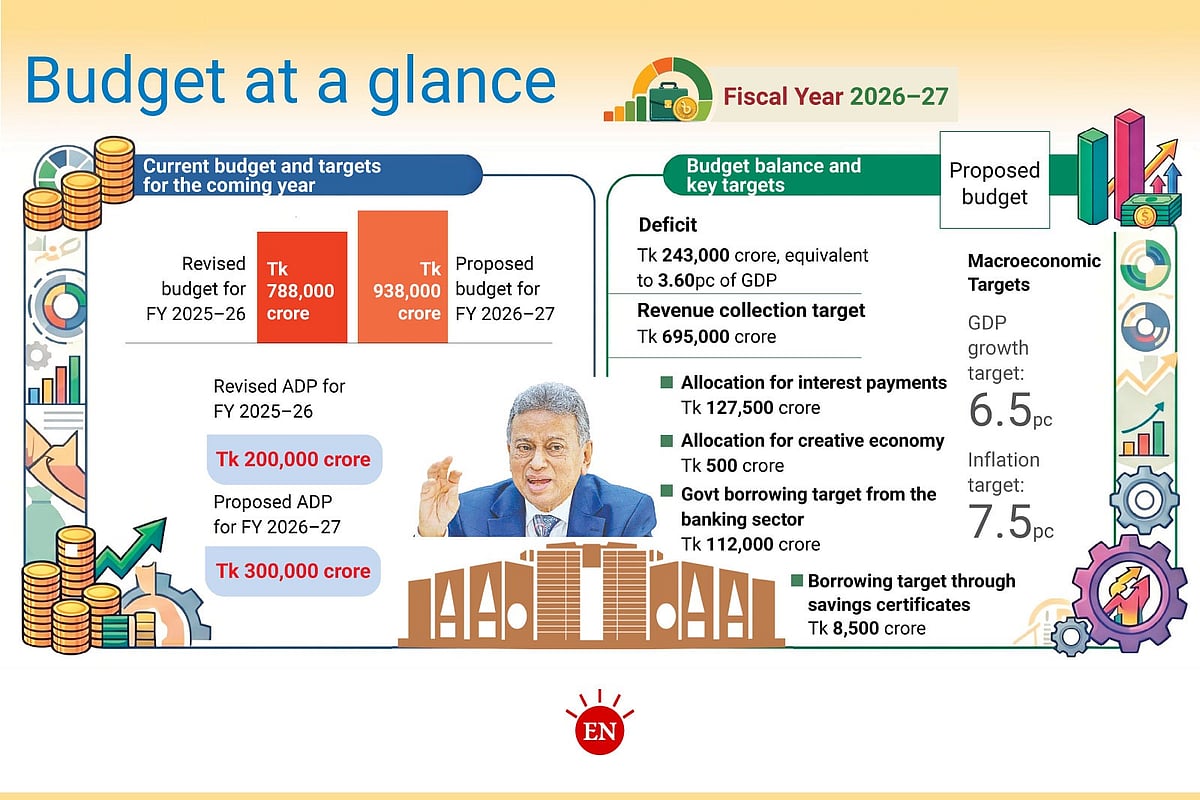
Finance and Planning Minister Amir Khasru Mahmud Chowdhury is set to present a Tk 9.3 trillion (938,000 crore) budget for the next fiscal year in Parliament today, Thursday. It will be the first budget of his career as finance minister and the first budget of the BNP government formed following the national election held in February.
The finance minister has repeatedly said he wants the benefits of the budget to reach grassroots communities. As part of that objective, allocations for social protection programmes could rise to nearly Tk 1.5 trillion (150,000 crore). At least eight new schemes, including the Family Card programme, are expected to be introduced.
The minister also aims to promote the creative economy and improve the ease of doing business.
He has repeatedly spoken of the need for the “democratisation of the economy” and has pledged to reflect that vision in the budget. He has also indicated that he intends to pursue extensive deregulation, reducing government controls wherever possible.
Despite fiscal pressures, the budget may include a partial implementation of a new pay scale for government employees in the coming fiscal year.
The finance minister has repeatedly said he wants the benefits of the budget to reach grassroots communities. As part of that objective, allocations for social protection programmes could rise to nearly Tk 1.5 trillion (150,000 crore).
For the first time, the finance minister may also publish a Citizens’ Budget booklet, designed to present budget information in a simplified format for the general public. The Ministry of Finance believes this initiative will make the budget more accessible and easier to understand.
The original budget for the current fiscal year stood at Tk 7.9 trillion (790,000 crore). The proposed budget is Tk 1.48 trillion ( 148,000 crore) bigger, representing an increase of nearly 19 per cent.
The finance minister has repeatedly defended the larger budget, arguing that higher public spending would support economic growth.
Speaking at a consultation meeting organised by the Federation of Bangladesh Chambers of Commerce and Industry (FBCCI), he openly stated that the economy could not move forward without increased expenditure.
According to Finance Division sources, the government is targeting GDP growth of 6.5 per cent in the next fiscal year, while inflation is projected at 7.5 per cent. Inflation currently remains above 9 per cent.
Revenue collection is expected to be targeted at Tk 6.95 trillion (695,000 crore). Including anticipated grants of Tk 61.5 billion (6,150 crore), total government income is projected to exceed Tk 7 trillion (700,000 crore).
Significant pressure on revenue collection and the reality
Of the total revenue target, more than Tk 6 trillion (600,000 crore) will need to be collected by the National Board of Revenue (NBR) alone.
The central question is how much of the budget can actually be implemented. Is such a large increase in revenue collection achievable within a single year?Zahid Hussain, former Lead Economist at the World Bank’s Dhaka office
The NBR collected Tk 3.7 trillion (370,000 crore) in FY 2024–25. Under the revised budget for the current fiscal year, its collection target was set at Tk 5.03 trillion (503,000 crore). However, during the first 10 months of the fiscal year, from July to April, revenue collection fell short by Tk 697.82 billion (69,782 crore). Collections during the period amounted to nearly Tk 3.27 trillion (326,928 crore).
The government is also projecting Tk 250 billion (25,000 crore) in non-NBR revenue for the next fiscal year, compared with Tk 81.92 billion (8,192 crore) collected in FY 2024–25.
Non-tax revenue (NTR) is expected to generate Tk 660 billion (66,000 crore). Although the original target for the current fiscal year was Tk 460 billion (46,000 crore), the revised budget raised that figure to Tk 650 billion (65,000 crore).
More borrowing, lower interest allocation
More than Tk 1.27 trillion (127,000 crore) may be allocated for interest payments in the next fiscal year.
The Finance Division had previously estimated that interest costs could reach Tk 1.58 trillion (158,000 crore). These payments relate to both domestic and foreign loans undertaken by the government.
Interest payments are considered mandatory expenditures and now constitute one of the largest components of government operating expenditure. The burden has reached a level that is increasingly putting pressure on other budget priorities.
How govt plans to finance deficit
The size of the economy is projected to reach Tk 68.30 trillion (6,830,024 crore) in the coming fiscal year.
The budget deficit, excluding grants, is expected to stand at 3.6 per cent of GDP, equivalent to Tk 2.43 trillion (243,000 crore).
To finance this gap, the government plans to borrow Tk 1.27 trillion (127,000 crore) from domestic sources and a net Tk 1.09 trillion (109,850 crore) from foreign sources.
My concern is that this could negatively affect investment, economic growth and employment. Under those circumstances, the government will also find it difficult to bring inflation under control.Zahid Hussain, former Lead Economist at the World Bank’s Dhaka office
In gross terms, the government intends to secure over Tk 1.55 trillion (155,850 crore) in external borrowing, of which Tk 460 billion (46,000 crore) will be used to repay existing foreign loans.
Of the domestic borrowing target, Tk 1.12 trillion (112,000 crore) is expected to come from the banking sector, which is Tk 60 billion (6,000 crore) lower than the revised target for the current fiscal year.
The government also plans to raise Tk 85 billion (8,500 crore) through the sale of National Savings Certificates.
Concerns over implementation
Speaking to Prothom Alo, Zahid Hussain, former Lead Economist at the World Bank’s Dhaka office, said the expansion of the budget itself was not the central issue.
“The central question is how much of the budget can actually be implemented,” he said. “Is such a large increase in revenue collection achievable within a single year? Likewise, based on past experience, the government may struggle to secure the volume of foreign borrowing it is projecting to finance expenditure and the deficit.”
He warned that if external financing falls short, the government will once again have to rely heavily on domestic sources, particularly bank borrowing.
“If government borrowing from banks rises significantly, the private sector will have less access to credit,” Zahid Hussain argued. “My concern is that this could negatively affect investment, economic growth and employment. Under those circumstances, the government will also find it difficult to bring inflation under control.”