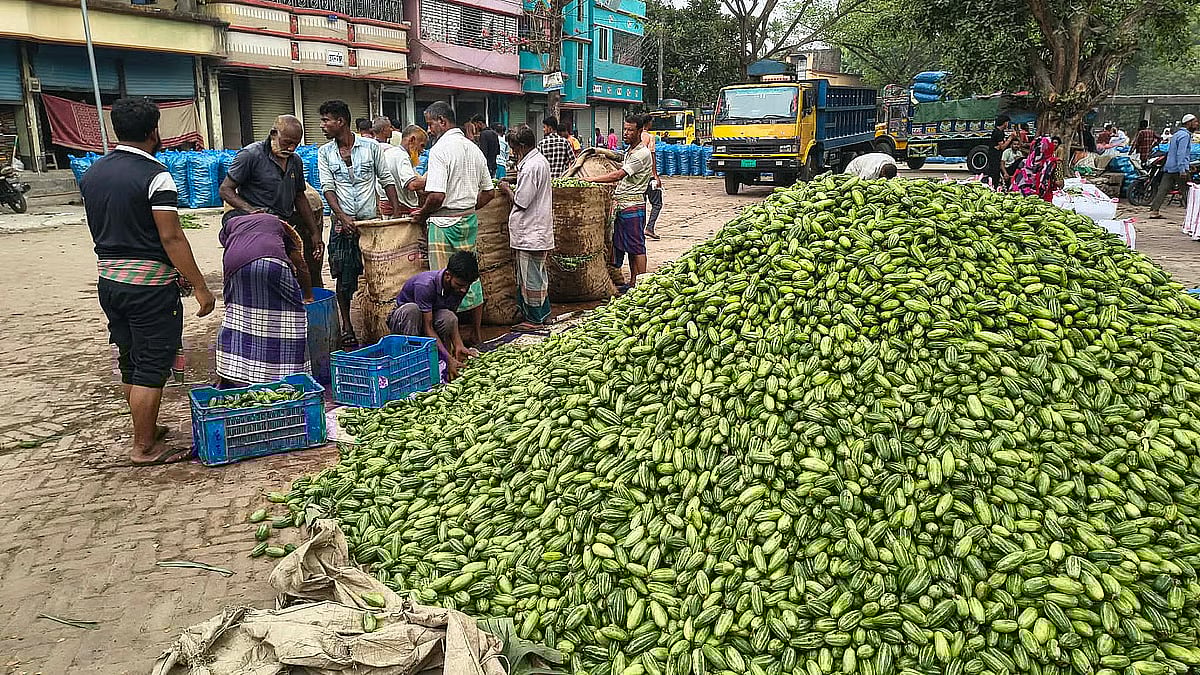
On ground: Jashore to Dhaka
From Tk 56 to Tk 100: How pointed gourd prices rise from farm to market
Farmers in Barinagar wholesale market in Jashore are selling pointed gourd at Tk 56 per kilogram. Before reaching kitchens in Dhaka, the vegetable changes hands at least five times—through traders, intermediaries and retailers. With each transaction, the price rises by Tk 8 to Tk 10, meaning a product sold by farmers at Tk 56 ultimately costs consumers more than Tk 100.
Besides these multiple transactions, several other factors contribute to the price increase: farmers’ inability to buy fertiliser and pesticides at fair prices, extortion in the name of municipal tolls on roads, tips demanded by market labourers, brokerage by political activists, excessive market fees, packaging costs, and high costs of diesel and labour.
Vegetables from the Barinagar wholesale hub are supplied to Dhaka and other parts of the country. On Thursday morning, wholesale prices at the market were Tk 55-56 per kg for pointed gourd, Tk 15-20 per bottle gourd depending on size, Tk 18-20 per kg for radish and Tk 17-18 per kg for red eggplant. About 90 per cent of the vegetables in the market that day were pointed gourd.
Traders purchase pointed gourd and other vegetables directly from farmers at the market. Workers wash and pack the vegetables before loading them onto trucks. On that day, at least 15 trucks carrying vegetables left the market for different destinations.
Atiar Rahman, a trader at the market, told Prothom Alo, “Today I bought 7,000 kilograms of vegetables, about 90 per cent of which are pointed gourd and bottle gourd. Just to buy this small amount of vegetables I had to pay Tk 1,200 as market fees.”
“Transport costs are Tk 18,000. Weight deductions, packaging sacks, labour and brokerage add another Tk 17,500. So sending 7,000 kilograms of vegetables from Jashore to Dhaka costs around Tk 35,000—about Tk 8 per kilogram. After that we still need to make a profit ourselves,” he added.
What was seen along the way
Vegetables from the Barinagar market are sold to consumers at nearly double the price in retail markets. To understand why prices rise so much, this correspondent of Prothom Alo boarded a vegetable-laden truck from Barinagar market on Thursday, bound for the Jatrabari wholesale market in Dhaka.
The truck began its journey at 3:20 pm and reached the Narail bus terminal intersection at 5:04 pm. Five workers in uniform holding sticks in their hands, stood on the road and stopped the truck. As soon as a mobile phone was taken out to take photos, three of them rushed forward. One said, “Shall I give you another camera to take pictures?”
They then handed over a slip and collected Tk 50 from the driver. The slip read, “Narail Municipality toll collection receipt. Transport/truck: Tk 50 per day.” The truck then resumed its journey.
Along the 170-kilometre route, tolls were collected at four places: Madhumati Bridge, Padma Bridge, the Mawa Expressway and the Arial Kha Bridge. Finally, the truck reached Jatrabari wholesale market at 10:02 pm.
Workers unloaded the vegetables from the truck and took them to different wholesale depots. Even after waiting for about an hour and a half, no one from the city corporation or any other group came to collect extortion.
Traders said wholesalers have to pay Tk 1 per kilogram for buying and selling vegetables at the depot. Those operating within the market centre pay another Tk 1, meaning a commission of Tk 2 per kilogram is charged at the wholesale depot for buying and selling vegetables.
When asked whether traders have to pay extortion to city corporation or other political activists in the market, Badhan Hossain, manager of Samad Banijjalay, said, “There is no extortion inside our market.”
When asked how pointed gourd priced at Tk 56 in Jashore reaches Tk 100 in Dhaka’s retail markets, Badhan said, “To bring 1 kg of pointed gourd from Jashore to Dhaka it costs about Tk 8-10 in total, including transport, labour, packaging sacks and market tolls. At that point, the trader would recover his cost if he sells it for Tk 66. At the wholesale market, it would be sold for Tk 70 with a profit of Tk 3-4. The commission agent then takes about Tk 2 per kg.”
“The gourd is then bought by a foria (middleman), from whom a wholesale trader purchases it. Retail traders buy 10-15 kg at a time from the wholesaler, and consumers finally buy it from the retailers. Including the initial trader, the produce changes hands five times.”
“During these transactions, shop rent, labour costs and some spoilage of vegetables are added. Altogether, the price increases by about Tk 8-10 at each level. As a result, by the time 1 kg of pointed gourd reaches the consumer, it costs around Tk 80-90. In that case, selling it for Tk 100-110 per kg is quite normal,” he added.
People involved in the sector say vegetable prices could fall somewhat if the number of intermediaries were reduced. If the government could create a system where vegetables are sold directly from farmers to consumers, prices might be easier to control.
Fertiliser and pesticides not available at fair prices
Farmers complain that they cannot buy fertiliser and pesticides at fair prices. Instead, they have to purchase them from local retail shops at prices higher than the government-fixed rates, which is another major reason behind rising vegetable prices.
Ariful Islam, a farmer from Samaspur village in Jashore Sadar upazila, said, “I cultivate pointed gourd, paddy, taro and lentils on 11 bighas of land. I need fertiliser and pesticides regularly. But we never get fertiliser at government- fixed prices. We have to buy fertiliser and pesticides from local shops at higher prices.”