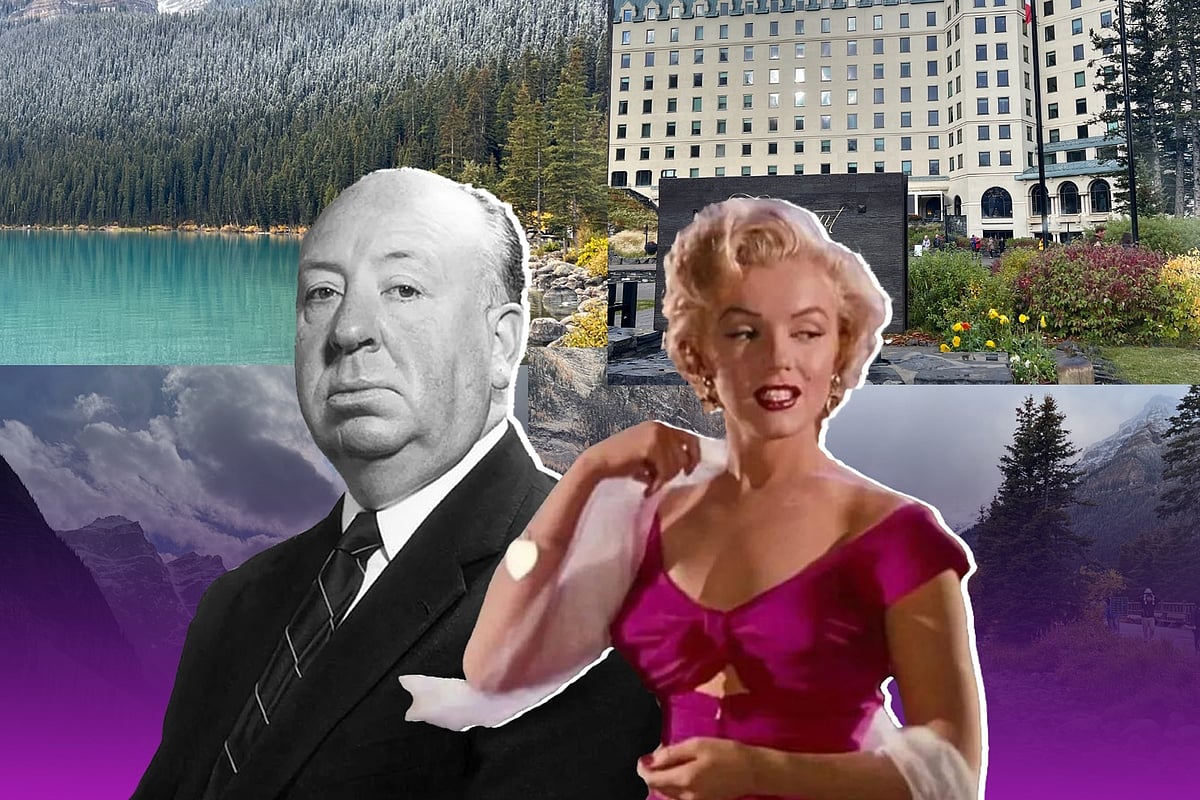
Marilyn Monroe to Hitchcock: Where nature itself becomes a movie set
Snowflakes were drifting down over Lake Louise when I arrived. Some disappeared into the turquoise water, others settled briefly on coats and camera lenses. Beyond the lake, Victoria Glacier rose against the Canadian Rockies, its white peaks fading in and out of the clouds. On one side stood the stately Fairmont Château Lake Louise.
It was the kind of landscape that seemed almost too perfectly composed to be real.
I had seen Lake Louise countless times in photographs before travelling there. Yet standing on its shore was different. A camera, I realised, could capture the mountains, the glacier and the extraordinary colour of the water, but perhaps not the sheer scale of it all.
I had driven from Calgary that Tuesday, watching the landscape gradually transform as the city and open plains gave way to the Rockies. Snow-capped peaks first appeared in the distance, then grew larger as we travelled deeper into the mountains.
Lake Louise, in Alberta's Banff National Park, is one of Canada's most celebrated destinations. But somewhere along the road, my journey acquired an unexpected cinematic dimension.
Our local guide, whom I will call Jason Miller, began pointing out the region's connections with film history. Marilyn Monroe had been here, he said. So had Alfred Hitchcock. Hollywood filmmakers had discovered these mountains nearly a century ago.
Then came another surprise: Bollywood had followed.
Hrithik Roshan and Preity Zinta's Koi... Mil Gaya entered the conversation.
By the time we reached Lake Louise, I was no longer looking at the Rockies simply as a traveller. I had begun looking at them as locations from a movie.
A hotel with a Hollywood past
The guide's stories sent me searching for more.
At Fairmont Château Lake Louise, I spent time looking through historical material and photographs. Later, I cross-checked what I had heard and seen with archival and historical records.
The connection turned out to be far richer than I had expected.
Historic Hotels Worldwide places Fairmont Château Lake Louise within the story of western Canada's "Hollywood North". The history of the hotel and the surrounding area intersects with names including John Barrymore, Betty Grable and Carmen Miranda, while its list of notable guests reads like a journey through generations of screen history: Mary Pickford, Douglas Fairbanks, Alfred Hitchcock, Marilyn Monroe and Superman star Christopher Reeve.
Long before smartphones turned Lake Louise into one of Canada's most photographed landscapes, movie cameras had already found their way here.
The hotel's own story began even earlier.
In 1890, Canadian Pacific Railway general manager Cornelius Van Horne commissioned a small, single-storey wooden chalet on the shore of Lake Louise. It had a dining room, a bar and only two bedrooms.
Its purpose was practical: to provide a base for travellers and adventurers arriving in the Rockies as the railway opened this remote landscape to visitors.
Only 50 guests were recorded in its first year. By 1912, annual visitor numbers had risen beyond 50,000.
The modest chalet grew with them. Fires, rebuilding and successive expansions eventually transformed it into the grand Fairmont Château Lake Louise that stands beside the water today.
The hotel also became intertwined with the development of mountaineering in the Canadian Rockies. Professional Swiss mountain guides were brought to the region around the turn of the 20th century, helping visitors climb and later explore the mountains on skis.
A remote wilderness was gradually becoming an international destination.
And cinema was beginning to notice.
Marilyn Monroe in the Rockies
Among all the famous names associated with the Château, one inevitably stands out: Marilyn Monroe.
Historic Hotels Worldwide lists Monroe among Fairmont Château Lake Louise's notable guests. But her connection with the Canadian Rockies went well beyond a holiday.
In 1953, Monroe travelled to the region to film River of No Return with Robert Mitchum. Directed by Otto Preminger and released the following year, the film used the dramatic Canadian wilderness as a major part of its visual world.
Scenes were filmed across the Rockies, including locations in Banff and Jasper national parks and around the Bow, Maligne and Snake Indian rivers.
For a Hollywood production of that era, the landscape was not simply scenery. The rivers, mountains and wilderness were essential to the story's sense of danger and isolation.
Monroe was already becoming one of Hollywood's defining stars. Gentlemen Prefer Blondes and How to Marry a Millionaire both appeared in 1953. Yet during that extraordinary period in her career, she spent weeks working amid the rugged landscapes of western Canada.
The trip also produced another piece of cultural history.
John Vachon, a photographer working for Look magazine, photographed Monroe in the Banff area in August 1953. During filming, she injured her ankle and was unable to work for several days. Vachon's photographs of Monroe on crutches would become among the memorable images from that Canadian trip.
Inside the Château, I saw some photographs from that period.
There was something striking about looking at images of Monroe from more than seven decades ago and then turning towards the windows to see the same vast mountain world outside.
The documented filming locations of River of No Return extend across the wider Banff-Jasper region rather than being confined to Lake Louise itself. That distinction matters. But Monroe's presence as a historic guest at the Château and her work in the surrounding Rockies have together made her part of the region's cinematic memory.
Hitchcock was here too
Then I came across another name: Alfred Hitchcock.
The director of Psycho, Vertigo, Rear Window and North by Northwest is also listed among the Château's notable historic guests. His photograph is part of the hotel's historical display as well.
Unlike Monroe, however, Hitchcock's Lake Louise connection is not a story of a famous film being shot here.
I could find reliable documentation of his stay, but not credible evidence that one of his major films was made at Lake Louise.
So his place in the story is that of a visitor.
Even that is intriguing. Few filmmakers understood the dramatic power of landscape and location as instinctively as Hitchcock. Standing beside Lake Louise, it was tempting to wonder what he made of the mountains, shifting clouds and enormous stillness surrounding the water.
Hollywood arrived before them
Monroe and Hitchcock were not the beginning of the story.
To find that, one has to travel back to the era of silent cinema.
Ernst Lubitsch's Eternal Love, released in 1929 and starring John Barrymore and Camilla Horn, was set in the Swiss Alps. But filmmakers turned to the Canadian Rockies to create that Alpine world, with historical records linking the production to Lake Louise.
The choice says something about the landscape.
There were no computer-generated mountains to extend a horizon or digitally replace one country with another. If filmmakers wanted an Alpine wilderness, they had to find one.
The Canadian Rockies could convincingly become Europe.
Nearly a century ago, therefore, these mountains were already performing on screen as somewhere else.
The relationship with cinema was not limited to production. Lake Louise also became a retreat for people from the film industry. Silent-screen legends Mary Pickford and Douglas Fairbanks are among the Château's historic guests.
Not everyone whose name appears in the hotel's history came to make a film. Some worked in the region; others came simply to escape work. But taken together, the names show that Lake Louise had become familiar territory to movie people remarkably early in the 20th century.
Why filmmakers keep coming back
Standing there, it was not difficult to understand the attraction.
Within a relatively compact region, filmmakers can find glacial lakes, dense forests, rocky valleys, snow-covered summits and immense open landscapes. Drive a little farther and the visual character changes again.
The seasons transform it even more dramatically.
A summer landscape of turquoise water and green forest can become an almost monochrome world of snow and ice in winter. The same mountains can suggest Canada, the European Alps or an unnamed cinematic wilderness.
Nature does much of the production designer's work.
Hollywood recognised that early. Decades later, Indian filmmakers began making use of Alberta's landscapes too.
When the Rockies entered Bollywood
It was Jason who first brought up Koi... Mil Gaya during our journey.
The 2003 Rakesh Roshan film, starring Hrithik Roshan and Preity Zinta, had filmed material in Canada, and the Château's historical information also pointed to the film's connection with the region.
That sent me to my phone. Standing at Lake Louise, I pulled up scenes and songs from Koi... Mil Gaya on YouTube. Watching them there changed what I noticed.
I had seen "Haila Haila Hua Hua" many times before, naturally watching Hrithik and Preity. This time my attention kept drifting behind them.
Across the song are the mountains, lakes and sweeping landscapes of the Canadian Rockies. With the real terrain now in front of me, those backgrounds no longer felt anonymous.
They looked familiar.
I later found further evidence of the film's Canadian shoot. Anuj Pandit Sharma, one of the child actors in Koi... Mil Gaya, recalled in an interview that the team spent about a month in Canada. He also remembered taking part in the filming of "Jadoo" and "In Panchhiyon Ko Dekhkar" there.
The film's Canadian connection therefore goes beyond a picturesque backdrop glimpsed in a song. The production spent substantial time in the country.
But Koi... Mil Gaya is only part of Bollywood's Alberta story.
From Tum Bin to Akshay and Katrina
As we had driven from Calgary towards Lake Louise, vast stretches of Alberta had unfolded outside the window. Those landscapes had been familiar to Indian filmmakers long before my journey.
Anubhav Sinha's directorial debut Tum Bin was substantially filmed in Calgary. Released in 2001, the romantic drama developed a loyal following, and Canada was more than decorative scenery in the film; it was part of the world in which the story unfolded.
Other Hindi productions followed.
The 2006 film Humko Deewana Kar Gaye, starring Akshay Kumar and Katrina Kaif, filmed in Alberta locations including Calgary, Drumheller and Edmonton, with the Canadian Rockies also forming part of its visual landscape.
Akshay returned to Calgary for another production. 8 x 10 Tasveer, the 2009 mystery thriller directed by Nagesh Kukunoor and co-starring Ayesha Takia, was also filmed there.
Seen together, these films create an interesting trail across the province.
From Tum Bin to Koi... Mil Gaya, from Humko Deewana Kar Gaye to 8 x 10 Tasveer, Alberta's landscapes have repeatedly appeared through an Indian cinematic lens.
The Rockies, it turns out, are familiar not only to Hollywood.
When the background becomes the story
At the beginning of the day, I had left Calgary simply wanting to see Lake Louise.
Then a guide mentioned Marilyn Monroe.
One name led to another: Hitchcock, Barrymore, Pickford, Fairbanks. Inside the Château were photographs and fragments of history. On my phone were Hrithik Roshan and Preity Zinta dancing against landscapes I could now recognise.
Something had shifted.
When we watch a film, we usually follow the actors and the story. Mountains, roads, hotels and lakes remain in the background. Visit one of those places in person, however, and the relationship reverses.
Suddenly you begin studying the background.
That was what happened to me at Lake Louise.
I began imagining the place in different eras: a small wooden chalet beside an isolated lake in 1890; silent-film crews arriving in the Rockies decades later; Marilyn Monroe here in the 1950s; Hitchcock visiting the Château; and, much later, Indian film crews travelling across Alberta.
Cinema changed enormously across those years—from silent pictures to sound, black and white to colour, celluloid to digital.
Lake Louise changed too.
The little wooden chalet of 1890 became the imposing Fairmont Château Lake Louise. Roads improved, tourism expanded and millions of photographs carried the lake around the world.
Yet standing on the shore that afternoon, the surrounding landscape seemed strangely untouched by all that history.
Lake Louise stretched out in front of me. Victoria Glacier and the Rockies rose behind it. As clouds and light moved overhead, the water seemed to shift between turquoise and green. A light snowfall continued. Flakes vanished into the lake and landed on visitors standing along the shore. Some were busy taking photographs. Others simply stood and watched.
Looking around, I felt as though I were standing inside an enormous movie set.
Then again, in a place like this, why would anyone need to build one?