Interview
Artistes were criticised, not acclaimed, for their involvement in politics: Babita
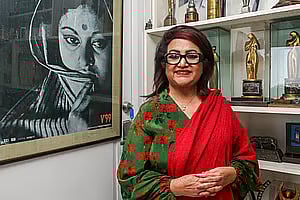
It was Friday morning and the renowned actress Farida Akhter, better known as Babita, sounded quite ecstatic over the phone. The previous day it has been announced that she was officially nominated for the Ekushey Padak for her contribution to cinema. In response to the congratulations, she expressed her gratitude to her fans at home and abroad. She talked about being nominated for this award, her long life in cinema, memories of the other awards won down the years and her present distance from acting. The interview was taken by Monzur Kader.
Congratulations. When did you receive the news of your award, the Ekushey Padak?
On Thursday afternoon, Channel i informed me, “You are receiving the Ekushey Padak.” It felt wonderful to hear the news. I was deeply moved to hear the announcement of receiving the Ekushey Padak in the spirit of Ekushey. Ekushey is my life, my love. I have become Babita and reached this stage because of the love of my fans and audience, and I am grateful to them. My elder sister Suchanda and younger sister Champa are also happy. I wanted to tell my son Anik myself; he has gone to Seattle on office work, so I couldn’t speak to him, but I have sent him a text.
You have previously received the National Film Award eight times, including a Lifetime Achievement Award, along with several other awards at home and abroad. Standing at this stage of life and looking back, will these awards remain as memories, or will they feel like a responsibility?
(Looking toward the drawing-room wall where the awards are displayed) I look at them every day, and of course they will remain as memories. In fact, it is the roles and the awards together that make me who I am. Because the characters found a place in people’s hearts, they eventually received state recognition. It wouldn’t be right to speak of one without the other. It is also true that for many films I did not receive any awards, yet those films are very beautiful, such as Dahan by Sheikh Niamat Ali. We took that film to the Karlovy Vary International Film Festival, where it was well received. Films that did not receive state awards have been honoured by other renowned organisations.
I entered the film world at the age of 13. Zahir Raihan brought me to cinema. At that time, money was not our primary consideration. The main goal was to work with dedication, to rise, to strive; there was a hunger for art. Because I was able to do that, the audience honoured me and gave me their selfless love. It is through their love that I became Babita. This award is also because of all that. Respected Zahir Raihan introduced me to the world of cinema; without him, I could not have come this far. Therefore, I dedicate my Ekushey Padak to Zahir Raihan.
You have had a long journey in cinema. Do you have any regrets?
I am an artiste. Whatever character I worked on in front of the camera, I always tried to become that character. I used to feel that the character I was playing was me. Away from the camera, I am a simple person. I have a family, I have a child. But what happened because of working so extensively in films was that I would leave home at 8 in the morning and return after midnight, often at 12 or 1 am. I even worked three shifts. There were no holidays. It made me feel that so many things in the world remain unknown to me. I couldn’t see or experience many things. Ordinary people do so much, they go out, have picnics, go shopping. Why couldn’t I do that? That is one regret, one lingering sense of loss.
There are others too. For instance, even now when I watch my own films, I am just a viewer. Sometimes I even feel that if I had worked just a little more carefully, it could have been even better. As a viewer, flaws or inconsistencies become noticeable.
Do you think the audience of that time was able to connect with your characters?
I believe they did. That’s why people watched the films. If I talk about Golapi Ekhon Train-e, its dialogues were quoted in offices and many other places. For example, “Amader kono class naikka, amra hogole ek class-er manush.” ("We have no class, we're all people of one class.") Golapi had such poverty and hardship, even her marriage broke down. Then the hero, Faruk, says, “Tui ekta kichu ko, Golapi.” ("Say something, Golapi.") People embraced these dialogues wholeheartedly.
Then there's Alor Michhil. many people told me that I shouldn’t do that role. I was even told, “You and Razzak are doing romantic films now, this one is about an uncle and niece.” I said, “So what? Let me think about it.” Then I realised that it would be a mistake not to do such a beautiful character. And after I did it, people received it very warmly.
Of all the films you acted in over your life, were the decisions always your own, or did you take advice from other family members?
I listened to my family, relatives, and even friends. Everyone offered advice in their own way. Some would say that a particular role wouldn’t be right, or that there was no need to work in a certain film. When I was busy with films, my mother was no longer alive. My father didn’t worry too much about these matters. I used to talk to my elder sister Suchanda, and I also discussed things with Champa. I listened to everyone. But at the end of the day, after careful thought, the decision was mine.
You have also acted in films outside the country. Did working abroad teach you to look at local cinema in a new way?
Absolutely, it taught me to see things anew. Apart from films by Satyajit Ray, I did two or three other films in Canada and Sri Lanka, including co-productions. When I worked in our country, I always learned something from the artistes here. It’s not that the director tells you everything. You can learn a lot from your co-actors as well. There were times when Razzak or Bulbul Ahmed would say, “If you do this part like this, it will feel better.” I tried and it was exactly right. This exchange, this give-and-take, is how I learned. From those I worked with abroad too -- Soumitra Chatterjee and others -- I learned from everyone. I observed how they worked, how things were done there.
You have been away from acting for more than 10 years. When an artiste takes a break, do they fade away, or do they grow inwardly?
An artiste never fades away, cannot fade away. An artiste grows, becomes stronger. Because of the break, a kind of hunger emerges. You may think that if only you had gotten a more beautiful role, you could have done it with full devotion.
If a young filmmaker were to come to you today with a story, what kind of story could persuade you to do a movie?
In neighbouring India, people like Amitabh Bachchan, Rakhi, Rekha --who are still working -- have stories written around them. But here, we don’t really see that happening for anyone. From the conversations here, it feels like they just want the name “Babita.” Either Babita as a mother, or a sister-in-law, or a sister. But even then, the role has to be satisfying. There’s no point in doing token roles as a mother, aunt, sister, or sister-in-law. That is why I don’t do films; it doesn’t feel good. I’ve acted in nearly 275 films. I have built a name for myself. I don’t want to ruin that name. But if someone comes with the right kind of story, then of course I would do it.
What sort of story or character would attract you?
It's difficult to pinpoint what exactly I would like to do. If a director comes to me with a realistic plot, that would be good. I really haven't thought this over. I just would like to do something I feel could portray well. I don't want to be specific, like I want to act as that prime minister or this character.
Lately, in a few films by newcomers that I’ve seen, it doesn’t feel like that kind of effort is there. I’ve even seen someone playing the role of a village girl wearing contact lenses! Is that realistic? Not at all
If a biopic is made about you in the future, what would you want it to be— the story of a successful actress, or the story of you as a person?
It could be the story of the person as well, but I wouldn’t want to bring the person inside me too much to the forefront. Since I am an artiste, I would prefer a biopic to be made focusing on my acting career.
Is an artiste’s success measured only by awards, or is earning a place in the audience’s hearts what truly matters?
Staying alive in the audience’s memory is the greatest success for an actress. Even if one receives all the major awards in the world, there is no true fulfillment if the artiste does not live on in people’s hearts. The people’s love, being remembered by them, is what truly matters.
Do you think films with women-centred stories are not being made here the way they should be?
Very few. Far fewer now. Most films made today are hero-centric; that was true in our time as well. But filmmakers like Subhash Dutta or Amjad Hossain made films with women-centred stories. Even when a film was women-centric, they included whatever else was necessary around the story. But now, women-centred stories are not being made in that way. I would call this a paucity of thinking among the directors.
What would be your most important advice for the new generation of actors?
My advice is that they should not focus solely on money, but to become a true artiste. They need to pay attention to what it takes to grow as an artiste. Lately, in a few films by newcomers that I’ve seen, it doesn’t feel like that kind of effort is there. I’ve even seen someone playing the role of a village girl wearing contact lenses! Is that realistic? Not at all. They need to think about such details as well.
All over the world, artistes get involved in politics, and this is often the subject of much debate. Do you think active professionals in the arts should engage in politics?
I believe artistes should not get involved in politics at all. An artiste works the way they do, becomes who they are, and receives awards and recognition and at one point, the people of the country love them immensely. I think the moment an artiste enters politics, all of that goes to zero. Perhaps I could be wrong. Many artistes here have gotten involved in politics, but I have never liked it. Later we have seen that because of getting involved in politics, artists were criticised booed by the public instead of being applauded. Why should I face public castigation! That is why I believe artistes should stay out of politics.
Do artistes get involved in politics because they feel insecure about their careers?
Not at all. Many artistes think that by entering politics they will gain prestige, become even more famous. That is a misconception. They think they might benefit financially. That’s also wrong. On the contrary, people will criticise them. An artiste is always an artiste. They may be politically aware, but why should they engage in politics? I strongly dislike it. Whatever anyone says, my one principle is that artistes should never enter politics. Look at Riaz, Ferdous, and others. They were quite good as artistes. Why did they go into politics? Now Riaz is running around, hiding! Politics is such a place that no one can predict what will happen tomorrow. Because of this, people are forgetting them as artistes. So I would say, those who enter politics make a mistake. I do not support it.
I hope the country moves forward. I want all the people of the country to live in peace, and I hope corruption is eradicated. I also wish that artistes can continue their work safely and unhampered.
Some think that if artistes enter politics, their power increases.
I think that is completely wrong. An artiste’s influence and acceptance are always greater than that of politicians. An artiste’s dignity and respect are also far higher. A politician is powerful only as long as their party is in power; the moment the party is out, their power ends. But an artiste’s influence remains forever. It grows with time, along with respect and honour. Regardless of party affiliation, religion, caste or creed, an artiste’s power endures. When artistes enter politics, the outcome is never good.
During your long career, did you ever receive an offer to get involved in politics?
I think many people knew that if they made such an offer, I would never agree. They probably assumed that what I have achieved through acting in films has made me very happy. No one has ever offered me a role in politics.
With elections ahead, what are your expectations from the new government?
I hope the country moves forward. I want all the people of the country to live in peace, and I hope corruption is eradicated. I also wish that artistes can continue their work safely and unhampered. I would ask the government to expand cinema halls and make the FDC more dynamic. I had heard that a large area would be developed for films, but I haven’t heard any updates about it for a long time. It would be good if attention was paid to that.