Why Ayaan is called Bangladesh’s first ‘carbon-neutral’ child
Nearly 600 trees will grow alongside one child, extending shade, producing oxygen, and absorbing carbon. If any of the trees die or are uprooted, new ones will be planted.
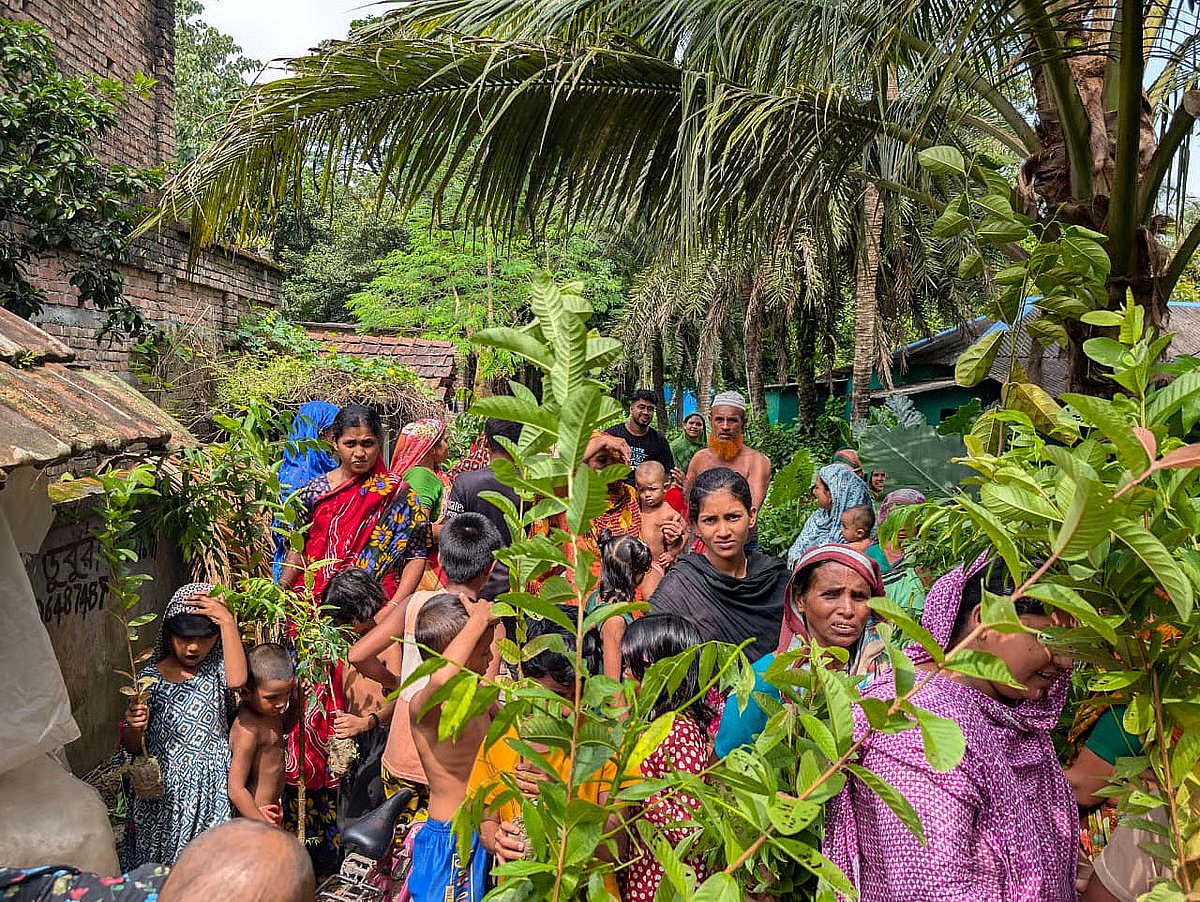
These trees, now growing in different parts of Satkhira district in Bangladesh’s south, have been planted to mark the birth of a baby boy named Ayaan Khan Ruhab, now just eight months old. Born in February this year, Ayaan is being recognised as Bangladesh’s first “carbon-neutral” child.
On 19 October, Ayaan was formally declared the country’s first carbon-neutral child at the IUB Multipurpose Hall in Bashundhara area of Dhaka. The announcement came jointly from the International Centre for Climate Change and Development (ICCCAD) and Dhaka Planters.
Previously, the world’s first carbon-neutral child was recognised in India’s Tamil Nadu. Two-year-old Aadavi received the title after her parents, with the help of local farmers, planted around 6,000 fruit trees even before her birth.
A “carbon-neutral” person means someone whose carbon emissions are balanced by equivalent carbon absorption. Aadavi’s parents’ effort earned her recognition from the Asia Book of Records as the world’s first carbon-neutral child.
Speaking to Prothom Alo, Ayaan’s mother Ayesha Akhter said, “I wanted to ensure natural protection for my child. Planting trees felt like the best way. We are not done planting trees and the number of trees will keep growing.”
Ayesha is currently a second-year undergraduate student at a college in Khulna. While speaking to Prothom Alo on Wednesday afternoon, she explained that Satkhira is a disaster-prone area, and both Ayaan’s paternal and maternal families live there. The trees need regular care, so they have been planted on their relatives’ land. The fruit-bearing trees will benefit local children too.
These fruit and timber trees including jackfruit, mango, black plum, neem, and betel nut among others have been planted in various locations, including Tala upazila in Satkhira. Some of the trees are growing on yards, some along village roads, while others are thriving beside ponds, closely intertwined with other plants.
Ayesha said she finds joy in seeing the trees grow alongside her son. She said they did not plant the tress thinking of their child to earn the title of a ‘carbon-nutral child’. However, this recognition has encouraged them to plant even more tress.
Ayaan’s father, Imran Rabbi, is pursuing a postgraduate degree in Climate Change and Development at the Independent University, Bangladesh (IUB). He is also the founding president of the environmental organisation ‘Greenman’.
Imran explained to Prothom Alo that according to his calculations, based on Bangladesh’s per capita carbon emissions, each person should plant at least 54 jackfruit trees to offset their annual emissions. That’s where the idea of planting trees for his child came from and the number eventually reached 580.
According to a World Bank report published in 2023, a person in Bangladesh emits about 0.7 tonnes of carbon per year on an average. Based on Greenman’s president Imran Rabbi’s estimate, 54 jackfruit trees are capable of absorbing this amount of carbon.
When contacted Sumaiya Binte Selim, coordinator for Youth and Gender Programme at ICCCAD about recognising Ayaan as the first carbon-neutral child of Bangladesh, she said, “Planting trees is not enough, they must also be cared for and replaced if damaged. These factors were considered in granting Ayaan the recognition.”
She added that India’s example inspired the initiative and that the title aims to raise awareness about environmental responsibility.
Ayaan’s father, Imran Rabbi believes these very trees will ultimately benefit his son directly. “I trust nature and it will always find a way to do that. So, I’ll teach my child to plant trees too,” he said.
Whether Ayaan when he grows up will share his parents’ passion for trees remains to be seen. But for now, it’s remarkable enough that an eight-month-old child “owns” hundreds of trees already.