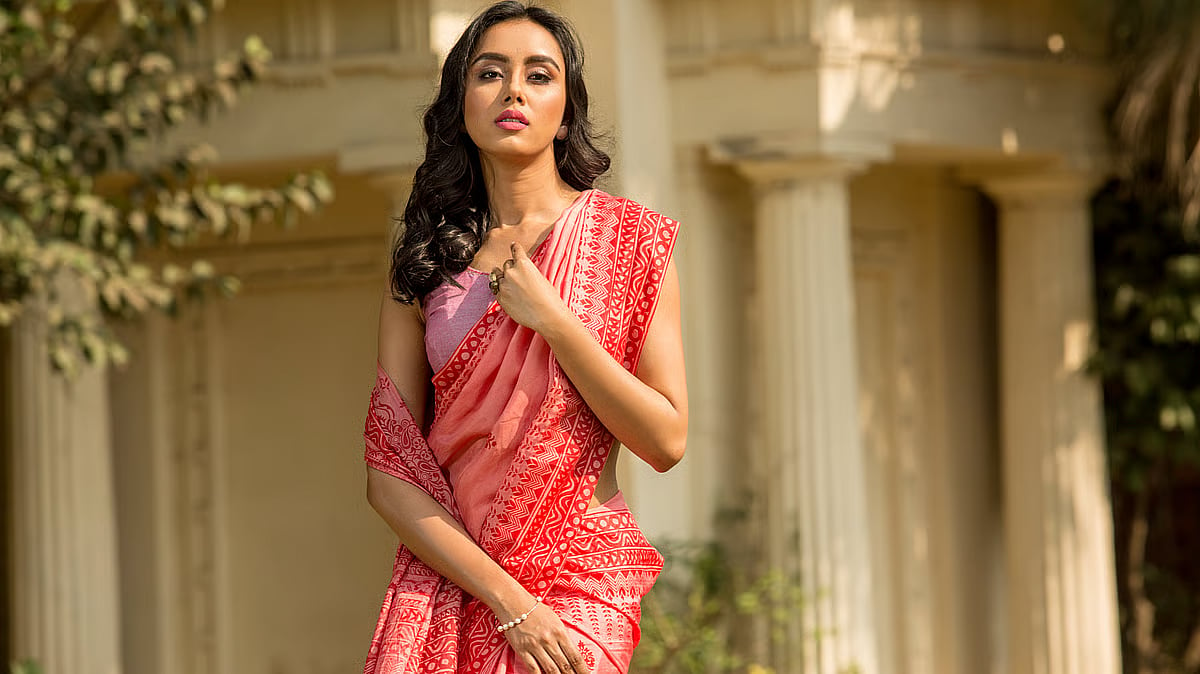
Why demand for Rajshahi silk is growing
When visiting Rajshahi, can one really return home without taking some Rajshahi silk as a souvenir? This tradition is nothing new. It is because of this heritage that silk has become a defining feature of the district’s identity.
Rajshahi is known as the ‘Silk Haven’. Its logo features two bright golden silk fabrics flying on either side of a circle, symbolising how the district’s development is centred on silk fabrics and the silk industry. Rajshahi silk has also received GI recognition. In recognition of this heritage, an intercity train running between Rajshahi and Dhaka has been named Silk City Express.
To find out how this traditional industry is faring, I visited the sales outlet of Sapura Silk on 27 September. There, I met college teacher Monika Kabiraj, who had come from Bogura to shop for Puja. Her maternal aunt accompanied her, while her son joined them from Rajshahi University.
“Puja is incomplete for me without silk. I bought three saris last Puja. This time, I will buy one for myself, as well as saris for my sister and aunt. I will also buy a silk panjabi for my son,” Monika said. When asked how much she usually budgets for silk saris during Puja, she laughed and said, “If I like something, the budget does not matter. I can always adjust it a little.”
Elina Tasneem, originally from Barishal, is a third-year student in the Department of Pharmacy at Rajshahi University. She had come with friends to buy silk saris.
When asked whether she had a particular favourite among the many silk products, she said, “Silk saris are very comfortable to wear and move around in. That is why I always give them priority. There are also many varieties to choose from, so I can buy one according to my preference.”
University student Tarin Tasneem had travelled from Tangail to visit Rajshahi. Remembering the heritage of Rajshahi silk, she visited the silk showroom. She said she liked everything from silk saris and scarves to salwar kameez sets. She had bought a scarf and was now looking at saris.
Sazzad Ali, director of Sapura Silk Mills, said demand for silk fabrics had increased. Women’s interest in silk saris had grown, he added. Around 700 women across the country are engaged in handwork on silk fabric sold by the length.
Saris featuring such handwork are highly sought after. Alongside saris, the company has introduced a wide range of products, including silk panjabis, shirts, three-piece sets and fatua tops. These items are also in considerable demand.
The variety of designs and styles has expanded as well. As a result, demand for silk clothing has nearly doubled compared to two years ago. In particular, even at maximum production, the company cannot meet demand for raw silk or muslin fabric sold by the length.
He said the muslin fabric was being embellished with handwork, block prints, embroidery, Jamdani designs and various other forms of decoration.
Some young people buy the fabric, add contemporary designs and sell the finished products online. They are bringing new ideas to clothing, which is helping drive demand for silk. This Puja season, however, three-piece sets are the most popular items, followed by panjabis and saris, he added.
Tania Sharmin, a young woman from the Sadhur Mor area of Rajshahi city, had come to the outlet to buy muslin fabric sold by the length, also known as raw silk. She said she had to visit the shop every two or three days.
She runs an online page, where she sells silk muslin fabric after adding contemporary designs to it. She showed several saris featuring hand-crafted designs, which she said were very popular. She was holding a large bundle of saris that she had purchased.
Customers are also buying silk fabrics from the sales outlet in front of the government silk factory. Its product list includes Garad saris, tie fabric, ties, 2/2 fabric sold by the length, printed saris, fabric sold by the length, two-piece sets, hijabs and scarfs, striped Super Balaka fabric, Dhupian satin and 2/4 grey fabric sold by the length, among other items.
Panjabis made from the somewhat heavier Dhupian silk fabric are generally worn at various functions. A government official from Sirajganj had come to buy these panjabis for his colleagues. He purchased 10 in one go. Prices can reach Tk 10,500.
A visit to another business, Usha Silk, nearby also confirmed the growing demand for silk clothing. The outlet was crowded with customers. Its general manager, Zahurul Islam, said demand was much higher this year than before. He also said silk three-piece sets, panjabis and saris were the top-selling items.
Prices of silk clothing
Item - Price (Tk)
Soft silk sari - 3,000–7,500
Endi silk sari - 3,850–7,950
Raw silk hand-printed sari - 3,550–6,500
Tussar silk sari - 8,800–19,200
Muslin silk embroidered sari - 9,500–32,500
Balaka silk stitched sari - 17,000–28,000
Tussar silk embroidered sari - 19,500–32,500
Soft and raw silk three-piece sets - 6,050–32,000
Silk shirt - 2,000–3,500
Endi/Balaka silk Panjabi - 6,500–22,000
Silk orna and scarf - 550–8,500
Fabric sold by the length (per yard)
Item - Price (Tk)
Raw silk muslin fabric – 450
Balaka fabric - 1,050
Dhupian fabric - 1,250
Matka fabric – 890
Soft silk printed fabric – 850
Raw muslin printed fabric - 550