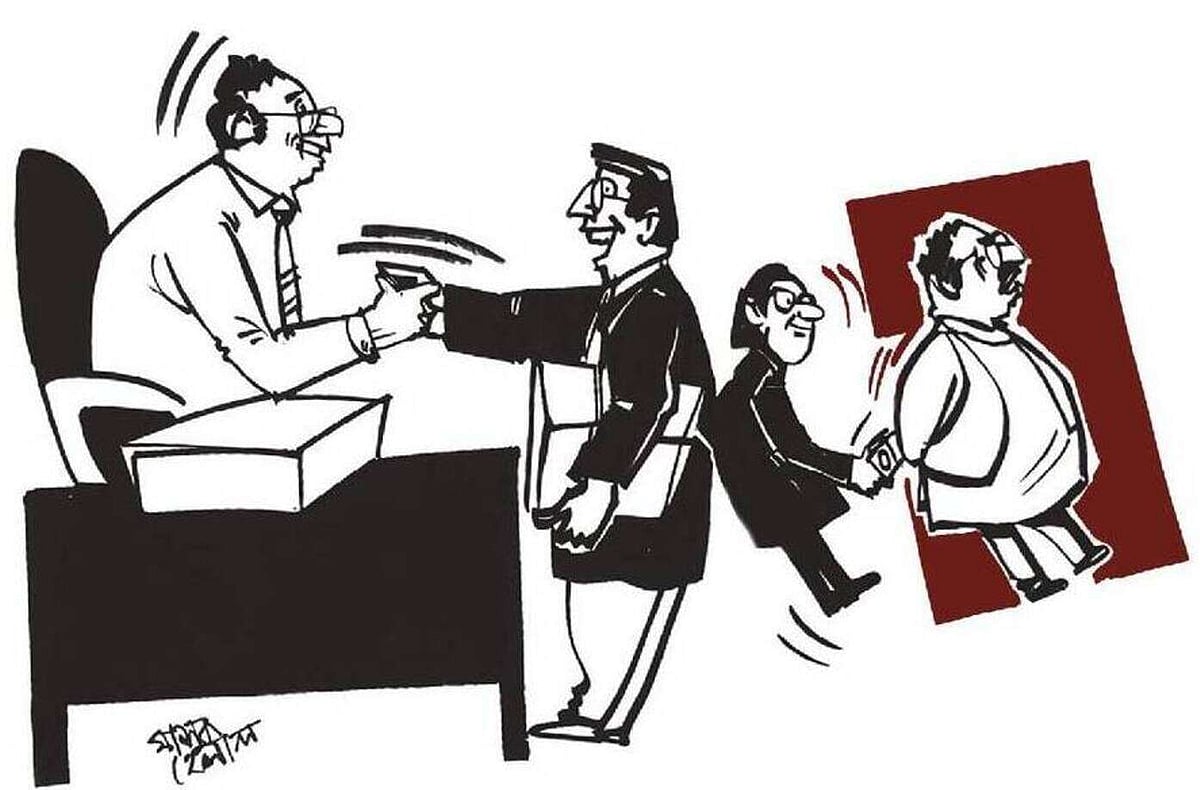
The failure to learn from history Civic amenities in the country have hit rock bottom. There is no gas, no electricity, endless chaos on the roads, and services cannot be obtained without paying bribes. Let me give an example of bribery. A man lives in an area of Dhaka, in a flat. As a flat owner, he has to pay various taxes, one of which is land tax. This has to be paid at an office in Katabon.
These days, the process of paying taxes has become digital. Several years’ worth of taxes had accumulated, so he went to a land office in Dhaka to pay the amount. There, one person sent him to another, and another sent him somewhere else.
Eventually, he reached the right place. Then came another problem. An employee told him that the server was down. He waited there for about three hours. The server never came back online. He returned home. When I heard this, I sensed there was something else behind it. I told him so.
The next morning, when the office opened, he went back to the same place. He met the same employee. The answer was the same, the server was still down. He said, “All right, I’m sitting here. I’m not moving until the server is fixed.” He sat there.
After a while, the employee came over and, without any attempt to hide what was going on, said, “Give me Tk 3,000 and I can get the job done.” He now understood the mystery behind the “server outage.” After some bargaining, they settled on Tk 1,000. As if by magic, the server came back online. He paid the land tax and returned home.
You might say he paid a bribe and thereby encouraged corruption. Why didn’t he complain to the boss at the office? Oh, the boss! In places like these, not only the boss but even the bricks, mortar, tables and chairs seem to take bribes.
What else could he have done? Beat up the people at the office? Gather people for a human chain protest? Both happen from time to time. But do they bring anyone to their senses?
Nothing gets done without a bribe. Alternatively, if you have personal connections with senior officials, things become easier. How many people have access to such connections? In many offices, getting past the guard and peon is like crossing the bridge of Sirat.
How are you supposed to reach the head of the office? Besides, this has become a system. A chain operates from top to bottom. The junior employee or peon acts as a “toll collector.” The toll is distributed all the way up the chain.
A few days ago, a man came to me with a problem. He had been a government schoolteacher and retired several years ago. He still has not received his pension.
He has run from office to office and accomplished nothing. He has no other source of income and is living a life unfit for human beings.
I remember that in 1972, Prime Minister Sheikh Mujibur Rahman called on the people at a public rally to practise austerity. He said the Pakistanis had destroyed everything and that the government would not be able to provide anything for three years.
Many people have died after spending months and years running from one office to another in pursuit of their pensions. We learn about such cases through the media. We hear from many people that there is some kind of “audit objection” standing in the way. Give someone money, however, and the problem is resolved. Many do not even know how to pay this money or whom to pay it to. I told him to go to the local education officer. He said he had already gone there and nothing had been resolved. I told him to go to the Education Bhaban in Dhaka.
This reminded me of an annual report on corruption published by Transparency International Bangladesh many years ago. It listed the most corrupt government agencies, with the education sector at the top. Whenever such a report or survey appears in the media, officials of the relevant agency come charging in, loudly declaring, “We reject this report.”
For a long time now, we have been hearing grandiloquent promises. There are showers of hope and floods of pledges. We have heard so many of them that our ears have gone numb.
How much of what those who make the rules—and those responsible for implementing their promises—actually remember after they have spoken? If even a quarter of their promises were implemented, wouldn’t this country have become a golden land by now?
Whenever people are in power, they loudly proclaim that the country’s problems have become so deeply entrenched because of the previous government’s limitless waste and corruption that there is no way out anytime soon. Cleaning up this mess will take a long time. Only after that can the real work begin. Therefore, they say, the people must be patient.
I remember that in 1972, Prime Minister Sheikh Mujibur Rahman called on the people at a public rally to practise austerity. He said the Pakistanis had destroyed everything and that the government would not be able to provide anything for three years.
The people were willing to wait not just three years but even thirty, if their leaders could have set an example of sacrifice. That did not happen. Instead, the occupation of houses, cars and offices, looting, permit trading, smuggling and hoarding continued unchecked. And behind all this were people affiliated with the ruling party.
Warnings of famine had been heard as early as 1972. The crisis became acute in 1974. Thousands of destitute people began leaving their villages and crowding into the cities.
After repeated appeals and pleas, the government opened gruel kitchens, or langarkhanas, in the cities. The rice and lentils supplied for those kitchens ended up being sold on the open market. Everyone saw who was responsible.
People wanted to change this situation. The change came brutally. Many explain what happened through various conspiracy theories. Some see the hand of foreign conspirators.
But one thing is undeniable: the cries of desperate people had reached such a point that they turned away from their leader. Many still cannot grasp this harsh reality. Or perhaps the people are simply absent from their field of vision, replaced by self-satisfaction.
Our country has many government offices and institutions that are maintained with taxpayers’ money. Yet some of them serve no useful purpose. We build enormous buildings and sit around in them. Hundreds of people work there.
I still do not understand what they actually do. Apart from the officials, employees and their dependents, no one benefits from these institutions. What terrible waste! Why do we keep maintaining them?
We often hear that the amount of corruption in a particular project was so enormous that the money could have been used to build another Padma Bridge. The Padma Bridge has been built.
People are benefiting from it. But what purpose do these idle government offices serve? This reminds me of something from many years ago. At the Adamjee Jute Mill, there was widespread disorder. The factory was frequently shut down because of shortages of raw materials or machinery breakdowns.
It was said that when the factory was closed, Tk 200,000 was stolen every day. And when it was operating, Tk 400,000 was lost every day.
In Bangladesh, many officials are made Officers on Special Duty, or OSD, for political or administrative reasons. They continue to receive their salaries and allowances, but are given no work. One OSD official once joked to me, “I get my salary, but I don’t get bribes!”
The question is, why do we have this OSD system? In a poor country like ours, how can we justify the waste of keeping so many people idle while continuing to pay them?
Either give them work or send them into retirement. If they have committed serious offences, dismiss them. No government takes that path. Instead, when governments change, officials who were made OSD or forced into retirement are reinstated, sometimes with retrospective promotions and compensation. It is a strange game.
In 1982, Shamsur Rahman wrote a poem titled The Homeland on the Back of a Bizarre Camel, which later became the title of a poetry collection. One line from it has stayed with me.
When people are pushed against the wall, they can become dangerous. We have seen this happen repeatedly throughout history. Yet people still do not learn. Why not? Is it an illness? Or is this simply the way things are?
* Mohiuddin Ahmad is a writer and researcher.
* The views expressed are those of the author.
* This piece appeared in Prothom Alo print and online has been translated by Farjana Liaqat for Prothom Alo English Online