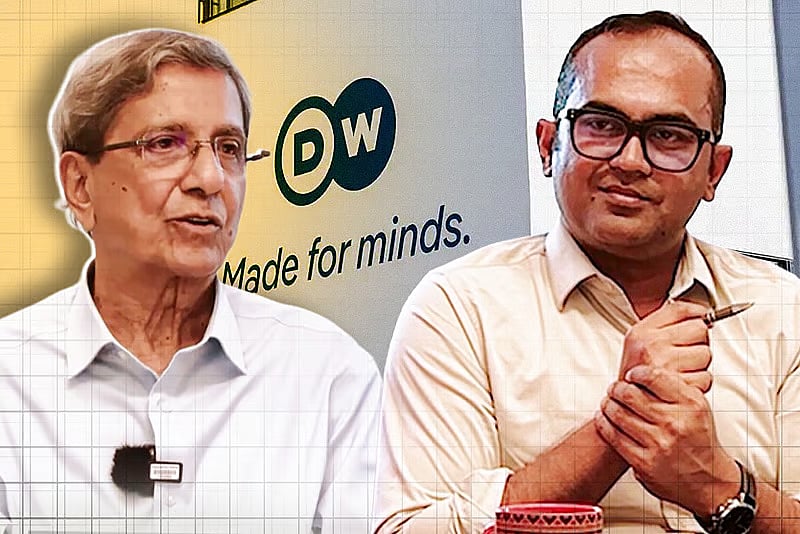
Interview: Matiur Rahman
If a newspaper can't survive, it becomes difficult to defend human rights, democracy and social justice
During a recent visit to Germany to attend the DW Global Media Forum 2026, Prothom Alo Editor Matiur Rahman sat down with Deutsche Welle''s Zobaer Ahmed for an in-depth interview. In this wide-ranging conversation, he spoke on the recent changes in Bangladesh's political scenario, the state of Bangladesh''s media landscape, press freedom, challenges and threats faced by Prothom Alo, the future of journalism, and much more. This is the first installment of a two-part interview.
Zobaer Ahmed: Joining me today is someone who hardly needs any introduction, the Editor of Prothom Alo, Matiur Rahman. Welcome, and thank you for joining us on Deutsche Welle for this discussion. You're here in Germany for the Global Media Forum conference. How are you finding Germany and the Global Media Forum?
Thank you. I haven't given an interview in quite a long time, so I'm glad to have the opportunity to speak with you. I've had the opportunity to join similar conferences in different parts of the world, but this is my first time attending this forum. We've been working with Deutsche Welle for several years now on a number of projects. At this morning's opening session, the Director General of Deutsche Welle emphasised freedom of the press, journalism, the protection of human rights, journalists' courage, and their right to speak out fearlessly.
One point she made particularly appealed to me. She said that at a time when newspapers are facing difficult challenges, their financial sustainability and financial stability are also essential if they are to continue their work. I strongly agree with what she said. These issues will play a major role in journalism, both now and in the future. Without financial stability, no newspaper can survive. And if a newspaper cannot survive, it becomes extremely difficult for it to defend human rights, democratic rights, or social justice. From that perspective, I think her remarks were very significant.
When it comes to press freedom, journalists’ independence, and the core mission of journalism, moving toward democracy, we should be able to stand together in the future and speak with one voice when obstacles arise
Zobaer Ahmed: We'll come back to that, but first I'd like to ask you directly about what happened on 18 December last year. Your Prothom Alo office in Karwan Bazar was attacked, vandalised and set on fire. The incident has been described as an attack on independent journalism and the free press. Could you elaborate?
Let me first provide a little background. During the July-August uprising of 2024, our newspaper took a firm stand in favour of change and in support of the fall of Sheikh Hasina's government. Very few newspapers took such a clear and transparent position at that time. As a result, our print circulation increased significantly, and our online readership also grew. Readers understood that our position was very clear. For sixteen years under Sheikh Hasina's increasingly authoritarian rule, we had lived under varying degrees of pressure, fear, and restrictions.
The movement offered a way out of that situation. From the very beginning of the movement until its conclusion, we played an active and committed role.
Then after the change in government, we began to see several groups, primarily extremist groups, along with groups of various political interests, started a campaign of misinformation against us. They targeted the newspaper in various ways and even staged demonstrations in front of our office. In fact, about a year earlier, there had been attempts to organise similar gatherings, although the turnout was very small. At the time, the police intervened firmly, and it did not go very far.
But over time, the situation escalated to the point where the attack eventually took place. Today we can say quite clearly that an extremist group was behind it. They had people operating within the government, outside the government, and even outside the country. It becomes apparent that there was a political objective behind the attack. The aim was to disrupt the country's political environment and create instability. That group continued its efforts right up until the elections, but ultimately did not succeed.
After the attack, more information came to light. The government arrested several people, around 34 to 36 individuals, and very recently another suspect was arrested. Based on their affiliations, their political identities, and their connections to various organisations, it is apparent that extremist groups were behind the attack.
Zobaer Ahmed: What were you doing at the time?
It was around 10:45 pm and I'd just reached home. There had been indications that an incident like this might happen. The government's intelligence agencies apparently had some concerns about such a possibility. We were also aware of those concerns, but perhaps we didn't take them seriously enough. That may have been a mistake. But even if we had taken them more seriously, I'm not sure what we could actually have done.
As soon as the attack began, our senior colleagues at the office and I immediately started contacting government officials. From around 10:45 pm or 11:00 pm onward, there was virtually no senior government official we didn't reach out to. Personally, I contacted the Inspector General of Police, the head of military intelligence, the Director General of RAB, officials from the Special Branch, and the Commissioner of the Dhaka Metropolitan Police. Everyone kept telling us, "We're trying... we're trying... the police are on their way... they're responding." But none of that turned out to be true.
The attackers faced no resistance whatsoever. Until around 2:00 am, they encountered no obstruction. The army and RAB arrived but remained at a distance. They allowed it to happen. Around 2:00 am, and then again around 3:00 am, I sent messages to at least three of the country's top officials. I wrote to them: "This happened right before your eyes, and you did nothing. You allowed it to happen. That is what this proves."
Zobaer Ahmed: Is your accusation against the interim government?
Yes, our complaint is against the interim government. To be fair, some advisers and some individuals within the interim government did make an effort. But it is clear that if the interim government had acted decisively, if it had taken a firm position, or if the Chief Adviser himself had intervened directly and instructed the authorities, then the attack could have been stopped. The police had received no clear instructions.
A few days after the incident, we saw that the second-highest official in the home ministry, a former Inspector General of Police, had to leave his position, although no official explanation was given. Personally, I believe he bears some responsibility for what happened that night. I'm not saying he was directly involved in the attack itself, but he failed to instruct the police to stop it or prevent it.
Zobaer Ahmed: You're saying that the Chief Adviser and the senior officials of the interim government could have issued those instructions if they had wanted to, but did not. Why not?
One reason is that at that time, various extremist and communal political groups were active both inside and outside the country. Many people may have been influenced by them. Otherwise, how could such an incident happen in broad daylight in front of everyone, without anyone of them expressing anger or making any effort to stop it? It seemed that everyone had taken a kind of passive position, allowing it to happen.
Zobaer Ahmed: About a month after this incident, you attended a media conference along with Mahfuz Anam and other senior editors and journalists. There you said that regardless of any differences in opinion, or ideology, there must be unity among journalists on press freedom, journalists’ personal safety and other professional concerns.
Does the media truly stand by each other in times of crisis? Journalist Shafik Rehman referred to past incidents like the closure of Naya Diganta or Jai Jai Din, asking what your position was at those times. How do you respond to these points?
Since the independence of Bangladesh, our society has been marked by many deep divisions and conflicts. Political division has been one of the most significant, affecting every sphere of life. The press was not outside of this reality. Many of us were, to varying degrees, involved in those divisions. Now I am trying to make it clear that when it comes to press freedom, journalists’ independence, and the core mission of journalism, moving toward democracy, we should be able to stand together in the future and speak with one voice when obstacles arise. That was the purpose of my statement.
Regarding what Shafik Rehman said, even in the past, we did publish news about illegal closures or attacks on various newspapers. We did take positions, but perhaps it was not at the level where a strong, unified voice could emerge. No single newspaper can create that impact alone; it requires collective action. Division among journalists has not helped in the past, it is not helping now. Unless we can build cooperation and coordination, it will remain difficult in the future. Protecting press freedom and improving journalism will become harder, not easier, if we cannot overcome these divisions.
We have persistently demonstrated what a newspaper can do when it is free. Those in power are always afraid of the truth. No ruling group, military, civilian, elected, or unelected, likes the truth to be published
You were talking about press freedom. Your journalistic career, if I’m not mistaken, began in 1970 with the weekly Ekota. Then until 1991 you were involved in both politics and journalism. After that, you became the editor of Bhorer Kagoj, and later in 1998 you founded Prothom Alo, where you have remained editor since. Given your long experience, how would you describe the state of press freedom in Bangladesh down the years?
Journalists and newspapers have played a major role behind Bangladesh’s rise, its achievements, and its successes. The press and journalists have repeatedly faced attacks under different governments. Journalists have been imprisoned and subjected to various forms of repression.
Our newspaper Ekota was first banned in 1975 during Bangabandhu Sheikh Mujibur Rahman’s one-party system, when BAKSAL was formed and all newspapers were shut down except four. That was certainly an attack on press freedom. Shutting down newspapers en masse was unjust, a mistaken decision. It took several years to regain permission to publish again. Ekota was relaunched in 1979.
After the 1996 election, Ekota was again declared illegal. About a year later, we were allowed to publish again. We then launched Bhorer Kagoj. At the time, BNP was in power. Soon they cut our government advertisements. Newspapers at that time depended heavily on government advertising revenue. They also objected to certain reports and blocked them.
Then Awami League came to power. There were tensions and disagreements with its leaders, just as there had been with BNP.
After we launched Prothom Alo in November 1998, during the BNP government, in 2000 all our advertisements were blocked. We had also begun our online edition at that time. Later, when BNP came to power again in 2001, our advertising was reduced further, we were allowed fewer than ten ads per day.
Mahfuz Anam and I went to the Information Minister, Tariqul Islam, and told him: remember, governments that attack newspapers cannot win the next election. During the BNP government from 2001 to 2006, there were many major mistakes and serious incidents involving RAB killings, attacks on Sheikh Hasina and such. We strongly criticised these, including issues like the widely discussed “10-truck arms case.” We maintained contact and debated with them directly, even with the prime minister, and we continued our work despite difficulties. Then came the caretaker government, and later the Awami League government again. During the Awami League period, we faced a very difficult situation. In parliament, long speeches were made calling for me to be detained, tried, and punished. There were repeated attacks in political rhetoric.
After the 2014 election and into 2015, government advertising had already largely stopped. Whatever little we received came from the private sector and multinational companies. At one point, advertising from 49 major national and multinational companies was cut off directly under orders from military intelligence agencies. Later, we managed to recover some of that advertising, though not all. For example, Grameenphone resumed advertising after the events of July-August 2024. Some restrictions remain. In certain military areas and in prisons, our newspaper is still not distributed because those instructions still remain.
Throughout different regimes, there were lawsuits, attempts to reduce circulation, efforts to cut advertising, and even attempts to block us from the Prime Minister’s Office. I have faced multiple cases and had to go to court in various districts several times. Mahfuz Anam also had to attend many court hearings over the years. Even in 2024, between March and May, I had to go to court in an ICT case and seek bail.
No court denied me bail. No lawyer ever stood against me in court, whether from BNP, Awami League, or any other party. Across the judiciary, there was always support for my bail. That was one of our strengths: Prothom Alo had public support and cooperation, and there was a general sympathetic attitude toward us, which helped us survive those periods.
Finally, before the 2018 election, there were attempts from early on by the Sheikh Hasina government to take control of Prothom Alo. I was told that she directly asked at least three major business groups to take over the newspaper. One of them was the S Alam Group.
By April 2024, there was a final major attempt. The Managing Director of Transcom Group, the parent company of Prothom Alo, was summoned by the intelligence agencies’ director general and another official and detained for about two and a half hours. She was questioned, threatened, and pressured to sell shares, step away, and remove the editor.
Then in April, things came to a head. The US government introduced a visa restriction policy, generating an atmosphere of fear. In July-August, the movement began, the government fell, and Sheikh Hasina fled. Had that not happened, it is certain that I would no longer have remained editor of Prothom Alo, and ownership of the newspaper would no longer have remained with Transcom Group.
Over the course of my 50–57 years in journalism and politics, across all governments, I have faced pressure, fear, intimidation, attacks, and lawsuits. Prothom Alo has repeatedly has to stand in the dock. But we have always believed in press freedom. We have persistently demonstrated what a newspaper can do when it is free. Those in power are always afraid of the truth. No ruling group, military, civilian, elected, or unelected, likes the truth to be published.
(End of Part I. To be continued...)
* This interview was taken in Bengali and has been transcribed and translated into English by Ayesha Kabir